‘Complex a Symbol of Struggle, Resilience’
She said the impacts were not only political but also deeply economic.
Wednesday 21 May 2025 | 08:41
Updated 08 August 2025 | 15:42 FJT

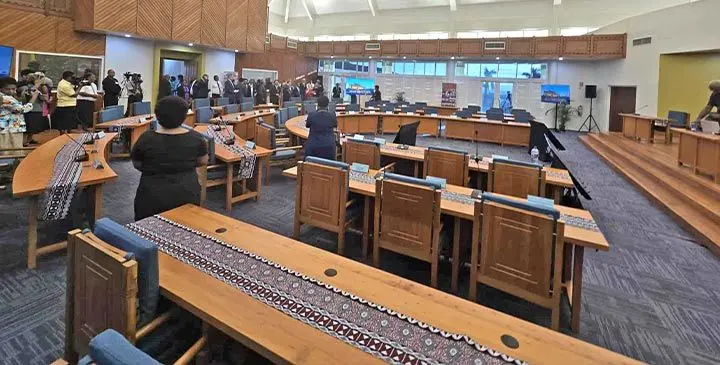
The Great Council of Chiefs complex in Suva on May 20, 2025. Photo: Ministry of iTaukei Affairs
Head of the Burebasaga confederacy and paramount chief Ro Teimumu Kepa yesterday recalled the great anticipation and hope felt by the iTaukei people, that the Great Council of Chiefs (GCC) finally has a permanent base.
“The initial establishment of the complex was meant to give a home to an institution long intertwined with the country’s traditional governance, a body that has represented the voices of Fiji’s indigenous communities for generations,” Ro Teimumu said.
“The opening of the GCC complex in Suva marks a significant milestone in Fiji’s history, representing not only a physical structure but also the long-fought struggle for the preservation of iTaukei culture and heritage,” she said.
Related stories
For many, this was not just the opening of a building, but a symbol of a long-awaited home for the GCC, an institution with deep historical and cultural significance.
Two years after the inauguration of the GCC complex, Fiji faced a dramatic political shift – the 2007 military takeover, marking the beginning of a series of legal and constitutional changes that would have profound consequences for the iTaukei and the GCC.
“The GCC, an entity that had long served as a vital bridge between the iTaukei people and the Fijian government, was suspended, and its functions were eventually repealed through a series of decrees. The decree led to the revocation of GCC’s power and authority, by extension, the indigenous iTaukei people were without a voice for 16 years,” she said.
She said the impacts were not only political but also deeply economic.
“During this time, many assets, resources, and lands that were traditionally owned by the iTaukei communities were systematically redirected and repurposed, leaving them marginalised, and struggling with a bitter sense of loss.”
Her words poignantly described the sense of betrayal many felt as they watched their traditional land and resources taken without their consent, often through legal frameworks that stripped them of their rights.
“For years, the iTaukei people were left to grapple with the disconnection between their “asset-rich” status and their “cash-poor” reality, a paradox that continues to confuse and frustrate many,” she said.
“The 2013 Constitution, which enshrined many of these changes, further cemented the legal framework that continued to diminish the economic standing of indigenous communities in Fiji.
“It remains unclear to many, both in Fiji and abroad, just how the iTaukei people were stripped off much of their land and resources under the guise of legal legitimacy, leaving the community to fend for itself in a changing political and economic landscape.”
Feedback: sosiveta.korobiau@fijisun.com.fj