Fiji and Pacific on the frontline of ‘hybrid warfare’, says Defence Minister
Pio Tikoduadua says climate‑driven disasters are opening doors to disinformation, organised crime and threats to maritime infrastructure across the Pacific.
Tuesday 21 April 2026 | 02:00

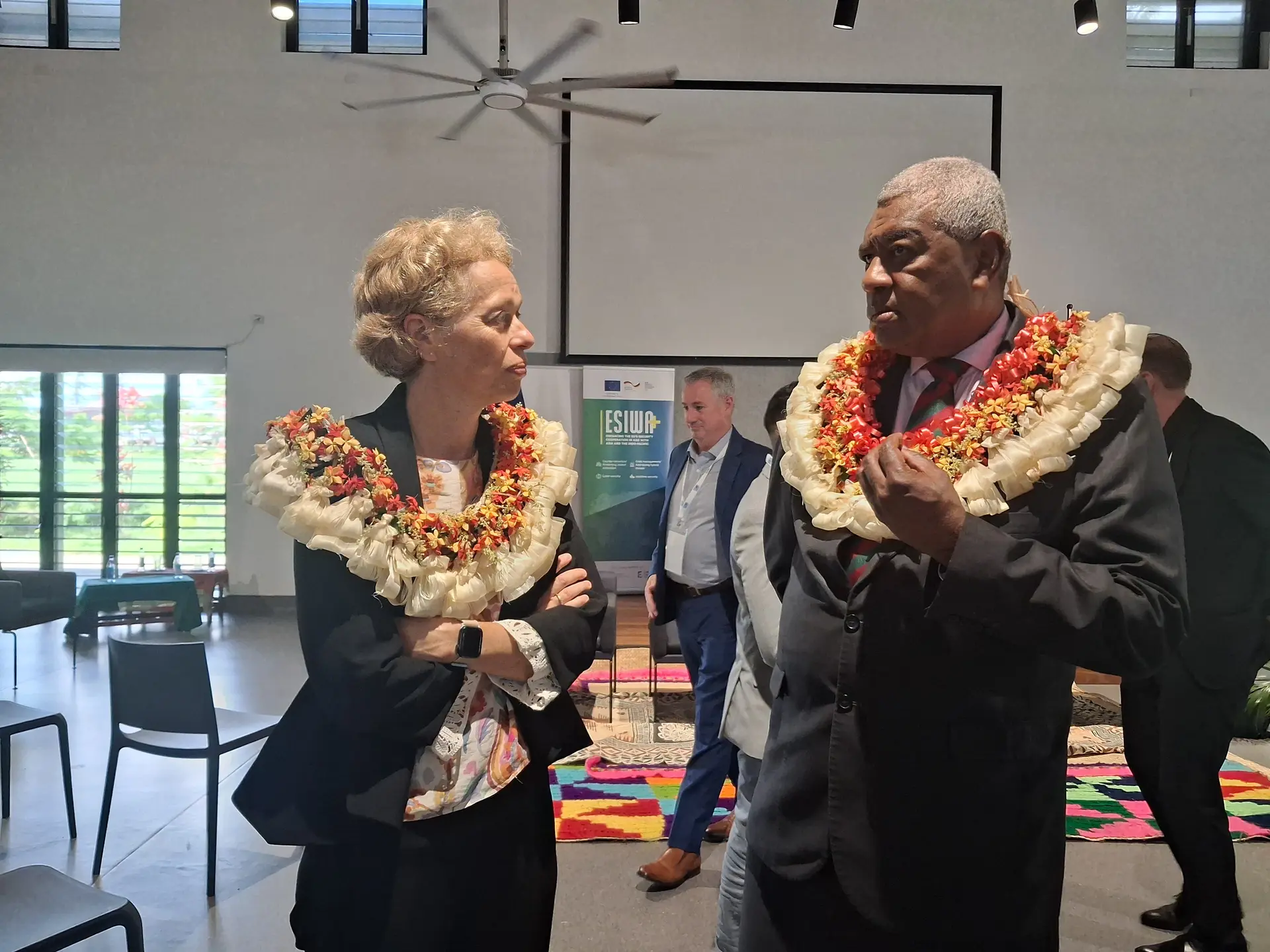
European Union Ambassador to the Pacific Barbara Plinkert with Minister for Defence and Veteran Affairs Pio Tikoduadua with the delegates.
Photo: Waisea Nasokia
Climate disasters create security gaps now exploited by hybrid threats in Fiji and the Pacific.
Minister for Defence and Veteran Affairs Pio Tikoduadua made the remarks at the Hybrid Threats and Natural Hazards regional workshop at Black Rock Camp in Nadi today.
He said security threats were shifting alongside changes in the geographic landscape and the increasing frequency of natural disasters.
Related stories
“Hostile actors are exploiting vulnerabilities created by climate stress and disaster response operations. They emerge concurrently with our natural disaster cycle,” he said.
“In Pacific Island countries, natural disasters are not an abstract risk. They are our reality. Cyclones, floods and rising seas shape our economies, infrastructure and communities. Increasingly, these events are creating operational openings for a different category of threat.”
Mr Tikoduadua said these included foreign information manipulation, transnational organised crime and risks to critical maritime infrastructure.
“This is what we now describe as hybrid threats. For Fiji and the Pacific, this is now an operational concern. When a disaster strikes, our primary directive is saving lives and restoring basic services," Mr Tikoduadua said.
“However, during this period, national systems come under strain. Information systems degrade, personnel resources are stretched, maritime surveillance is reduced, and communities become more isolated from verified sources of information.
“These are not incidental conditions. They are vulnerabilities that can be exploited. Transnational criminal networks use reduced patrol presence to move illicit goods. Disinformation campaigns target populations disconnected from official communications.
“External actors may also seek to map or interfere with critical infrastructure, including communication cables and port systems, during periods of disruption. The convergence of disaster response and hybrid threat activity presents a complex challenge to national security.”
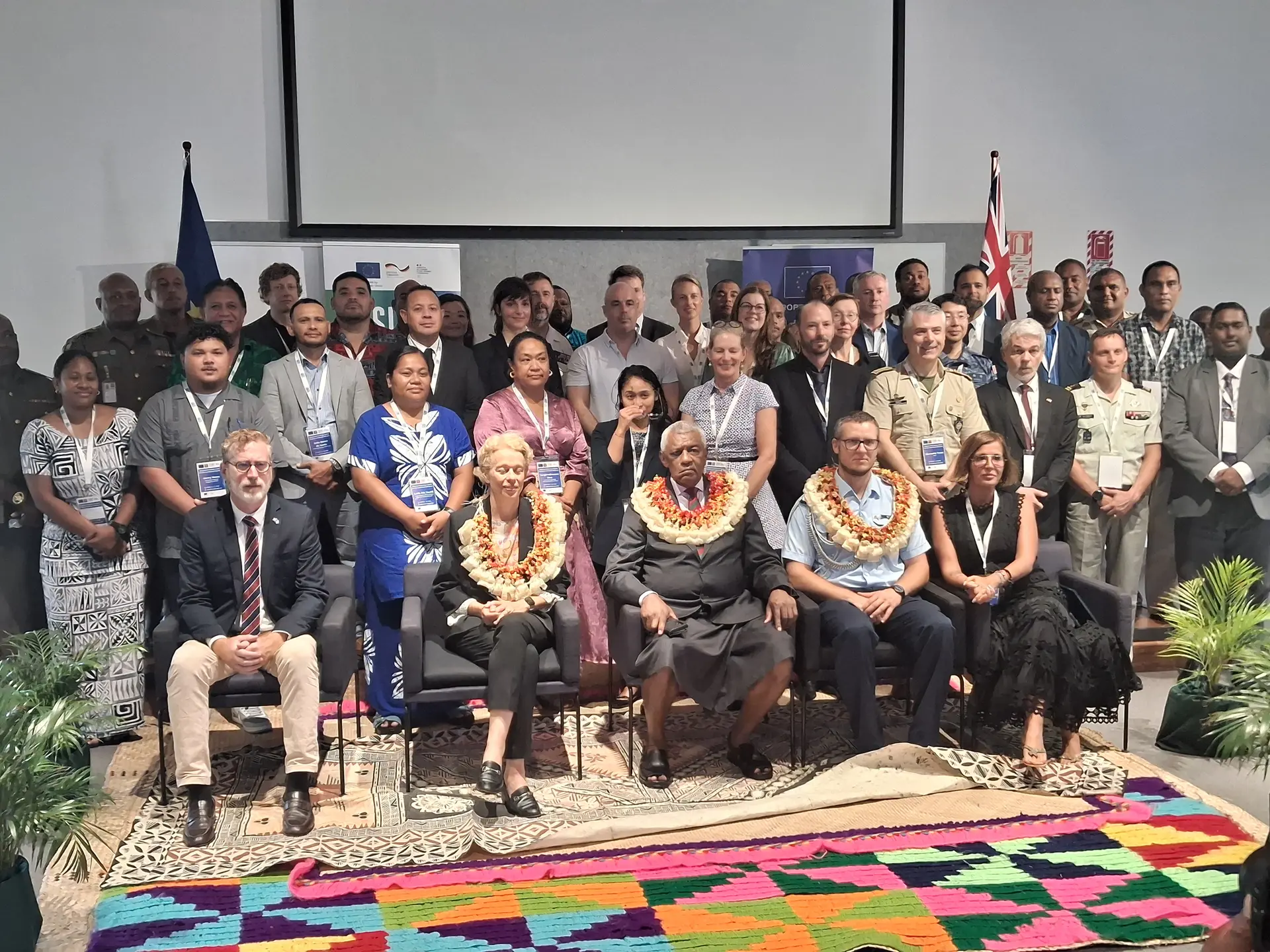
European Union Ambassador to the Pacific Barbara Plinkert with the Minister for Defence and Veteran Affairs Pio Tikoduadua.
Photo: Waisea Nasokia
He said this required a broader understanding of resilience.
“Resilience must extend beyond infrastructure. It must include continuity of government systems, information integrity, supply chain redundancy, and protection of sovereign data and maritime assets during periods of vulnerability.”
Mr Tikoduadua said Fiji had taken structural steps in this direction, with its national security strategy recognising the concurrent nature of modern threats.
“It establishes that security is not confined to the military domain, but requires coordination across government.
“It strengthens data‑sharing protocols across civil defence, cybersecurity and the public public agencies, while investing in maritime domain awareness and advancing maritime security strategy.”
He said initiatives such as the Maritime Service Centre were improving the integration of intelligence and response functions.
“The co‑location of maritime and communication services enables real‑time coordination between patrol units and disaster management authorities. But no country can address hybrid threats alone.”
“Our commitment is to work with partners to address these evolving security challenges. We must not only fund disaster response, but also the systems exposed because of it.”
European Union Ambassador to the Pacific Barbara Plinkert said disasters highlighted the region’s vulnerabilities.
The workshop is the first Pacific activity under the European Union‑funded project, Enhancing EU Security Cooperation in and with Asia and the Indo‑Pacific.
“The European Union understands that its approach to security is changing amid profound geopolitical shifts,” she said.
“The international rules‑based system is becoming more fragmented, contested and less predictable.”
She said information manipulation was not just a communications issue, but a security and foreign policy challenge within the cyber threat landscape.
“In this evolving global context, we must balance avoiding entanglement in great power rivalries while safeguarding our economy, resilience and security.”
The two‑day workshop ends today.
Explore more on these topics








Advertisement
Advertise with Fiji Sun