Taking refuge in mountains, bus shelters must end: Villagers
Mr Tubese recalled an incident last year when villagers sheltered overnight at a roadside bus stop during a tropical disturbance.
Monday 09 February 2026 | 07:00

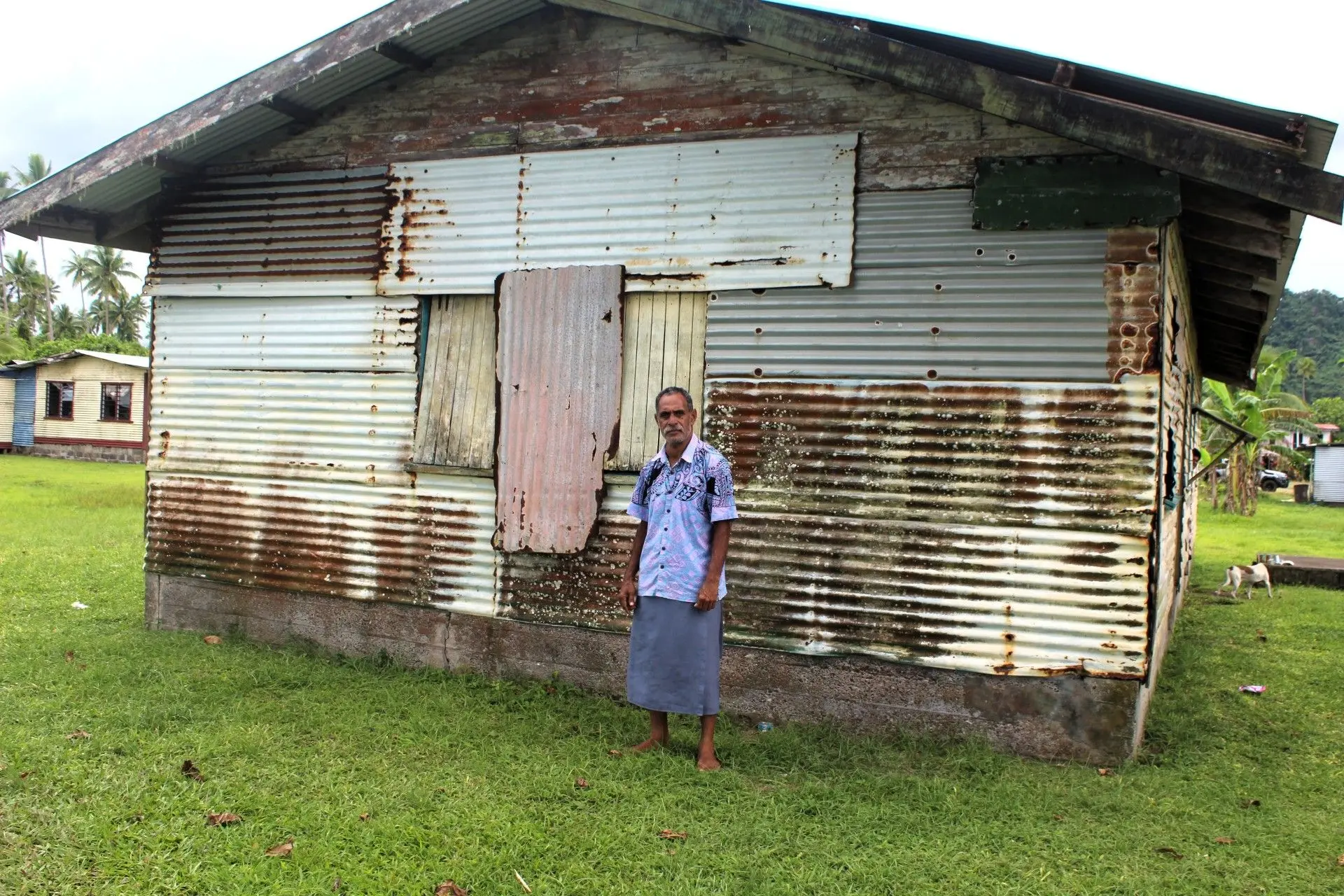
Turaga ni Yavusa Vadrani, Semesa Tubese, calls on the Government to renovate or construct a new cyclone resilient evacuation centre at Nakasa village, Cakaudrove on February 3, 2026. Photo: Sampras Anand.
Sampras Anand
Lives remain at risk in Nakasa and Nacodreudreu villages in the Wailevu District, Cakaudrove, where families are forced to flee to mountains and roadside bus shelters during severe weather events due to the absence of cyclone-resilient evacuation centres.
Both coastal villages have endured years of strong winds and cyclones, leaving residents fearful whenever bad weather approaches.
Turaga ni Yavusa Vadrani, Semesa Tubese, said Nakasa Village lacked a proper cyclone-resilient evacuation centre, forcing villagers to run inland to the main road during cyclones and severe weather.
Related stories
He said strong winds often damaged partially built and even furnished homes, leaving residents with no choice but to seek shelter elsewhere.
“When there is a cyclone or strong winds, we have to run to the main road, far from the coast, to protect ourselves,” Mr Tubese said.
When this newspaper visited Nakasa Village earlier this week, the village hall was found to be in a poor and deteriorating condition. The structure was barely standing, had no ceiling, and its doors and windows were temporary, making it highly vulnerable to strong winds.
Mr Tubese recalled an incident last year when villagers sheltered overnight at a roadside bus stop during a tropical disturbance.
“We stayed there the whole night and returned the next morning,” he said.
He appealed to the Coalition Government to assist with the construction of a cyclone-resilient evacuation centre to protect lives.
“Our lives are constantly in danger whenever there are strong winds or cyclones. We need help, and help should come fast,” he said.
Mr Tubese said requests were submitted last year to the Provincial Council and district office but received no response. He said the issue was also raised during the Bose ni Tikina meeting in Natewa, Cakaudrove, where a representative attended in the absence of the Provincial Administrator.
“All our grievances have been raised, and they keep telling us the request is still in the pipeline. I ask them how long the pipeline is,” he said.
He suggested that the existing village hall could be renovated and strengthened into a functional evacuation centre with Government assistance, or relocated further inland to reduce exposure to strong coastal winds.
Mr Tubese said the village was willing to contribute through fundraising if Government support was provided. He was unable to provide an estimated cost for construction or renovation.
The Nakasa village hall was first built in 1974 and was the first hall in the Wailevu district cluster.
“I have seen other villages in the country have their halls renovated, renewed or newly constructed, while Nakasa Village continues to wait,” he said.
Meanwhile, Nacodreudreu Village resident and Wailevu East Coast Assemblies of God assistant church minister, Etati Rokoua, shared his experience of evacuating to nearby mountains with his three-year-old son during Tropical Cyclone Ana.
Mr Rokoua said the lack of an evacuation centre was largely due to high construction costs.
“We need Government assistance to help construct an evacuation centre for the village,” he said.
He said that during his time as village headman, he repeatedly sought Government intervention, but without success.
Mr Rokoua invited Government stakeholders and non-government organisations to visit the village to see the challenges faced by residents.
“We have resources such as timber to assist with construction, but we need funding to complete the project,” he said.
He also highlighted the added risks faced by elderly residents and people living with disabilities during cyclones.
Mr Rokoua said he previously cared for his late disabled wife and elderly villagers during cyclone periods.
“I had to give them extra care despite the cyclone risks,” he said.
Nacodreudreu Village has 15 households, and Mr Rokoua said he regarded every household as part of his extended family.
Minister for Rural, Maritime and Disaster Management Mosese Bulitavu said he understood the hardship communities faced during natural disasters.
Speaking during a recent village relocation visit in Dreketi, Macuata, Mr Bulitavu said natural disasters created panic and fear not only for individual families but entire communities.
He said adequate assistance would be provided to disaster-prone and disaster-affected areas to help them overcome such challenges.
Fiji’s cyclone season runs from November to April.