Why Fiji must put employment at the centre of economic policy
Friday 17 July 2026 | 13:00

The author argues Fiji's next development challenge is creating productive jobs, closing skills gaps and retaining talent, not simply growing GDP.
There are, in many ways, two stories of Fiji. The first is a story we should all be proud of.
Over the past four decades, Fiji has undergone a remarkable transformation. More children complete school, more young people attend university, our economy is larger, our infrastructure has improved, and we are more connected to the world than ever before. Tourism has flourished, businesses have expanded, and opportunities that once seemed unimaginable have become reality for many Fijians.
I know this story because I have lived it. I grew up in a small farming village in Dreketi, where my parents, despite never attending school themselves, believed education was the pathway out of poverty. Their sacrifices took me from rural Fiji to the University of the South Pacific, then to further studies in France, and eventually to a career with the United Nations, working on employment, skills and economic development around the world.
But today, another story is emerging.
Employers struggle to recruit workers. Hospitals cannot retain nurses. Schools compete for teachers. Hotels and construction companies report persistent labour shortages. More young people graduate than ever before, yet many struggle to find meaningful work, while increasing numbers of skilled Fijians leave for opportunities overseas.
How can these two stories exist at the same time?
How can a country that has made such remarkable progress also face growing labour shortages, persistent skills gaps and rising migration?
The answer, I believe, is that Fiji has entered a new stage of development.
For decades, our challenge was to grow the economy, expand education and create opportunities. Much of that progress has been achieved. Today's challenge is different. It is ensuring that growth creates productive jobs, education leads to employment, businesses have access to the skills they need, and talented Fijians can build successful careers without feeling they must leave the country.
In short, Fiji's next development challenge is no longer simply about growing the economy. It is about making the labour market work.
A labour market in transition
For decades, Fiji's labour market was defined by a simple challenge: creating enough jobs for a growing population. Economic policy rightly focused on expanding the economy, attracting investment, growing tourism and improving education. The assumption was straightforward: if the economy grew, employment opportunities would follow.
That strategy served Fiji well. It transformed the economy and created opportunities for thousands of families like mine.
But today's labour market tells a different story.
The conversation has shifted from unemployment to labour shortages. Employers across the country report increasing difficulty recruiting skilled workers. The National Skills Gap Assessment identified shortages in 95 occupations, spanning construction, tourism, health, education, manufacturing and information technology. At the same time, Fiji is producing more graduates than ever before, yet businesses continue to report critical skills gaps.
Migration has added another dimension to this transition. Fijian workers are increasingly sought after overseas, creating valuable opportunities and remittances. Yet those same nurses, teachers, engineers, electricians and hospitality workers are also essential for Fiji's own development. As more skilled workers leave, employers struggle to replace them.
Meanwhile, Fiji is no longer competing only for tourists and investment, it is competing with wealthier economies for talent. At the same time, one of its greatest resources remains underutilised. Women's labour force participation remains well below that of men, while many workers remain trapped in low-productivity informal and subsistence employment.
Together, these trends point to a labour market undergoing profound structural change. The challenge is no longer simply creating jobs. It is developing the right skills, improving productivity, expanding workforce participation and creating opportunities that encourage talented Fijians to stay and build their future at home.
Fiji has entered a new stage of development. The question is no longer whether the economy should grow, but whether our labour market is evolving quickly enough to support that growth.
That requires us to rethink one of the most fundamental assumptions in development: economic growth alone is no longer enough.
Why yesterday's model no longer works
For decades, Fiji's development strategy was built on a simple assumption: grow the economy, and jobs will follow.
For many years, that approach worked. Economic growth expanded employment, improved education and raised living standards. But labour markets evolve, and today's Fiji faces a different reality.
The evidence is reflected in a series of paradoxes.
The economy grows, yet employers struggle to recruit workers. Fiji produces more graduates than ever before, yet skills shortages persist. Young people face unemployment or underemployment while businesses struggle to fill vacancies. Skilled Fijians leave for opportunities overseas even as employers recruit workers from abroad. Labour shortages coexist with low female labour force participation, while many workers remain trapped in low-productivity informal and subsistence employment. And although the economy continues to grow, many households still struggle with rising living costs.
These paradoxes point to one conclusion: Fiji's next development challenge is no longer simply about producing more economic growth. It is about ensuring that growth creates productive jobs, develops the right skills, raises productivity and improves living standards.
GDP remains an essential measure of economic performance, but it tells us only how much an economy produces. It does not tell us whether businesses can find the workers they need, whether graduates possess the right skills, whether talented people are staying, or whether growth is creating opportunities for ordinary Fijians.
The questions that should define Fiji's next chapter are therefore no longer simply "How fast is the economy growing?" but also "Who is benefiting from that growth?" and "Is our economy creating the opportunities that encourage people to build their future in Fiji?"
Answering those questions requires a new way of thinking about development—one that places jobs, skills and people at the centre of economic policy.
A jobs-first agenda
If Fiji's labour market has changed, then our development strategy must change with it.
The answer is not to abandon economic growth. Growth remains essential. Without it, we cannot create opportunities, reduce poverty or finance better schools, hospitals and public services. But growth should no longer be viewed as an end in itself. It should be judged by its ability to create productive jobs, develop skills, raise productivity and improve people's lives.
In short, Fiji needs a Jobs-First Agenda.
A Jobs-First Agenda does not ask a different question from traditional economic policy—it asks an additional one. Alongside "How fast is the economy growing?", we should also ask, "What jobs is that growth creating?" Every major investment, tourism project, infrastructure programme and industrial initiative should be evaluated not only by its contribution to GDP, but also by its contribution to employment, skills and productivity.
A second priority is to strengthen the connection between education and the labour market. Fiji has made remarkable progress in expanding access to education, but the next challenge is ensuring that graduates leave with the skills employers need today—and those they will need tomorrow. Universities, technical institutions and employers should work much more closely together, using labour market evidence to guide curriculum development, apprenticeships and lifelong learning.
Third, Fiji needs a coherent strategy to manage talent in an increasingly global labour market. Migration is not a failure of development; it reflects the quality and competitiveness of Fiji's workforce. The challenge is to create an economy where people choose to stay because opportunities exist at home, and where those who leave also see Fiji as a place to which they can return, invest and contribute. Talent retention and talent circulation should become central pillars of national development.
A fourth priority is to unlock Fiji's untapped workforce. Women's participation in the labour market remains significantly below that of men, despite major gains in education. Expanding access to affordable childcare, promoting flexible work arrangements and creating more family-friendly workplaces are not simply social policies, they are smart economic policies. At a time when employers consistently report labour shortages, Fiji cannot afford to leave such a significant share of its talent underutilised.
Finally, better decisions require better evidence. Labour market forecasting, employer skills surveys, graduate tracer studies and productivity analysis should become routine tools of economic policymaking. We cannot continue to respond to shortages only after they emerge. We must anticipate change and prepare for it.
None of these priorities are new. Indeed, many are already reflected in Fiji's National Development Plan and in the work of government, employers, workers' organisations and educational institutions. The challenge is not a lack of ideas. It is bringing those ideas together within a coherent labour market strategy that places jobs and people at the centre of development.
A Jobs-First Agenda is therefore not simply an employment policy. It is a development strategy. It recognises that jobs are where education meets opportunity, where businesses find the skills they need, where productivity is created, where families earn their livelihoods, and where young people decide whether they can build their future in Fiji.
If the twentieth century taught us that growth drives development, the twenty-first century is teaching us something equally important: the quality of growth matters just as much as its quantity. Fiji's future prosperity will depend not only on how much the economy grows, but on whether that growth creates opportunities for its people.
Building the Fiji we want
Fiji's labour market has changed. Our development strategy must change with it.
This is not an argument against economic growth. Growth remains essential. Without it, we cannot create opportunities, reduce poverty or finance better schools, hospitals and public services. But growth should no longer be judged by GDP alone. It should also be judged by the quality of jobs it creates, the skills it develops, the productivity it raises and the opportunities it provides for ordinary Fijians.
That is what a Jobs-First Agenda is all about.
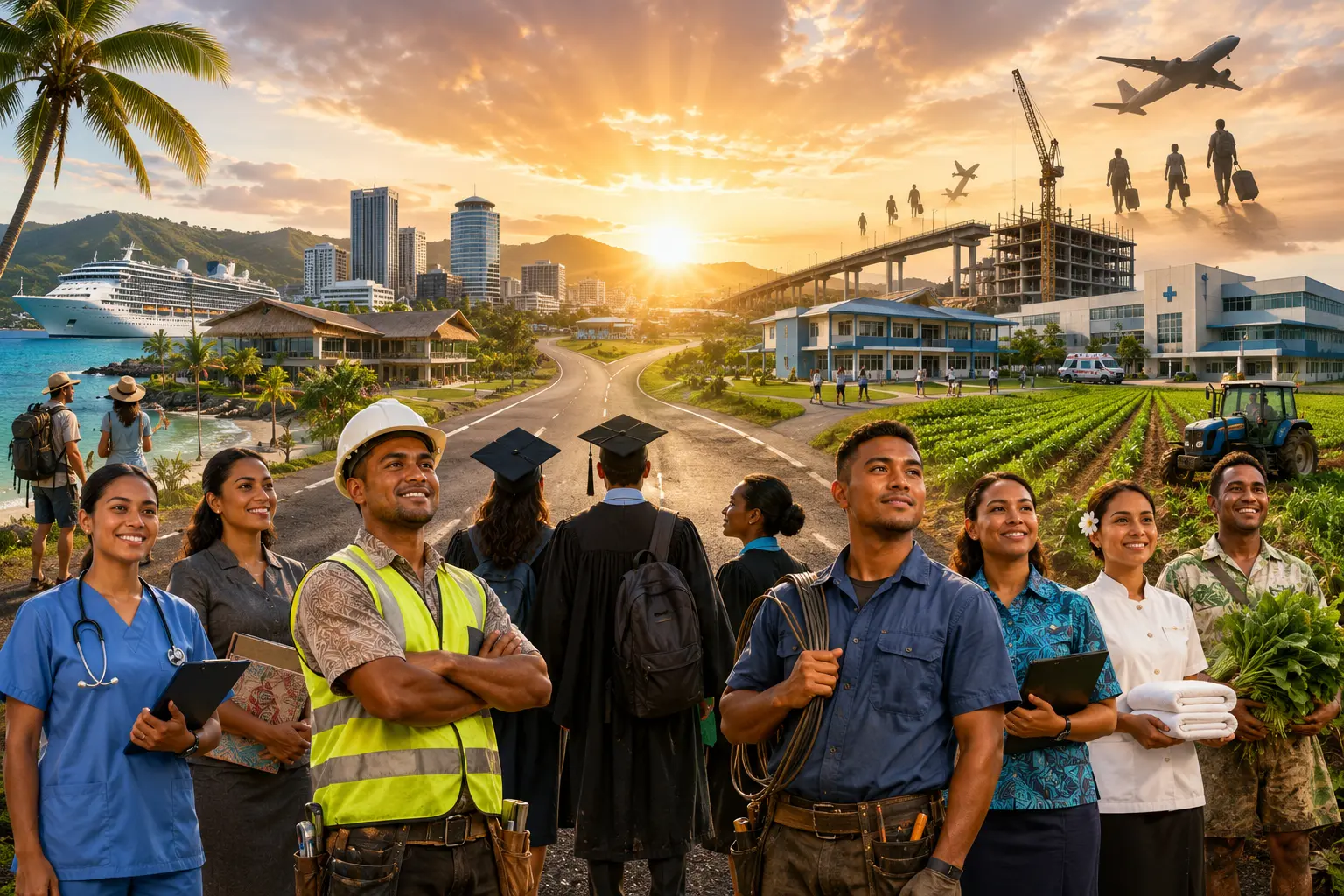
It means placing employment at the heart of economic policy. It means ensuring that education leads to meaningful work, that businesses can access the skills they need, that more women participate fully in the workforce, and that talented Fijians choose to build their futures here at home. Above all, it means recognising that people are Fiji's greatest asset.
When I left Dreketi, my parents believed that education would change my life. They were right. It opened doors they themselves never had the opportunity to walk through and eventually took me around the world. But wherever I have worked, I have learned one enduring lesson: the true wealth of a nation is not measured by what it produces, but by what its people are able to achieve.
That is the Fiji we should strive to build, a Fiji where young people graduate with confidence that meaningful careers await them at home; where employers can find the skilled workers they need; where women participate fully in the economy; where migration is a choice rather than a necessity; and where economic growth translates into better lives for everyone.
Ultimately, the success of our nation will not be measured simply by the size of our GDP, but by whether our people believe their future lies here.
Because when we put jobs first, we put people first. And when we put people first, we invest in Fiji's most valuable asset, its people.
(Dr. Naren Prasad, Head of Education & Training, International Labour Organization, Geneva, Switzerland. The views expressed are those of the author alone and do not represent the views of this newspaper.)