Pacific immigration leaders tackle future migration pressures
Conflict, economic instability and climate change are increasing migration pressures across the Pacific, Immigration Minister Viliame Naupoto says.
Wednesday 10 June 2026 | 12:30

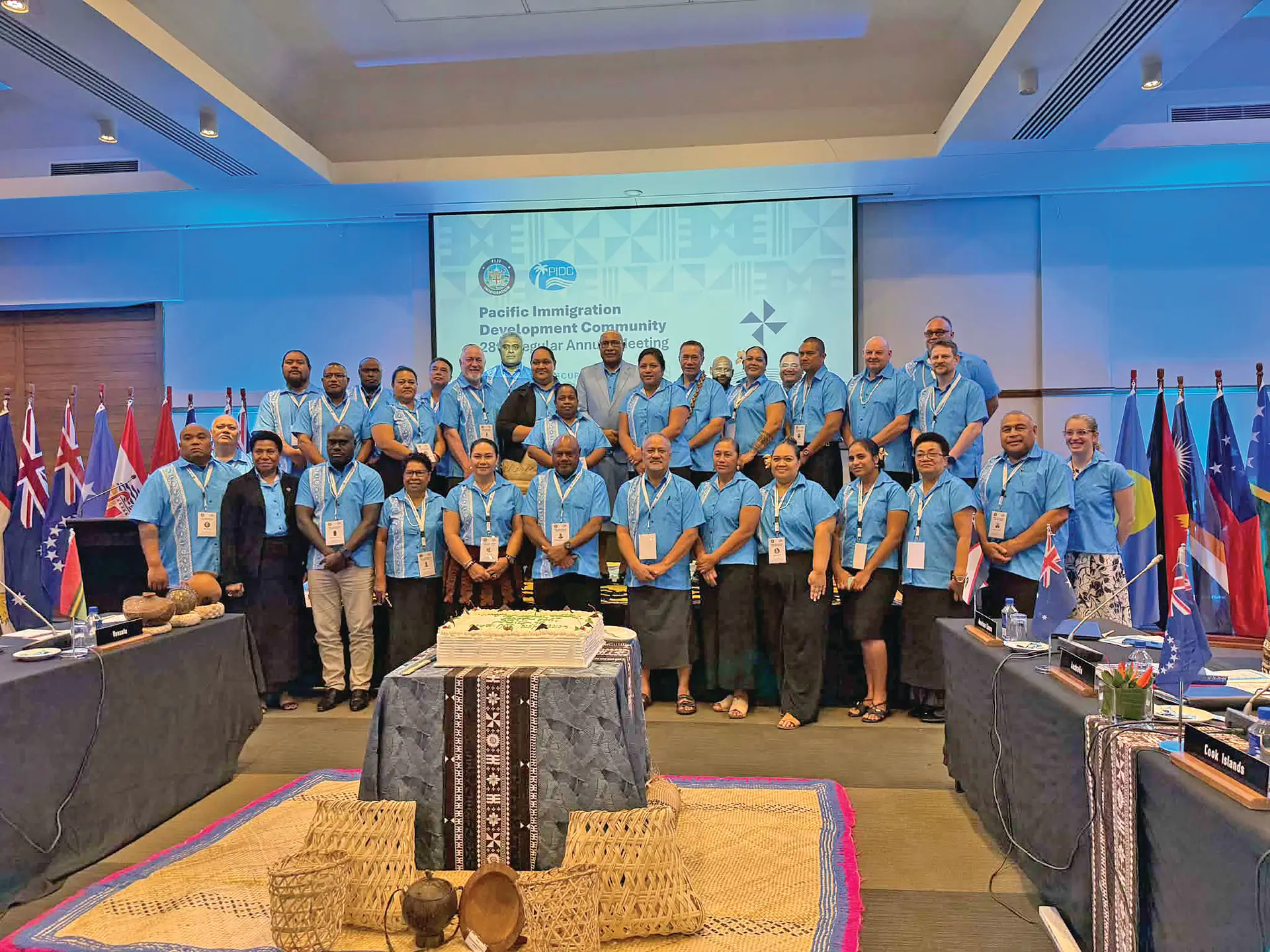
Minister for Immigration Viliame Naupoto (middle back row), with Pacific Immigration leaders during the 30th PIDC regional annual meeting (RAM) at the Grand Pacific Hotel in Suva on June 9, 2026.
Photo: DEPTFO News
Escalating global conflicts, economic instability and climate change are creating unprecedented migration pressures that Pacific nations must prepare for through stronger regional cooperation and innovation.
Minister for Immigration Viliame Naupoto delivered the warning while opening the 28th Pacific Immigration Development Community (PIDC) Conference at the Grand Pacific Hotel in Suva yesterday.
He said immigration agencies across the Pacific were operating in an increasingly complex environment where human mobility was being shaped by forces beyond the region's control.
Related stories
"We gather at a time of global economic turmoil because of war and geopolitical tensions," Mr Naupoto told delegates from across the Pacific.
"History tells us that economic hardship often drives migration. Global conflicts can create increased visa applications from affected regions, greater demand for humanitarian protection pathways, pressure on labour mobility programmes, enhanced border security requirements and the need for stronger international cooperation on migration management."
Mr Naupoto said the Pacific was facing a rapidly changing landscape marked by shifting migration patterns, advancing technology, expanding labour mobility schemes and increasingly sophisticated criminal networks.
"The Pacific is changing, changing fast," he said.
"Immigration work has never been more important than it is today. It is no longer a peripheral issue, but a central issue to our countries' development, prosperity and security."
Climate mobility challenge
Mr Naupoto highlighted the growing impact of climate change on migration within the Pacific, describing climate mobility as one of the region's emerging challenges.
"For the Pacific, climate change is not a future issue. It is already here," he said.
"Sea-level rise, coastal erosion, flooding and stronger storms are already forcing movement, and this will increase. As a region, we must not only respond, but lead in a way that reflects our values, dignity, respect and humanity."
Security threats
Mr Naupoto also pointed to increasing security threats facing immigration authorities, including human trafficking, migrant smuggling, fraudulent travel documents and cyber-enabled crimes.
"These threats demand that we work together," he said.
"We must share information faster, strengthen cooperation, build modern and capable border systems, and ensure that our laws are modernised accordingly."
He said immigration agencies play a critical role in achieving the vision outlined in the 2050 Strategy for the Blue Pacific Continent by enabling trade, tourism and economic growth while safeguarding borders and communities.
Citing figures from the United Nations Population Division, Mr Naupoto said there were an estimated 304 million international migrants globally in 2024, representing about 3.7 per cent of the world's population.
The figure has nearly doubled since 1990 and quadrupled from the 77 million recorded in 1960.
While migration presents economic opportunities through labour mobility, tourism, education and diaspora connections, he said it also comes with significant responsibilities.
"Mobility must be safe, orderly and well-managed," Mr Naupoto said.
"This requires modern systems, strong processes and close cooperation."
Innovation key
Delegates were urged to embrace innovation through digital identity systems, biometrics, automation, artificial intelligence and data analytics to strengthen border management.
"These are not future ideas; they are today's tools," Mr Naupoto said.
"If we use them well, we can improve security, improve efficiency and improve the travel experience."
The Minister also encouraged participants to embrace the Fijian spirit of Talanoa throughout their discussions, emphasising active listening, understanding and mutual respect.
The conference theme, Innovation, Security and Partnerships for a Secure Pacific Border, reflects the region's commitment to addressing evolving migration and security challenges through collective action.
Established 30 years ago, the Pacific Immigration Development Community has evolved from a forum for dialogue among immigration directors into a key regional mechanism for cooperation on migration management and border security issues across the region.