New scholarships target next generation of agricultural researchers
ACIAR, FNU and USP partnership aims to build research capacity around Pacific priorities.
Wednesday 12 August 2026 | 10:30
Updated 12 August 2026 | 12:37 FJT

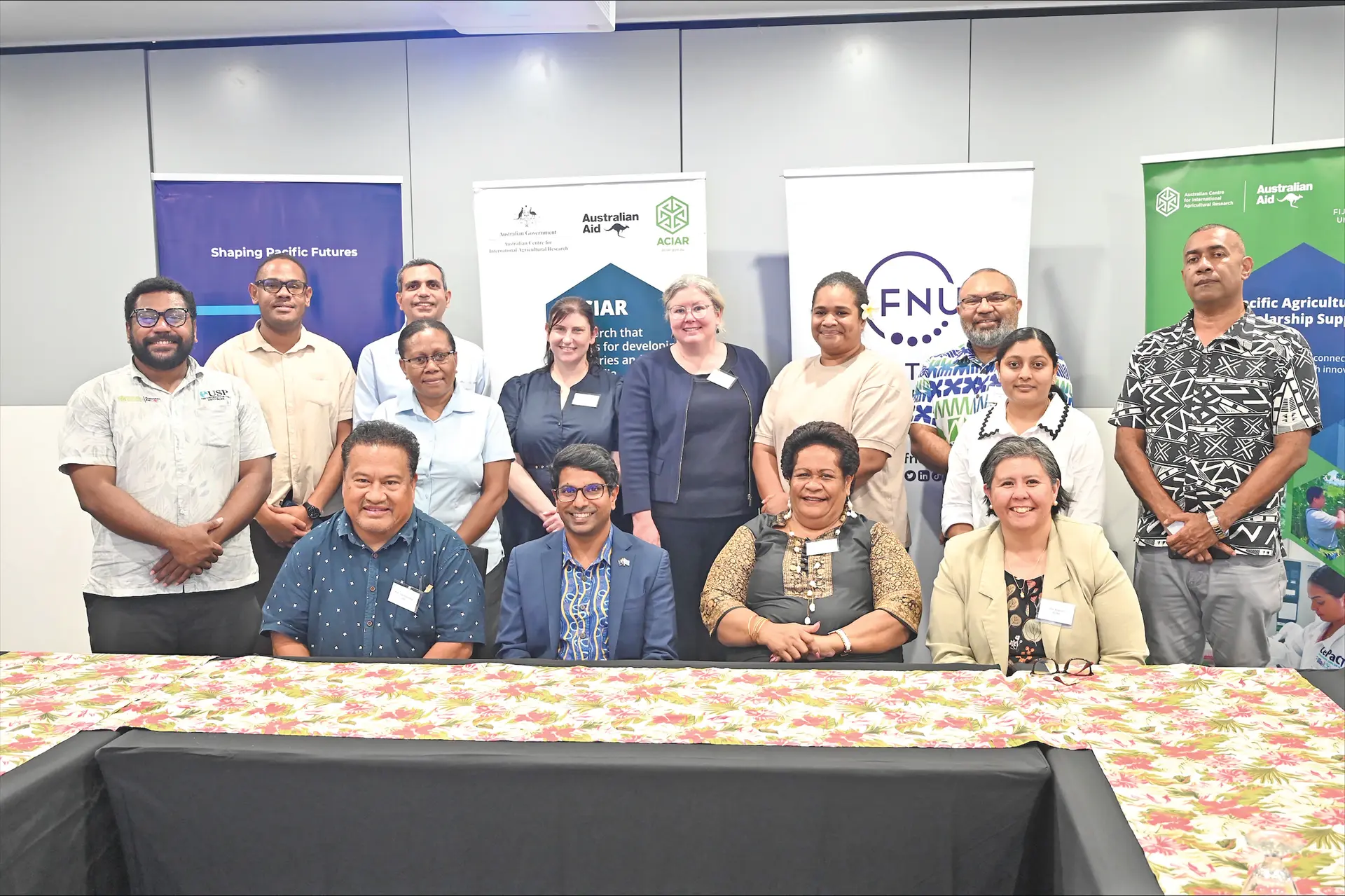
From left: USP Deputy Vice-Chancellor and Vice-President (Education) Professor Jito Vanualailai, Australian High Commission Counsellor for Economic and Development Cooperation Vas Withanage, FNU Vice-Chancellor, Professor Unaisi Nabobo-Baba, ACIAR Regional Manager Pacific Mai Alagcan. Standing (L-R) USP ACIAR Graduate officer, Josevata Cava, ACIAR Assistant Manager, Jone Ravuikadavu, USP researcher, Professor Utkal Meha, Vanuatu PASS scholar, Norah Rihai, ACIAR PASS Manager Capacity Development, Michelle Bruce, ACIAR Director Capacity Development, Jennifer Ross, PASS Alumni Salote Nasalo, FNU Associate Professor, Dr Donald Wilson, PASS Job Ready Program and Local Coordinator Shivani Singh and FNU College of Agriculture, Fisheries and Forestry (CAFF), Dr Kaliova Ravuiwasa on August 11, 2026.
The Australian Centre for International Agricultural Research (ACIAR), Fiji National University (FNU) and the University of the South Pacific (USP) are partnering to strengthen Pacific-led agricultural research and develop researchers to tackle food, climate and environmental challenges.
The partnership will deliver the redesigned Pacific Agriculture Scholarships and Support (PASS) Programme, providing postgraduate scholarships and institutional support for research in agriculture, fisheries and forestry.
The initiative builds on nearly two decades of ACIAR investment in Pacific agricultural research capacity since PASS was established in 2008.
Related stories
ACIAR acting chief executive officer Nick Austin said the redesigned programme would help Pacific countries develop research capacity that responded directly to local priorities and emerging challenges.
“For almost two decades, ACIAR has invested in developing agricultural research capability across the Pacific,” Mr Austin said.
He said the new phase of PASS would support Pacific partners to develop solutions in areas including agriculture, fisheries and forestry while aligning research and capacity development with priorities identified by Pacific countries.
The partnership comes as Pacific countries face increasing pressure to strengthen food security, build climate resilience and ensure sustainable management of agricultural, fisheries and forestry resources.
FNU vice-chancellor Professor Unaisi Nabobo-Baba said the programme was important because research must be grounded in the realities facing Pacific communities.
“We need research that responds to the realities of our region, whether it is food security, climate resilience, sustainable agriculture, fisheries, forestry or the livelihoods of our communities,” Ms Nabobo-Baba said.
Under PASS, FNU students have received opportunities to undertake postgraduate research in areas including agriculture, horticulture, fisheries, aquaculture and forestry.
Ms Nabobo-Baba said FNU would seek to strengthen its partnerships under the new phase of the programme, with agriculture, fisheries and forestry remaining critical to the region’s future.
USP deputy vice-chancellor, vice-president (Education), acting deputy vice-chancellor and vice-president (Research and Innovation), Professor Jito Vanualailai, said regional collaboration was essential to achieving sustainable development outcomes.
He said the enhanced PASS programme would help equip Pacific scholars with the research skills needed to respond to complex challenges facing agriculture and food systems.
“Through PASS, our students and researchers gain opportunities to generate knowledge that is grounded in Pacific realities while contributing to regional and global conversations on agricultural systems,” Mr Vanualailai said.
The renewed programme also builds on a track record of measurable outcomes.
A previous tracer study found that more than 90 per cent of PASS scholarship graduates were employed in the agricultural sector after completing their studies, highlighting the programme’s contribution to developing a skilled agricultural workforce in the region.
ACIAR, FNU and USP say the redesigned programme will strengthen locally led research, postgraduate training and long-term institutional capacity while ensuring research remains aligned with the Pacific research agenda.
The partnership is expected to provide a stronger platform for Pacific researchers to generate knowledge and develop practical responses to the region’s agricultural, fisheries and forestry challenges.
Feedback: milika.rabulu@fijisun.com.fj