Pacific journalists receive anti-corruption reporting boost
A new regional programme will provide training and investigative reporting grants to journalists across 14 Pacific Island countries.
Thursday 11 June 2026 | 12:30

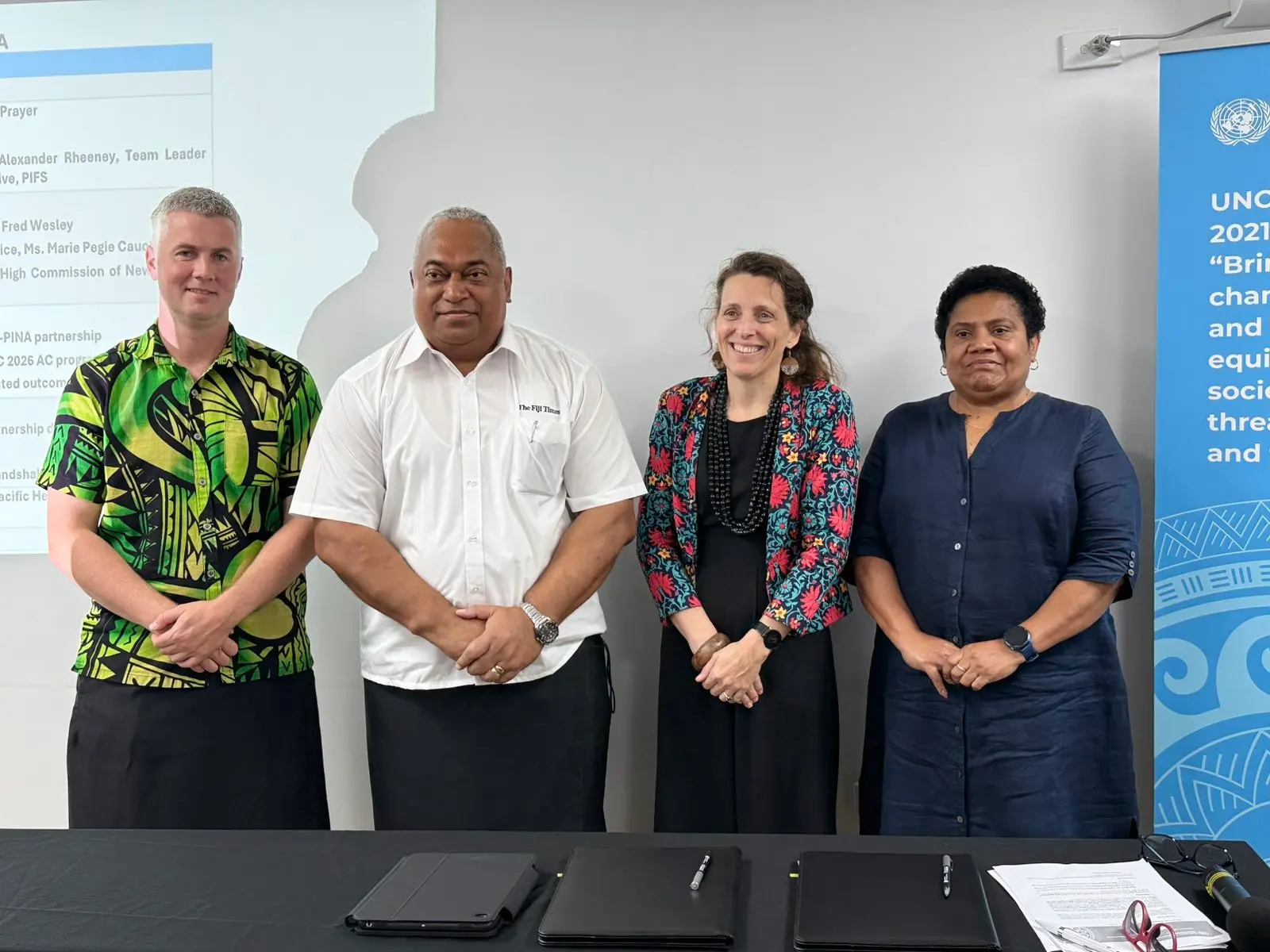
From left: High Commission of New Zealand Deputy Head of Office Samuel Cox, PINA board member Fred Wesley, UNODC Pacific Head Marie Pegie Cauchois and Pacific Islands News Association managing editor Makereta Komai.
Photo: Joseph Balolo
Journalists across the Pacific received a major boost yesterday with the launch of a regional initiative aimed at strengthening anti-corruption reporting, transparency and accountability in 14 Pacific Island countries.
The initiative was launched following the signing of a partnership agreement between the United Nations Office on Drugs and Crime (UNODC) and the Pacific Islands News Association (PINA), with support from New Zealand's Ministry of Foreign Affairs and Trade (MFAT).
The Journalism for Pacific Anti-Corruption and Transparency Project will strengthen the capacity of journalists and media organisations through training, small investigative reporting grants and regional learning opportunities.
Related stories
The programme will also support the institutional development of PINA and the Pacific Anti-Corruption Journalists Network (PACJN).
Speaking at the launch in Suva, UNODC Pacific Head of Office Marie Pegie Cauchois said independent media played a critical role in promoting transparency and public accountability.
“The media plays a vital role in fostering transparency, accountability and public trust,” Ms Cauchois said.
She said the initiative would help journalists undertake in-depth investigations that were often difficult to pursue because of limited resources, while ensuring media organisations remained sustainable in a challenging economic environment.
PINA board member Fred Wesley said journalists played an essential role in helping citizens understand how decisions were made and how public resources were used.
“As journalists, our role is not only to report events, but to help citizens understand how decisions are made, how public resources are used, and why accountability matters,” Mr Wesley said.
The project builds on a decade-long partnership between UNODC and PINA and follows the establishment of PACJN in 2019, which continues to serve as a regional platform for advancing integrity, transparency and accountability.
The initiative is expected to strengthen investigative journalism across the Pacific while supporting regional efforts to implement the United Nations Convention against Corruption and the Teieniwa Vision.