Artificial Intelligence (AI) Around Us: How should we respond?
Growing use of AI in schools, business and social media is raising concerns about misinformation, cybercrime and cultural preservation.
Wednesday 27 May 2026 | 13:00
Updated 27 May 2026 | 14:48 FJT

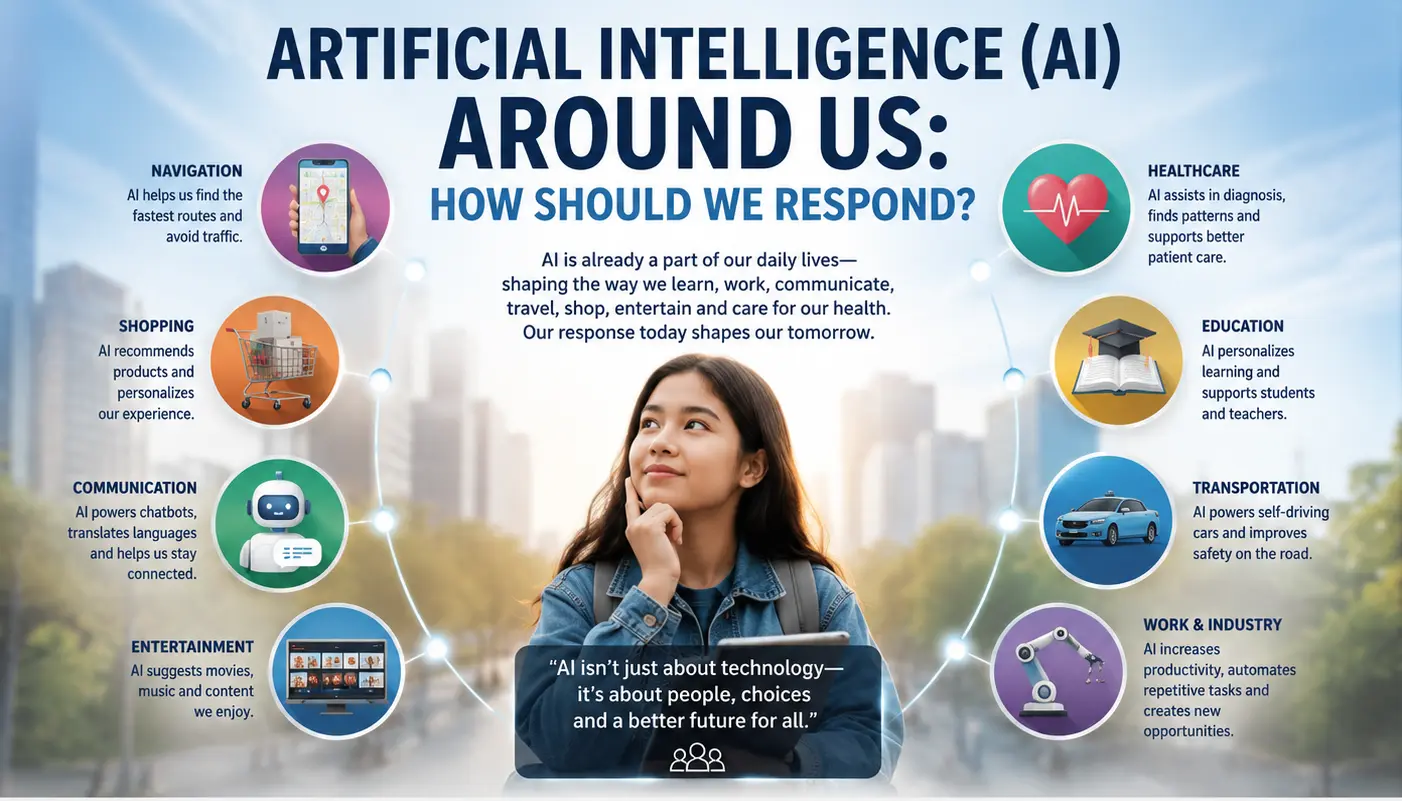
Over the past twelve months, public discussion of artificial intelligence in Fiji has remained limited. It has focused mainly on the risks AI poses to social life and workplace productivity. A more structured and balanced debate, one that considers both the benefits and the risks of this technology, has not yet taken place.
Sit in any Fijian living room in the evening, and there is AI around unnoticed. The mother on Facebook, her feed arranged for her by an algorithm she could not name if you asked.
The daughter is finishing her Year 12 economics essay in ChatGPT in less time than it takes to boil a jug of water. The aunty next door is asking a free app to write Facebook posts for her market stall this weekend. The cousin half-watching a YouTube video that another algorithm picked. Ask any of them if they are using artificial intelligence, and they will say no. Unknowingly, they all are, in different forms.
Related stories
This is what AI looks like in Fiji now. Not the cinematic version that fills the international press. A quieter thing: foreign software, threaded through our phones, our classrooms, our small businesses, and the family group chats that hold us together.
The question we have not yet put to ourselves with any seriousness is whether we will shape how this technology behaves in our lives, or keep using it without asking who built it, who profits from it, and who pays the bill when it does harm.
The quiet arrival of AI in our daily life
Most of us in Fiji are already using AI every day. Few of us could name when we started. When we scroll TikTok, dictate a text message, auto-translate a Messenger chat, or watch a Facebook reel served up by recommendation software, every one of those actions is mediated by machine learning. These are no longer optional features. They are the floor on which the platforms stand.
The more visible tools (ChatGPT, Gemini, Copilot, Claude) are built by a small handful of very large foreign corporations: OpenAI, Google, Microsoft, Meta, and Anthropic. None are based in the Pacific. None were designed with iTaukei, Fiji Hindi, or our economies in mind. That is not a complaint. It is a fact, and it should shape how we discuss AI in Fiji, because it tells us where the design choices are being made, and where they are not.
The misuse we are already living through
The harms are no longer hypothetical. Deepfake images and cloned voices are turning up in romance scams, investment scams, and political smears across the Pacific. AI-generated photographs build fake Facebook profiles that target our elderly relatives and our children. The beauty filters on TikTok and Snapchat, powered by the same generative technology, continue to do measurable damage to teenage self-esteem. The research on this is now too substantial to ignore.
Cyberbullying in our secondary schools was already a serious problem before any of this. Now it is worse. AI tools can fabricate convincing messages and altered images in seconds, and our existing cybercrime and online safety laws were drafted before any of this technology existed. They are not fit for the current moment. Updated legislation, better-trained police investigators, and a clear public reporting channel are overdue.
Students, ChatGPT, and the deeper question
Let me be direct about what I see in my own classrooms. ChatGPT is now used routinely across USP, FNU, the University of Fiji, and our secondary schools. Some students use it to write whole essays. Others use it the way I had hoped they might: as a tutor that explains a concept three different ways at midnight when no lecturer is available. Some teachers have quietly started using it to mark assignments. That is its own debate.
Banning the tool will not work. We tried that with mobile phones, social media, and Wikipedia and each time the technology won. So, the question is not whether students should be allowed to use AI. The question is whether we are teaching them to think critically about it. If a student in my class asks ChatGPT to describe the events of May 1987 in Suva, whose version of that history is she given? If she asks for advice on traditional iTaukei healing, will the model recognise that knowledge, or will it confidently invent something that sounds about right? If she asks for a poem in Fiji Hindi, will it write poetry, or a clumsy approximation no Fiji Hindi speaker would accept?
These are not abstract worries. I put them in front of my students every trimester. The answers are sobering. The ones who pass the course are not those who write the cleverest prompts. They are those who learn when to trust the machine, and when to push back. That is a different skill. We have barely begun to teach it.
The hidden costs behind the screen
Behind every AI tool that feels effortless on our phones sit two costs that rarely appear in the marketing. The first is human. To make ChatGPT and similar products safe enough to release, the firms that build them have hired workers in Kenya, the Philippines, and other low-wage economies to read and label some of the most disturbing material on the internet. Those workers are paid a few dollars an hour to absorb psychological harm so that wealthier users do not have to.
The second cost is environmental. Training a single large language model burns through enormous quantities of electricity, and consumes fresh water for cooling on a scale that should startle anyone living in the Pacific. As AI use spreads, so does its carbon footprint. For a country already living with rising seas and stronger cyclones, this is not a side issue. We cannot solve either problem alone, but our silence in regional forums reads as consent.
A classroom example
Picture a scene that could happen in any Year 12 classroom this week. A student is asked to write an essay on the cultural significance of the tabua, the whale’s tooth. She enters the question into ChatGPT and, within seconds, has three pages of fluent prose. The writing is beautiful. It is also, in places, quietly wrong. The model may confuse the tabua with similar objects from Tonga, describe ceremonies in ways no Fijian elder would recognize. It will almost certainly miss the spiritual weight of the object, because that weight is carried in our communities and in the slow exchanges of village life. Not on the open internet that trained the model.
If she submits the essay without question, she has learned almost nothing. Worse, she has been taught, quietly, that a foreign machine knows her culture better than her own grandparents do. But if her teacher invites the class to compare the AI text with what an elder actually says, the same exercise becomes powerful. Students see, in real time, what the tool can do, what it gets wrong, and why it matters who carries cultural knowledge in the first place. That, in my view, is what AI literacy in Fiji should look like. Not memorising warnings. Practising judgement.
What is actually working
It would be dishonest to write only about harm. AI is also doing useful work in Fiji, and we should say so. A farmer can photograph a diseased leaf and receive a diagnosis through a phone app. This may be imperfect, but faster than waiting for the extension officer. A nurse on a remote island can use AI-assisted screening to detect diabetic retinopathy, a growing problem in our population. A small tour operator in Nadi can run a multilingual chatbot overnight, fielding enquiries in English, Mandarin, and Japanese without paying for round-the-clock staff. A young woman in Labasa can teach herself coding, graphic design, or accounting from YouTube, and start a freelance practice from her home.
These are not futures. They are happening now. The Fijians who will do well in the coming decade will not be those who fear AI and avoid it, nor those who accept it without question. They will be those who use it with skill and with judgement. The task for the rest of us, and I include those of us in the universities, is to make sure more young Fijians, in the maritime divisions and in the interior as well as the urban centres, have the internet access, the devices, and the training to be among them.
Who AI is built for
Now the harder part. AI is not being built equally for everyone. The large language models most of us use are trained overwhelmingly on English-language data drawn from Western sources. They understand a New York lawyer better than they understand a Lautoka teacher, and they do so by design, not by accident. The training corpus simply contains far more of the former.
Our Pacific languages (iTaukei, Fiji Hindi, Rotuman, and those of our neighbours) are spoken by relatively few people in global terms. That makes them commercially uninteresting to the firms deciding what to build next. If we do nothing, the next generation of Pacific children will grow up using a technology that does not speak their first language and does not know their stories. That is not a minor cultural concern; over time, it is a slow erosion of who we are.
The answer is not to reject AI. The answer is for Pacific institutions, my own included, to invest in Pacific-led work: datasets in our own languages, built with the consent of the communities they describe, used to train tools that serve our own people. Iceland has done this with Icelandic. Maori communities in Aotearoa have done this with te reo. There is no honest reason why we cannot.
What must be done
Concrete action is overdue at four levels. The Government of Fiji should publish a national AI strategy within the next twelve months, drafted in genuine consultation with educators, business, faith communities, and youth, and covering at minimum data protection, cybercrime, education, and language preservation.
The Ministry of Education, together with USP and other universities, should release clear classroom guidelines focused on critical literacy rather than blanket bans.
The private sector, particularly tourism, agriculture, and the creative industries, should invest in AI training for its workforce, with support from development partners.
And the rest of us as parents, employers, neighbours, citizens need to understand these tools. Not to master them. Just to know enough to ask sensible questions when our children and colleagues use them.
A choice, not a wave
It is convenient to describe AI as something happening to us, like the tide. That convenience is the point: a tide carries no responsibility. But AI is not a tide. It is a long sequence of human decisions, taken every day, in offices we can name, by people whose interests can be examined and challenged. Fiji is small in population.
Our voice in Pacific regional forums, in international bodies, and inside our own households is real.
We can choose to be informed and organised. We can also choose to be quiet. There is no third option. If we want our children to grow up as thinkers and builders rather than as customers of foreign software, the work must begin now.
Dr Sharma is a Senior Lecturer at USP’s Graduate School of Business. The views expressed here are his and do not represent those of his employer.