'Shine A Light': Meth Trade Creeps into Lau: Youths Barter Marijuana for Ice
"We've always known about marijuana being cultivated and used on the island, but now we have received some reports from Vanuabalavu, Ono-i-Lau, Lakeba and Moala that ice is now in the islands," he said.
Sunday 06 October 2024 | 11:00

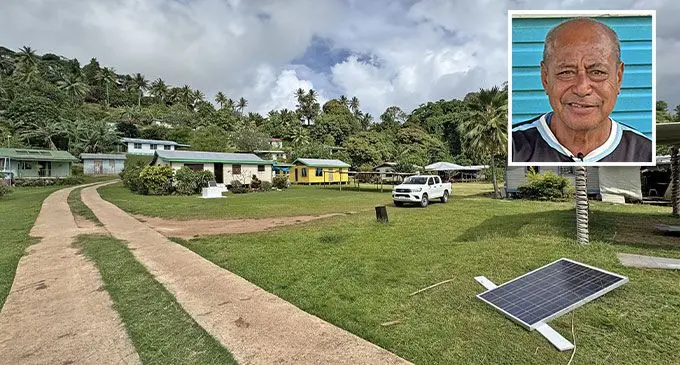
Daliconi Village, Vanuabalavu. INSET: Daliconi Village elder Jione Kali. Photos: Asenaca Ratu
Marijuana is allegedly being bartered by some of the youths in Lau, especially on the island of Moala, for methamphetamine from Suva, a concern expressed by village headmen in the province.
Information gathered by Shine a Light during our trips to Moala and Vanuabalavu in Lau indicates that meth is now allegedly used by young people on the islands.
The Fiji Police Narcotics Bureau in Suva have been alerted. However, Police have yet to gather hard evidence.
Related stories
Meth is allegedly smuggled to the islands through other Lau villagers who board the passenger boats from Suva because of the lack of security checks conducted by Police at the wharf to complement the limited resources and police based on the islands.
Young people in the Lau Group are exposed to the use and sale of methamphetamine every day through yachts, inter-island shipping, domestic flights, and the internet- tutorials on how it's cooked.
Village headmen across the 72 villages in the province have expressed grave concern that the use of meth will destroy the peace and way of life in the islands.
Roko Tui Lau Jaji Kalounivalu said the Lau Provincial Council was concerned about the welfare and future of its people on the islands.
"We've always known about marijuana being cultivated and used on the island, but now we have received some reports from Vanuabalavu, Ono-i-Lau, Lakeba and Moala that ice is now in the islands," he said.
"Not many young people in Lau may be using this drug right now, but our biggest concern is that given our small population, the use of this drug will spread like wildfire on the island."
The Lau Group has over 50 scattered islands, with only 19 inhabited.
There are 13 tikina (districts) with 72 villages spread across the 19 islands.
It is estimated that the province has a total population census of about 80,000 people. As of November, last year, village profiling statistics show that there are 6800 villagers living on the islands.
Majority of the young population are male between the ages of 10 and 30 years. For those between the ages of 10 and 20, females number at 654 and males at 724. For those between the ages of 20 and 30 years, females total 267 and males 321.
In this week's edition, we highlight how meth is slowly entering the Lau group and taking control of the lives of young people on the islands.
CASESTUDIES: MOALA AND VANUABALAVU
Marijuana is known to the Police and the village elders to be illegally cultivated, sold, and used by the young people in the islands.
However, the discovery of packaged cocaine along the shores of some of the islands in Lau in 2018, including Moala, opened a pathway for hard drugs to enter the islands, as well as a route to traffic them to Australia and New Zealand.
"When this happened, there was a fear that white drugs were already in Lau," Mr Kalounivalu said.
Station officer at the Moala Community Post Biutoka Vuli said he's aware of the connection between a group in Moala and a drug dealer who shared blood links to the island.
"There is most probably a link between the island and Suva. We have yet to gather evidence of ice on the island," he said in an interview in July.
However, the indicators of drug use are strong among the male youths, some dropping out of school at a young age, increase in alcohol consumption and violence, and loss of respect.
"We can identify the presence and use of this drug through the behaviour of young men in the village.
"There's an increase in violence resulting from alcohol consumption, which indicates to us that the young men are exposed to drugs."
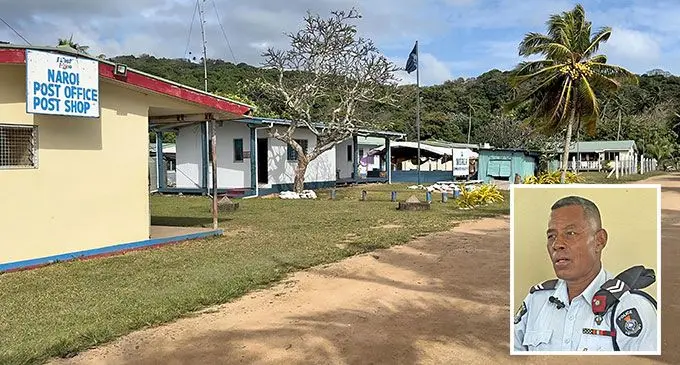
The Post Office and Police Station at Naroi, Moala. INSET: Moala Police Station Officer Biutoka Vuli. Photos: Asenaca Ratu
"When we bring the nets and buoys to shore, we realise that the nets are different from the ones used for fishing.
"We feel that these are put into the ocean with the drugs that are to be picked up."
About five to six yachts visit Daliconi Village every week.
"We've heard that the illicit drug from Suva is now used in the Lau Group but there is yet any evidence.
"We talk to the villagers, especially the young people, and we try to raise awareness on illicit drugs."
Vessels visit Moala, Vanuabalavu and other islands in the Lau Group every two weeks.
Domestic flights are on Tuesday for Moala and Wednesday for Vanuabalavu.
COCAINE FIND
Savenaca Ledua, 18, was in Year 8 when he found a package lying among the coconut trees on Moala beach.
He recalled it was a Saturday in October 2018, when he and his brother were walking along the beach to look for mud crabs.
It was when they were returning to the village that they found a package with a buffalo image on it.
"Out of curiosity, I picked the package thinking it was a book or milk packet and put it in my pocket and carried it to the village," he said.
"We didn't know it was cocaine and that the same kind of package was washed up in other islands in the Lau group."
Mr Ledua said it was when Police had started their investigation that they realised the package was cocaine and the net which the drugs were put into was washed to the shore.
SILENT LAWS
Police have been strongly criticised for the lack of monitoring and policing of the wharfs and the domestic terminal at the airport.
Goundar Shipping Limited owner George Goundar said Police were tied up with shore-based criminal activities and the shipping industry is left alone.
"And it's only occasionally that Police come in and do spot check, but that's not good. They should be more visible on the vessels," he said in an interview in August.
"Police used to come and do random checks. Now, they've stopped doing it for a while."
Mr Goundar said when Police carry out their search on the vessels, drugs dealers would stash and hide the drugs in the vessel.
"Police have got to be more visible on the loading point."
Drug Free World founder Kalesi Volatabu said whatever the shipping routes were in Fiji, those were being used for urban to island drug trafficking.
"To get a plane from Nausori to Vanua Levu, Labasa, Lau, you don't have to go through any drug detector, your bags don't go through drug screening. I've never had a canine unit sniff my bags," she said.
"Drugs don't discriminate. It doesn't care what political affiliation you have, age, gender, socioeconomic status. Everybody is affected by this."
■ This is the fifth part in a six-part series on the methamphetamine problem in Fiji.
Feedback: ivamere.nataro@fijisun.com.fj