Expert warns of narco sub threat
The Fiji Police Force has indicated that the seized 2.64 tons of cocaine valued at AUD$780 million (FJ$1.2 billion), was trafficked from South America to the Pacific in a semisubmersible vessel.
Sunday 25 January 2026 | 12:30
Updated 25 January 2026 | 17:46 FJT
Fiji and the Pacific are faced with a criminal innovation that a transnational crime expert says will test the capability of our law enforcers to fight the war against drugs.
Jose Sousa-Santos, an Associate Professor at the Pacific Regional Security Hub, University of Canterbury, says the use of low-profile vessel outboard motors also known as narco submersible is a new tactic used by drug cartels in the Pacific.
The Fiji Police Force has indicated that the seized 2.64 tons of cocaine valued at AUD$780 million (FJ$1.2 billion), was trafficked from South America to the Pacific in a semisubmersible vessel.
Related stories
The drugs were destined for another Pacific Island country.
"We've started to see the appearance and the usage of narco submarine in the Pacific over the past two years," Mr Sousa-Santos said.
"Traffickers operating through the Pacific are no longer experimenting at the margins; rather, they are selectively deploying mature technologies already proven elsewhere, recalibrated for Pacific geography and risk profiles.
"It's been utilised in the Americas and Southeast Asia for over a decade. The tactics used in the Pacific are different than how they're used in South America, moving the drugs from South America to the United States, or moving methamphetamine through Southeast Asia to different markets."
Capabilities
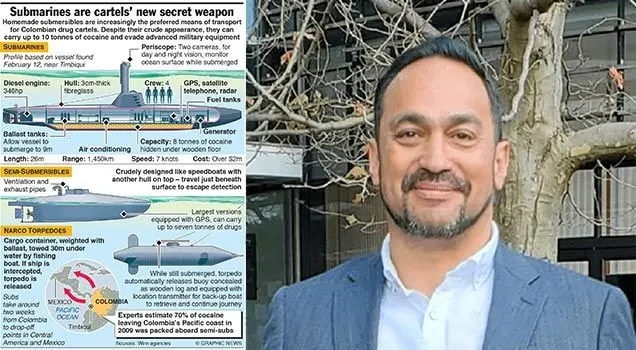
Mr Sousa-Santos said narco submarines could carry up to four tonnes of drugs, depending on how much fuel, water and food would be required for the crew. "We need to understand that these vessels do not just make one trip to a mothership.
"When this mothership comes in, it brings in a large number of drugs, not just four tonnes, so these narco subs will make several trips. So, we need to be able to track, to map these vessels to where the holding place for these drugs.
"Where are these small resupply bases or locations being built. This is very important."
Mr Sousa-Santos said it was interesting that four Ecuadorian nationals were arrested in Fiji, indicating the possible link with the seized narco subs seized in the Solomon Islands.
"There was a voter identification card from Ecuador found in one of the vessels seized in the Solomons. Is the ID card left behind in the vessel the same as one of the nationals arrested in Fiji, if they're not, are we dealing with the same cartel."
Operation
Narco submersibles are designed to travel short distances because of the weak structure, and most often they are towed from South America to the region.
"These types of vessels are built in mangroves, in rivers in South America and in Central America," Mr Sousa-Santos said.
"These are the kind of narco subs that are utilised to island hop, they are not utilised to travel long distances.
They're made out of fibreglass. Their structure is weak. They can't carry large amounts of fuel because of the space is taken up with drugs, or large amounts of water and food for the crew."
Mr Sousa-Santos explained that these narco subs would make several trips to a mothership, which would bring large amounts of drugs closer to the exclusive economic zones.
"The narco sub would pick up the drugs, take them back to a support base, which might only just be a small base where you'd have a place to refuel, before moving on to the next island, until they reach Australia or New Zealand.
"They are then able to rendezvous with Australian or New Zealand fishing or commercial vessels, which have not been to the Pacific or South America. Therefore, they're not seen as high-risk vessels, so they are able to return to Australian ports loaded with drugs."
Challenges and threat
Mr Sousa-Santos believes there is a risk that these types of vessels could be built in the Pacific in future because of the many uninhabited islands with mangroves. He said narco submersibles were high-powered speedboat and they travelled very low, leaving a small signature above the water.
"This make is difficult for radar and visually for our patrol boats to identify them," he said.
"Once they are identified, our guardian patrol boats are not able to keep up and intercept them because of the amount of power that these engines have, the speed that they can reach.
"It also means that at night, it makes it almost impossible to detect and intercept."
Mr Sousa-Santos said Pacific law enforcers needed the right technology to detect this criminal tactic.
"There is a need for night vision capabilities for our patrol boats, heat signature cameras to pick up thermal signature left by these boats, and air drones."
Mr Sousa-Santos said it's paramount that law enforcers needed to have the training and resources to counter activities of drug cartels.