New digital safety toolkit targets online risks for persons with disabilities
A first of its kind digital safety toolkit will be tested with persons with disabilities, offering practical safeguards against technology-facilitated gender-based violence.
Thursday 04 December 2025 | 15:00
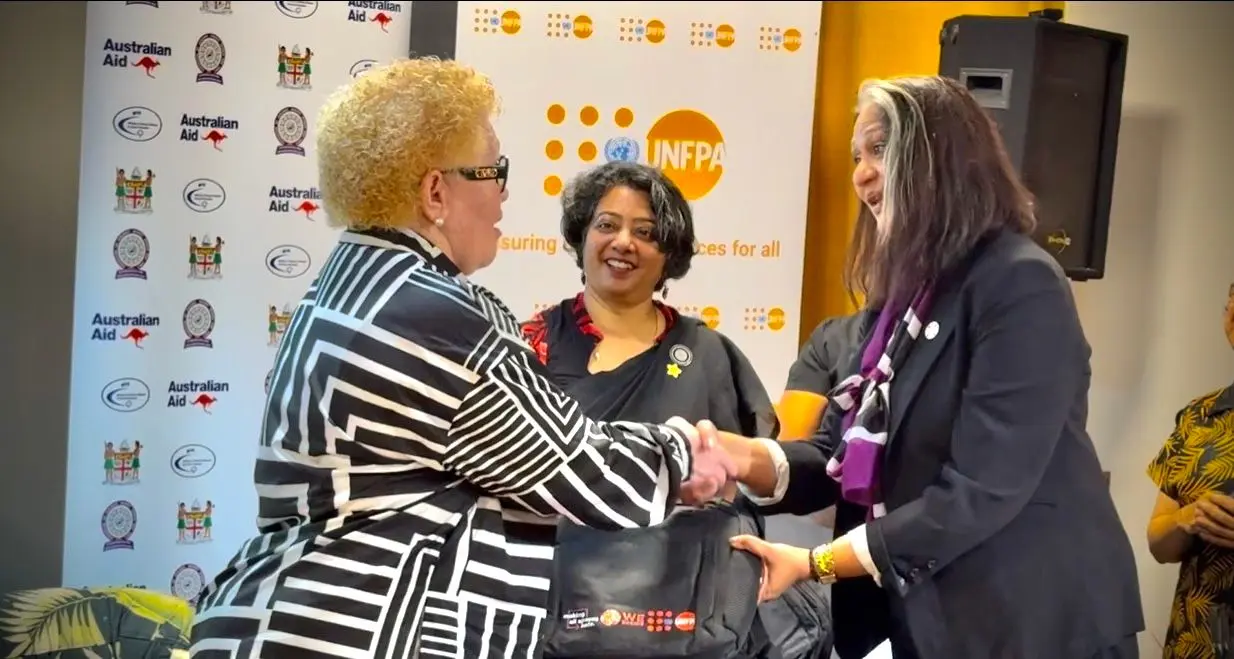
From Left: Ceo of Pacific Disability Forum Sainimili Tawake, Minister of Women, Children and Social Protection Sashi Kiran and Director of UNFPA Bidisha Pillai handing over of the new tool kit at the Pacific College University, Nasese on 4th December 2025.
Photo: Talei Roko
Digital inclusion for persons with disabilities took a major step forward today after Minister for Women, Children and Social Protection Sashi Kiran launched a new digital safety toolkit at the Pacific Community University in Nasese, Suva.
Ms Kiran said the toolkit would now be tested directly within disability communities to ensure it is practical, accessible and effective for people with diverse needs.
“We want to know whether these tools truly work for people with different disabilities,” she said.
Related stories
“Everybody’s reality is different, and our safeguards must reflect those realities.”
She said conversations around gender-based violence and online harm often excluded women and girls with disabilities, despite their heightened vulnerability.
“We talk about gender-based violence and we talk about technology, but we rarely talk about girls and women with disabilities,” Ms Kiran said.
The Minister said technology could play an essential role in education, communication and independence for persons with disabilities — but only if strong digital safety systems are in place.
“We want them to use technology to learn, to connect with the world and to live fuller lives,” she said.
“But if we do not protect them, we risk placing them in spaces where they are extremely vulnerable.”
Ms Kiran also called on technology companies to take greater responsibility.
“Safeguards cannot be an afterthought. We keep asking tech companies to do more, but as a nation we must also grow in empathy and heart for people living with disabilities,” she said.
She said future technologies should be designed with inclusion in mind rather than adapted after development.
“With AI now, there are incredible tools for people who are blind or deaf. These innovations should empower them and not endanger communities,” she said.
Ms Kiran said there was a need for rights-based digital governance, with stronger standards of transparency, accountability, data protection and content moderation.
“We are exploring legislative options because online safety can no longer be optional, and digital inclusion is now central to our social progress,” she said.
She said any national response must recognise the complex layers of vulnerability faced by women with disabilities.
“Policies must acknowledge the intersection of gender, disability and digital vulnerability. Only then can we build systems that truly protect everyone.”
Ms Kiran said the upcoming International Day of Persons with Disabilities should prompt Fiji to prioritise digital safety as a fundamental right.
“If we want an inclusive Fiji, then online protection must be part of that vision,” she said.