OPINION | Troops without a seat: The Gaza 'Board of Peace' and Fiji
While New Zealand was formally invited to join the Board — and chose to decline — Fiji was not invited at all.
Sunday 08 February 2026 | 13:00
Updated 08 February 2026 | 14:17 FJT

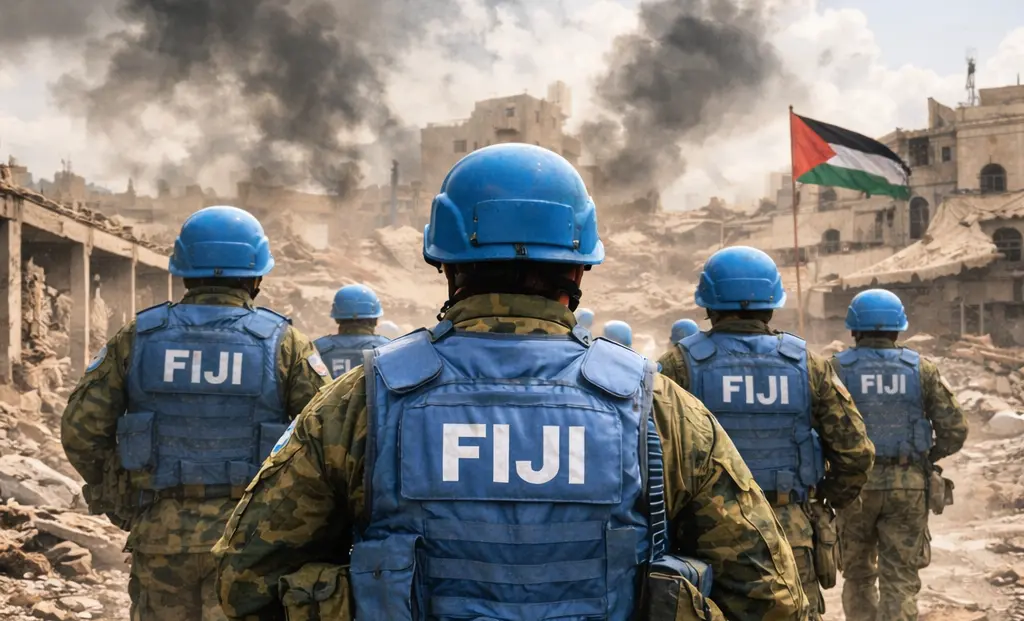
When peace is being designed, Fiji is not invited into the room.
When peace needs enforcing, Fiji is asked to send soldiers.
That uncomfortable reality is exposed by the emergence of United States President Donald Trump’s proposed Board of Peace for Gaza.
Related stories
While New Zealand was formally invited to join the Board — and chose to decline — Fiji was not invited at all.
Yet Fiji has reportedly been asked to contribute troops to a proposed “stabilisation force” linked to Gaza.
The contrast is revealing. It highlights how global security is increasingly organised — and where Fiji is positioned within that order.
The Board of Peace is reportedly structured as an exclusive body with a joining fee of around US$2 billion.
That cost alone places participation far beyond the reach of most developing countries.
For Fiji, whose entire national budget is only a fraction of that amount, membership is not simply impractical; it is structurally impossible.
In this model, peace is something designed by those who can afford entry – a ‘pay to play’ arrangement.
Yet although Fiji cannot afford to ‘play’, its military presence is required.
The peacekeeping paradox: respected soldiers, limited voice
For decades, Fijian soldiers have served with distinction in peacekeeping missions under the United Nations flag.
Their professionalism, discipline and reliability are widely recognised.
But that reputation now risks confining Fiji to a familiar role: valued for its manpower but excluded from decision-making.
This is not partnership. It is subcontracting.
Fiji should not carry the risks of other people’s decisions without having a voice in them.
New Zealand had a choice. Fiji did not.
New Zealand’s refusal to join Trump’s Board of Peace, underscores the imbalance.
Wellington cited concerns about mandate clarity and alignment with international norms.
New Zealand had the opportunity to make that choice.
Fiji did not.
One country was offered a seat at the table; the other was offered boots on the ground.
For Fiji, this raises serious foreign policy questions.
The issue is not opposition to peacekeeping. The issue is peacekeeping without political voice — being asked to assume risk in missions shaped by others and detached from established multilateral oversight.
Alignment with existing policy
These concerns align closely with Fiji’s National Security and Defence Review (NSDR), which recognises that national security includes the adherence to international law, and the maintenance of trust in Fiji’s external engagements.
Central to the NSDR is the requirement that security commitments be legitimate, transparent and accountable, supported by clear civilian oversight.
Being asked to deploy troops into a stabilisation force designed outside the UN system, while being excluded from the political body determining its mandate, sits way outside those espoused principles.
The moral burden on soldiers and the families
Fiji will bear the operational and political risk but has little influence over strategic direction. Fiji will carry the risks without shaping the outcome.
This puts RFMF soldiers in an unclear and fraught position. They—and their families—are the ones who will carry the risk in this venture.
It is a morally and ethically unfair burden for the Government to place upon them.
This moment therefore calls for clarity and restraint by the decision makers in Fiji’s Parliament and Cabinet.
The question is not whether Fiji can contribute troops - history shows that it can and has done so with honour.
The question is whether such contributions serve Fiji’s national interest and upholds international legitimacy.
Honouring our legacy
Fiji’s peacekeeping legacy should not be used to justify accepting deployments where authority, accountability and purpose are unclear.
Peacekeeping without representation is not partnership.
Fiji has earned international respect as a contributor to global peace.
It should not accept a future in which it is always invited to serve but never invited to decide.
No soldier should be sent into harm’s way without clear purpose, lawful authority, and their nation’s voice at the table.
- The author Jim Sanday was a commissioned military officer in the pre-coup RFMF and commanded Fijian battalions in Lebanon and Sinai. In 2025, he led the National Security and Defence Review (NSDR) and co-authored the National Security Strategy that was approved by Cabinet in June 2025.