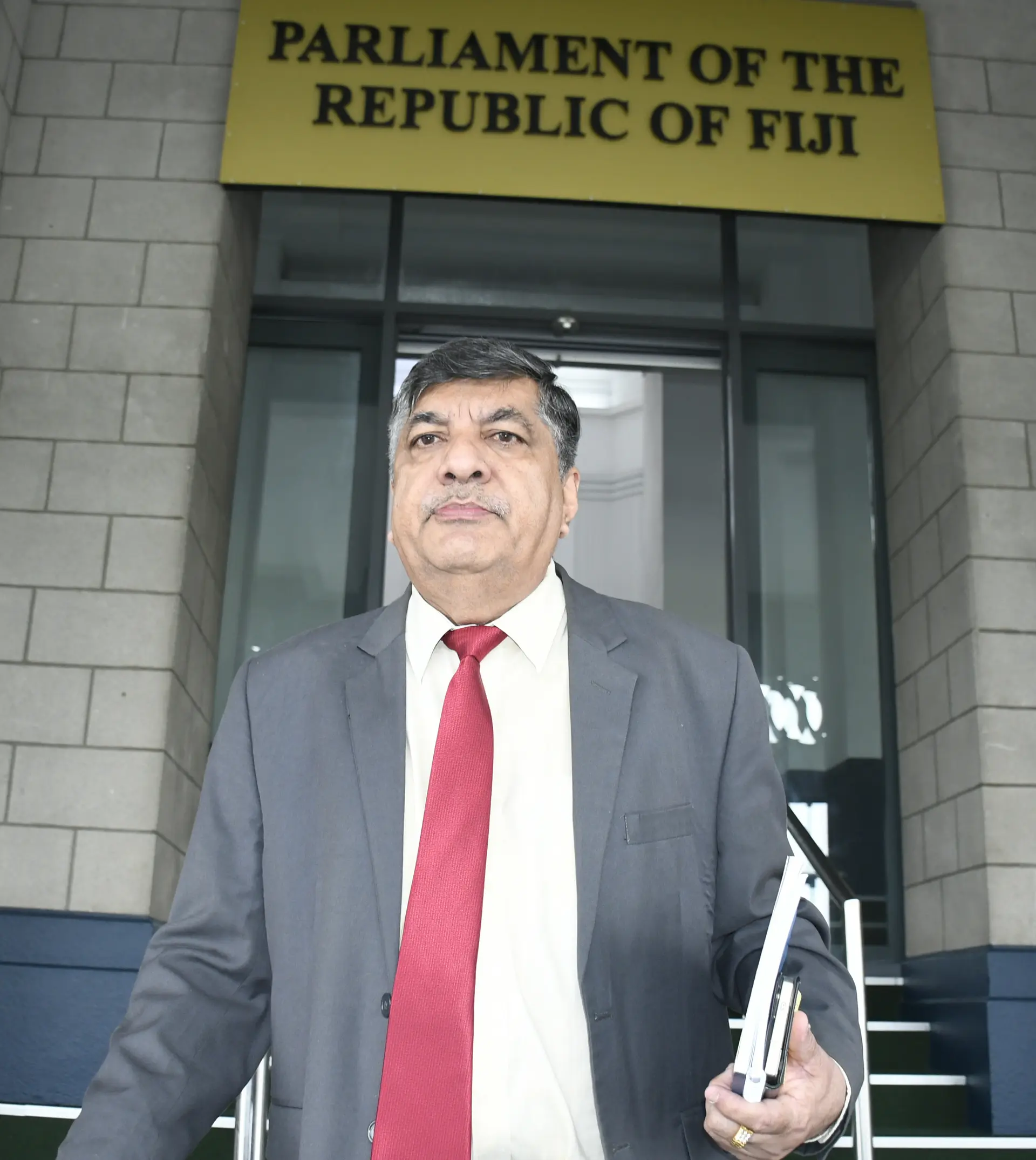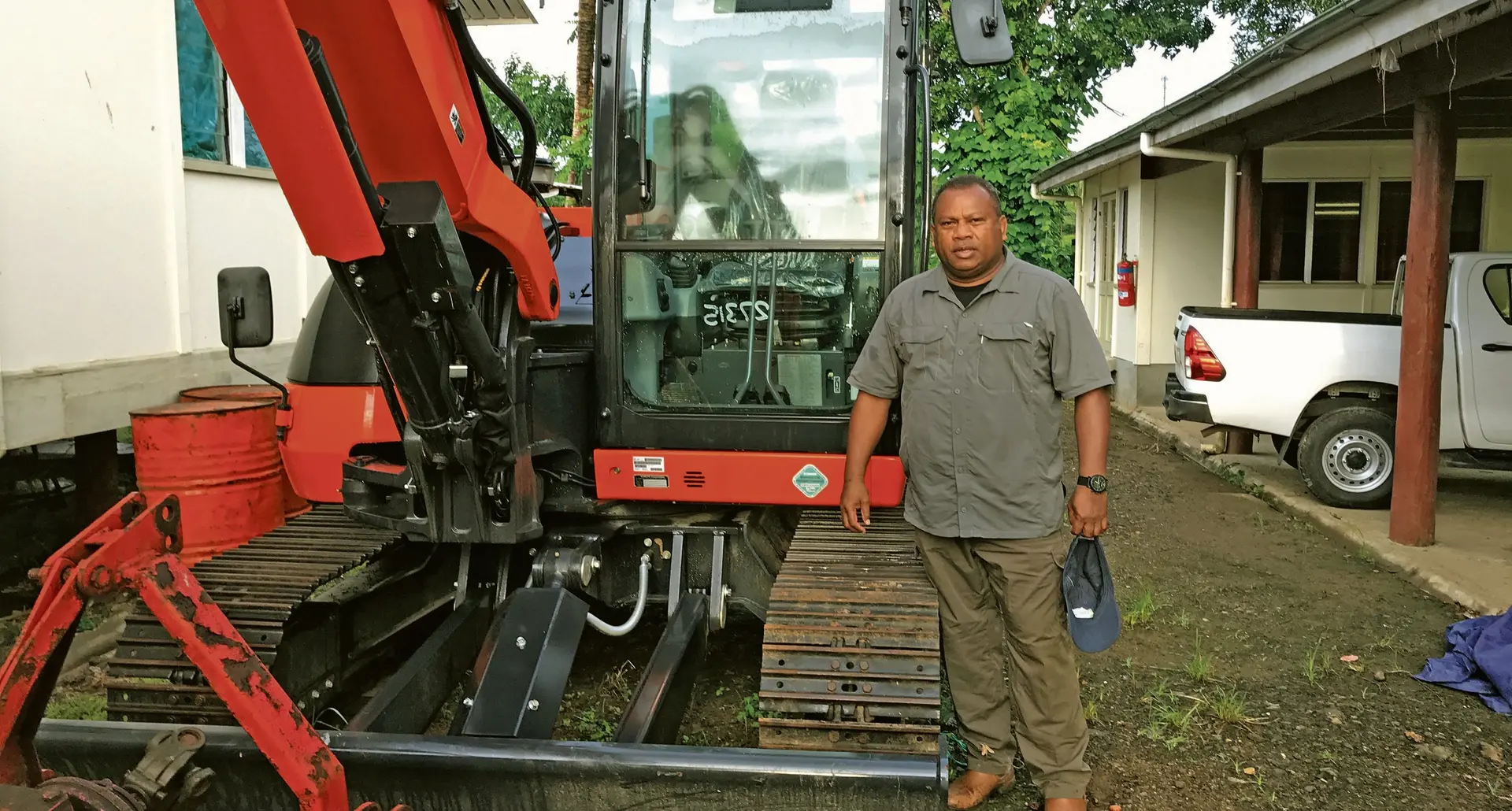
Inia Seruiratu at Korovou, Tailevu, in front of digger on February 28, 2018.
This is dairy week in Inia Seruiratu’s book.
It’s 4.55am on February 28 and the Minister for Agriculture is waiting outside the Agricultural Marketing Authority in Nausori for the Fiji Sun team to arrive.
The group leaves precisely at 5am as planned and heads for Korovou in Tailevu. It’s still dark, the road seems deserted and people are still either asleep or just getting up.
Related stories
I understand why he is dressed casually. His boots indicate that we are heading into dairy country and we should expect to be trudging through mud and cow dung.
Our aim is to catch farm hands still milking. But when we get to J S Singh dairy farm at the Waimaro flats past Korovou town, they are cleaning up. Milking started at 2am and finished after 4am.
Mr Seruiratu meets the workers and they seem to know him. It comes as no surprise because we learn that Mr Seruiratu is a frequent visitor there. He loves those farm visits. He gets the opportunity to see the impact of the policies, changes and new initiatives on the ground. This is reality check.
Today the farm hands milk 990 litres from 140 cows. Previously, they had 240 cows and were averaging 1000 litres. While the number of cows has dropped, the milk yield per cow has risen.
That’s good news because it shows that the new changes are having a positive impact. However, what is worrying is that tuberculosis has led to the slaughter of infected cows and the reduction of the herd. Milk production will grow higher if the numbers increase.
He has not lost the same enthusiasm that he showed the day before while planning for this trip.
It’s an early start to a long day for a Cabinet minister who also looks after Rural and Maritime Development, National Disaster Management, Meteorology and Acting Minister for Waterways while Mahendra Reddy is away overseas attending the Commonwealth Parliamentary Association meeting.
The farmers he visited are happy with the help and encouragement they are getting from Mr Seruiratu and the ministry.
Harvindar Singh, 32, of J S Singh farm, says they are happy with Mr Seruiratu’s performance. His father, Kashmir Singh, 63 shares similar sentiments. Again he express concerns on TB saying they had lost a lot of cows because of it. He asks Mr Seruiratu to see if something can be done to minimise the movement of cows from farm to farm and that all farms are routinely tested for the disease.
He claims some farms are bypassing these tests, putting livestock at risk. He tells Mr Seruiratu that he is attending a meeting at the Korovou Hotel of stakeholders at 10am to discuss dairy issues.
Mr Seruiratu’s next stop is the Agriculture Station in Korovou.
A digger and a tractor, both brand new, are parked in front of the office building. Mr Seruiratu explains that these machines are available to help people engaged in farming.
There are three categories. One group is those who have land but don’t have the capital to develop it. Some have swamps which can be drained and cultivated. Mr Seruiratu says these machines will start them up free of charge.
The next level will be the medium group which may require a subsidy. Then you have the big fully commercial groups who can afford to pay for the digger.
“We can’t apply one size fits all,” Mr Seruiratu said. “Fertilizers are also available to help farmers.”
Mr Seruiratu then travels to Lokuya in Waidalice where he is received by Joseva Toganivalu Madraitabua, a former school teacher turned dairy farmer.
Mr Madraitabua expresses his appreciation to Mr Seruiratu for his understanding of the plight of the farmers and the help he has received from the ministry. He invites him for a cup of lemon grass tea (co boi) and reveals his plans to expand the operation up to 2020.
On his way back to Koronivia Research Station he is inspired to stop over at the Fiji Co-operative Dairy Company Limited in Nausori. There he finds the man he is supposed to meet at Koronivia, Kiwi Stewart Cairns, seconded from New Zealand as chief technical adviser. Mr Cairns does not mince his words. He says TB is the big threat to the dairy industry. The only solution is to isolate and kill the infected cows, he says.
Mr Seruiratu also meets Sachida Nand, the chief executive officer of FCDCL, and relays the grievances of the farmers he visited. Mr Nand says all the cases have been taken care of.
“It is based on affordability,” he says.
Mr Seruiratu dismisses a suggestion that FCDCL should increase its prices of dairy items it sells. He says FCDCL is here to help farmers.
He looks at his watch and knows that he has not got much time left for his next appointment in Suva at 11am.
He begins a series of meetings that starts with a high-ranking official from the New Zealand High Commission.
Then he welcomes a Fijian investor overseas wanting to invest here. This is followed by a meeting with a Fijian surf group about tourism. A meeting with a delegation of a group of organic agriculture stakeholders is next. This is followed by a meeting with senior managers in the ministry and the permanent secretary.
If he is thoroughly exhausted, we don’t blame him. But this is his love and passion and it’s not surprising.
Agriculture has always fascinated him – the potential and opportunities in rural Fiji - since his days as Divisional Commissioner Northern in the late 2007. Most rural Fijians depend on agriculture for their livelihood and improving the agriculture sector means raising the living standards and quality of life for our rural people.
This has been his vision and passion since; a prosperous rural community.
Government has made significant investment in infrastructure development plus other incentives to create the environment for further development including economic empowerment through it’s agriculture programmes.
This started in 2014 with the launching of the Fiji 2020 Agriculture Sector Policy Agenda focussing on “Modernizing Fijis Agriculture Sector”.
The modernization plans aim to build modern Agriculture as an organised system of producing; processing and marketing crops and livestock products; improve delivery of agro support services, enhance local capabilities in attracting foreign investment; developing an integrated production, processing, energy and transport infrastructure and PPP and other innovative Agribusiness arrangement.
He says: “This has been our main focus in the last three years and with FAO (Fiji and Agricultural Organisation) the ministry has developed it’s Rural and Agriculture Statistics, review of policies and strategies, improvement in the value chain from farm to market, enhancement in mechanisation and farming techniques and technology, breed and genetic improvement, human capital development to name a few.
“With good agriculture statistics, the Ministry is in a better position to make the right policy interventions, develop the strategies, and most importantly effective implementation and monitoring.
“Understanding the needs of the various stakeholders along the value chain is so critical and regular visits and meetings with them is very important to me and I make the most of such opportunities when my schedule permits.
This has led us to creating different policies based on the needs of these stakeholders whether they be subsistence farmers, semi or full commercial farmers, exporters, processors etc.
I am confident that this will have a positive and significant impact on the performance of the agriculture sector.”
It’s this philosophy that drives him to visit dairy farmers in Tailevu.