Editorial: How many women are still waiting for their chance?
Three graduates from Tavua remind us that talent has no age limit and opportunity should have no gender
Thursday 13 August 2026 | 10:30
Updated 13 August 2026 | 12:23 FJT

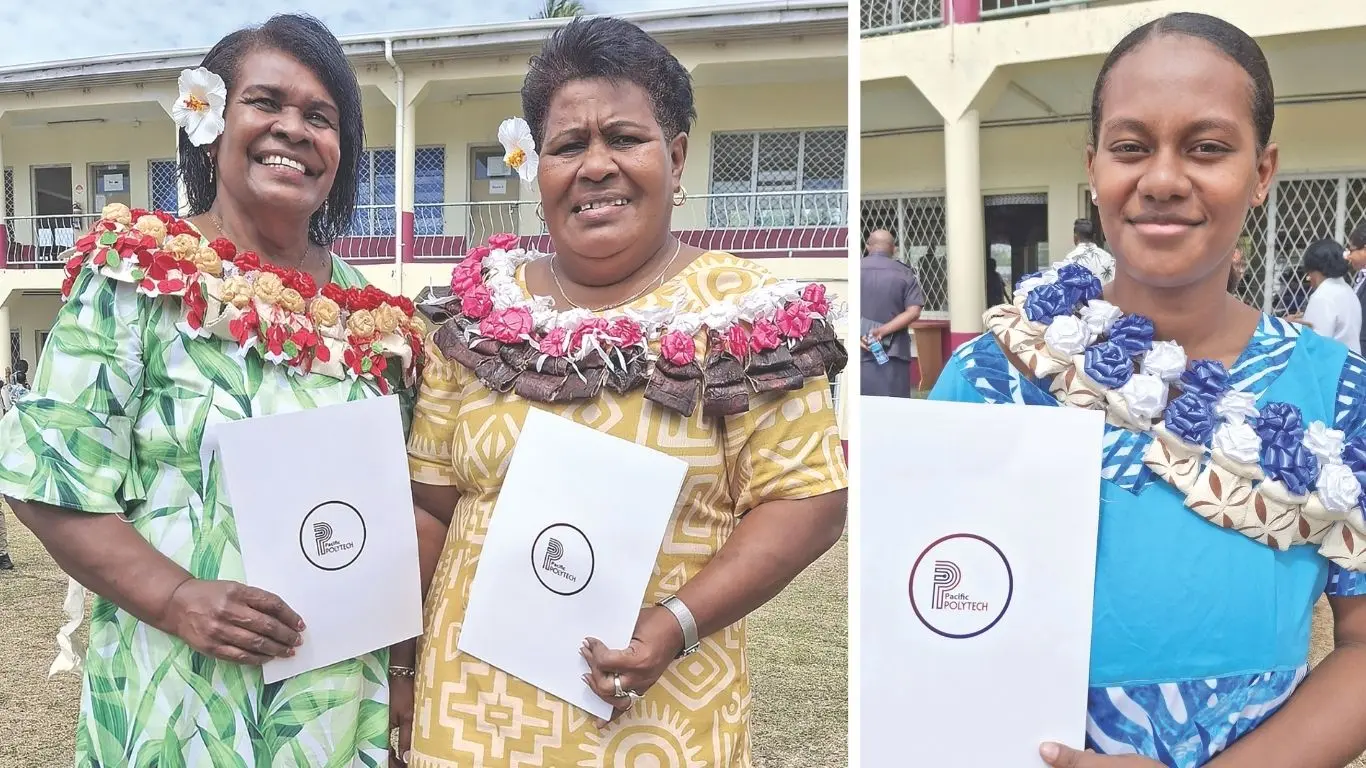
From left: Miriama Tuinawavo, Verenaisi Raditora and Adi Laite Tuvuki after the Pacific Polytech graduation in Tavua on August 7, 2026.
Photos: Mereleki Nai
The stories of three women who graduated from Pacific Polytech in Tavua last Friday deserve more than a passing mention.
They deserve to be seen for what they represent: determination, second chances and the refusal to accept that age, motherhood, geography or gender should decide what a woman can achieve.
Two of the graduates were grandmothers.
Verenaisi Raditora, 52, and Miriama Tuinawavo, 65, completed a National Certificate in Literacy and Numeracy. Both have worked in the tourism industry and both see improved English and literacy skills as a pathway towards better opportunities, including their hope of working overseas.
Their stories challenge a familiar assumption that education is primarily for the young. It is not.
Ms Tuinawavo returned to the classroom at 65 because she believed better English would remove a barrier to her ambition of working overseas. Ms Raditora, who runs a small business in Lautoka, said she had always wanted to improve her English and literacy skills.
Their message is simple: age should not determine when a person stops learning.
Then there is 20-year-old Adi Laite Tuvuki, a young mother from Nalawa in Ra who graduated with a Certificate in Automotive Mechanical Engineering. She was the only female student in her programme.
She travelled daily to Tavua for classes, often returning home late at night, while her husband and mother cared for her baby. She persevered in a field still commonly associated with men.
Her achievement is important not because she is a woman doing “a man’s job”, but because she should never have had to prove that engineering belongs to men in the first place.
Taken together, these stories tell us something important about women in Fiji.
There are women, particularly outside the major urban centres, whose ambitions and abilities can easily go unnoticed.
Some are raising children and grandchildren. Some are working in farms, businesses, hotels and other industries. Others are supporting their families in ways that may never receive public recognition.
Much of this work happens quietly. That does not make it less valuable. What makes these three women particularly inspiring is that they were given an opportunity and chose to seize it.
Pacific Polytech’s free literacy and numeracy programme gave two grandmothers a chance to strengthen skills they believed could open new doors. A technical education programme gave a young mother the opportunity to enter a field in which she was the only woman in her class.
But celebration alone is not enough. The bigger question is how many other women have the ability and determination to succeed but never get the opportunity.
Access to education, information, transport, childcare and appropriate training can make the difference between a person’s potential remaining hidden and that potential becoming a qualification, a career or a business.
This is why these graduation stories matter. They remind us that talent does not have an age limit. Ambition does not disappear with motherhood. And engineering does not come with a gender attached to it.
Fiji should not wait for women to overcome extraordinary obstacles before we notice them. We should create more opportunities for them to be seen, heard, trained and recognised in the first place.
The three women from Tavua have done their part. They stepped forward. Now society must make sure there are many more doors for women to walk through.