Budget 2026–2027: Fiscal consolidation without economic transformation?
Sunday 28 June 2026 | 12:30

Former finance minister says expenditure restraint is necessary but Fiji also needs a strategy to lift productivity, investment and exports.
Introduction
The Hon. Esrom Immanuel, Minister for Finance, delivered Fiji's 2026–2027 National Budget at a time when the country faces important fiscal and economic challenges.
Now every national budget tells two stories, the first story explains how the Government intends to manage public finances over the next twelve months.
Related stories
It outlines how much revenue will be collected, how much will be spent, the expected fiscal deficit, and how that deficit will be financed. In essence, it is the Government's annual financial plan.
The second story is far more important. It explains how the Government intends to build the economy over the next decade. It tells us whether today's spending decisions will strengthen productivity, stimulate investment, diversify exports, create better-paying jobs and ultimately improve the living standards of future generations.
The first story is about managing Government finances; the second is about building the nation's future.
The 2026–2027 Budget tells the first story reasonably well. However, it is less convincing in telling the second.
Unlike many budgets presented during politically sensitive periods, this Budget is neither excessively expansionary nor overtly populist. Instead, it reflects a conscious shift towards fiscal consolidation.
The Minister has correctly recognised that Fiji's public finances have deteriorated significantly over the past decade and that restoring fiscal discipline is now essential.
Rising public debt, persistent fiscal deficits, increasing debt-servicing costs and the growing dominance of recurrent expenditure have steadily reduced the Government's fiscal space and limited its capacity to invest in the productive assets needed for long-term economic growth.
The decision to respond through expenditure restraint ($4,833.4m to $4,869.8m), tighter financial management and improved efficiency is therefore both understandable and economically appropriate.
Indeed, one of the Budget's greatest strengths is its honesty.
Rather than presenting an overly optimistic picture, the Minister openly acknowledges that Government cannot continue financing expanding expenditure through ever-increasing borrowing.
That recognition marks an important departure from the tendency to postpone difficult fiscal decisions. Fiscal consolidation is no longer simply desirable; it has become unavoidable.
However, fiscal sustainability rests on two complementary pillars. The first is expenditure sustainability, while the second is revenue sustainability.
The Budget devotes considerable attention to the first. It presents a detailed strategy for controlling expenditure, improving efficiency and slowing the growth of recurrent spending.
Comparatively less attention is given to the second: the policies required to strengthen Government revenue, both in the short term and, more importantly, over the longer term through higher productivity, stronger investment, expanding exports and sustained economic growth.
This distinction is fundamental.
Governments do not become fiscally sustainable simply by spending less. They become fiscally sustainable when their economies become more productive, more competitive and more capable of generating the revenues needed to finance quality public services without continually increasing debt.
The long-term success of the 2026–2027 Budget will therefore depend not only on how effectively the Government restrains expenditure during the coming financial year, but also on whether it lays the foundations for transforming Fiji into a faster-growing, more productive and more diversified economy over the coming decade.
That is the central question this article seeks to answer.
The Budget Correctly Diagnoses Fiji's Fiscal Challenge
Every successful reform begins with an accurate diagnosis. On this point, the Budget deserves considerable credit. The Minister correctly identifies the major fiscal pressures confronting the country.
Public debt has increased substantially over the past decade. Debt servicing has become one of the fastest-growing components of Government expenditure.
Recurrent expenditure now dominates the national Budget, while the proportion devoted to productive capital investment has gradually declined. These trends have progressively reduced the government's fiscal flexibility and increased the vulnerability of public finances to future economic shocks.
The diagnosis is economically sound. Governments cannot indefinitely finance growing recurrent expenditure through borrowing.
Eventually, interest payments consume increasing shares of public revenue, leaving fewer resources available for investment in infrastructure, education, health and climate resilience. Fiscal consolidation therefore becomes not a policy choice but an economic necessity.
This conclusion is reinforced by the longer-term fiscal indicators shown in Table 1.
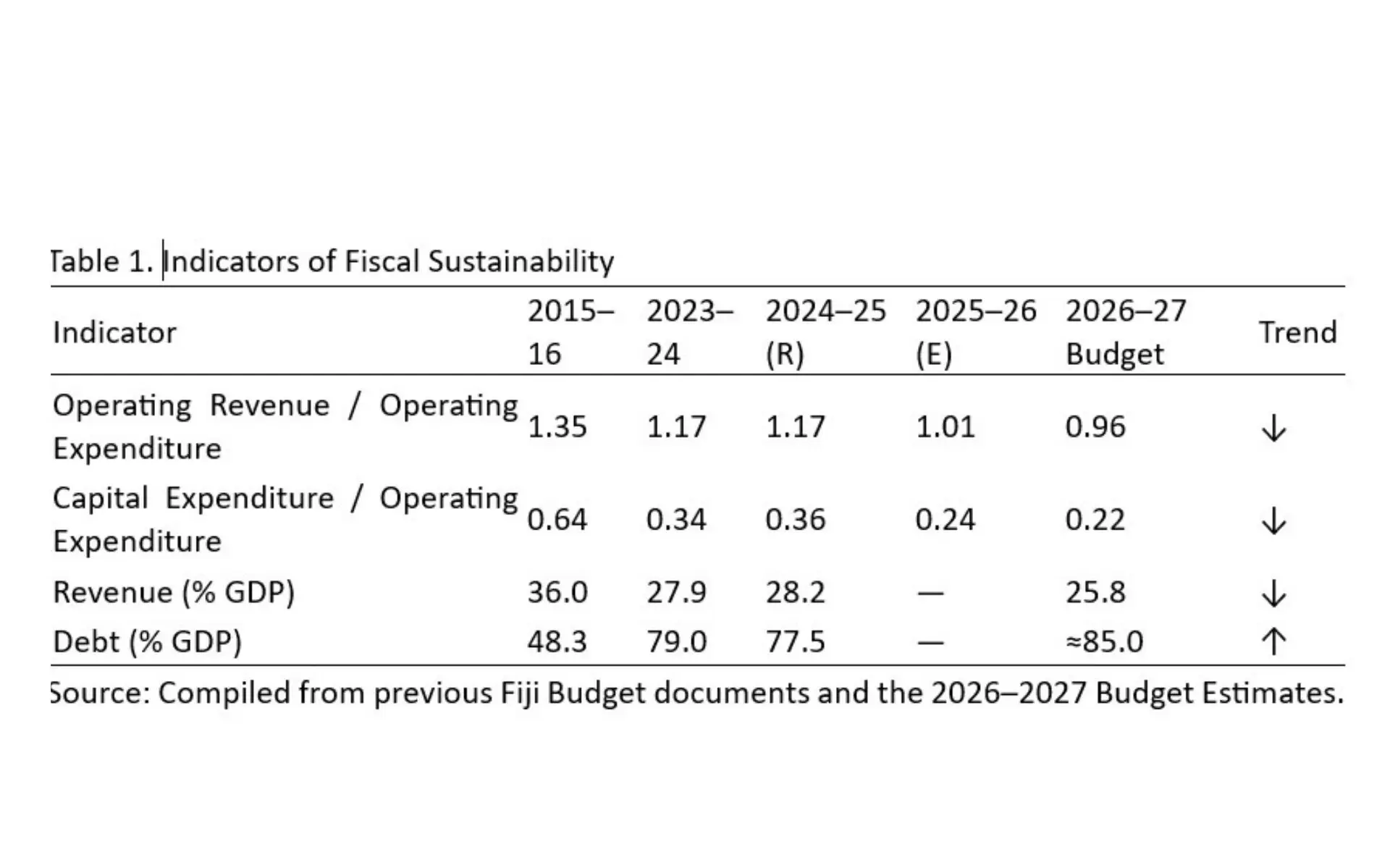
These indicators reveal four important trends.
First, the operating revenue coverage ratio has steadily declined. This is perhaps the single most important indicator of fiscal sustainability because it measures whether the government can finance the cost of running itself from its normal operating income. A decade ago, operating revenue comfortably exceeded operating expenditure.
Today, based on the Budget Estimates, recurrent expenditure is expected to exceed recurrent revenue. This means that the government is increasingly dependent on borrowing or other financing sources to sustain day-to-day operations. That is not a position that can be maintained indefinitely.
This is a historic mistake made by the government, one which could have been easily avoided by a simple spreadsheet exercise. This will send very negative signals to development partners, lenders and investors.
Second, the capital-to-operating expenditure ratio has almost halved. In 2015–16, every dollar spent on recurrent activities was accompanied by approximately sixty-four cents of capital investment. Under the current Budget, that figure has fallen to about twenty-two cents.
This shift has important long-term implications. Capital expenditure builds the productive assets, roads, ports, hospitals, schools, digital infrastructure and water systems, that raise future productivity and economic growth. When capital investment becomes a progressively smaller component of Government expenditure, the economy's future productive capacity grows more slowly.
Third, Government revenue as a proportion of GDP has weakened. With revenue bite declining, we are compounding our revenue shortfall further vis-à-vis the falling output dimension to declining revenue. While we all understand to some extent why we are not able to raise output to an annual growth rate or % in real terms, we have avoided this fundamental question of falling declining revenue bite.
Finally, public debt remains elevated. Although debt accumulation was driven in part by unavoidable external shocks, including the pandemic and natural disasters, the current level of debt inevitably constrains future fiscal policy by increasing debt-servicing costs and reducing fiscal space.
Collectively, these indicators do not justify the Budget's strong emphasis on fiscal consolidation. The only sign is a restraint on total expenditure, but without due consideration to the magnitude of revenue decline.
Fiscal Consolidation vs Economic Transformation
There should be little disagreement with the Minister's decision to place fiscal consolidation at the centre of the 2026–2027 Budget. Given Fiji's current fiscal position, expenditure discipline is not simply desirable; it is unavoidable.
Over the past decade, recurrent expenditure has grown much faster than Government revenue. Public debt has increased significantly, interest payments have become a growing burden on taxpayers, and fiscal space has narrowed considerably. Under these circumstances, restoring discipline to Government finances is both responsible and necessary.
The Budget therefore attempts to provide a comprehensive strategy for managing expenditure. It seeks to restrain operational spending across ministries, rationalise administrative expenditure, tighten recruitment into vacant positions, reduce non-essential expenditure and improve the efficiency of public service delivery.
Collectively, these measures are intended to slow the growth of recurrent expenditure and gradually restore fiscal balance.
From a public finance perspective, this approach is entirely appropriate.
However, fiscal consolidation should never be confused with economic transformation. There are two parts to economic transformation that lead to a rise in revenue for the government.
One is the strategies to extract revenue immediately without stifling growth, and the second is to build productive capacity in the economy to provide sustained growth in the medium to long term, which will provide sustained revenue for the government and improve development indicators.
Reducing expenditure improves the government's financial position, but it does not automatically strengthen the economy. This distinction is fundamental because every government's fiscal position is determined by two complementary forces: expenditure and revenue.
Eighty per cent of the budget address focused on expenditure distribution, and most public discussion following the Budget mostly focuses almost exclusively on expenditure, how much Government intends to spend, which ministries receive additional allocations and where savings have been identified.
Far less attention has been devoted to the second side of the equation, raising revenue for the government and setting up the foundation for long-term, sustained growth and development of the economy.
The pertinent question is, how will Fiji generate the revenue required to sustain public services over the next decade?
This question is considerably more important than whether expenditure grows by one or two percentage points in a particular year.
Governments have only four sustainable mechanisms for improving their fiscal position: (i) they can reduce expenditure; (ii) they can increase taxation; (iii) they can strengthen tax administration and improve compliance; and (iv) they can expand the economy so that Government revenue increases naturally through stronger production, investment, employment and business profitability.
The first three improve Government's balance sheet. While the fourth expands the nation's balance sheet. History demonstrates that successful economies eventually rely primarily on the fourth.
Countries do not become fiscally sustainable because governments continually reduce expenditure. They become fiscally sustainable because their economies become larger, more productive and more competitive.
As businesses invest, exports expand, workers become more productive and household incomes increase, Government revenue grows naturally without increasing tax rates.
Fiscal deficits narrow, debt becomes easier to manage, and Governments acquire greater capacity to invest in education, health, infrastructure and social protection.
Economic growth therefore, performs a dual function; it raises national income as well as strengthens public finances. This relationship is often overlooked in Budget debates. The discussion today was more on managing the economy rather than growing the economy.
Investment Approach
The Budget introduces a number of useful investment incentives. Measures supporting domestic manufacturing, value-added timber processing, workforce development, capital market innovation, indigenous enterprise and selected infrastructure investments should contribute positively to business confidence.
These are sensible initiatives and deserve recognition. However, they remain largely sector-specific interventions rather than components of an integrated national growth strategy.
There is no clearly articulated framework explaining how Fiji intends to raise its long-term potential growth rate from around 3 per cent towards the 5–6 per cent required to substantially increase employment, broaden the tax base and restore stronger fiscal sustainability. This is the critical gap.
The government has failed to grasp the notion that fiscal consolidation creates stability in the short run but economic transformation will contribute to prosperity in the longer run.
This observation should not be interpreted as criticism of the Budget. Rather, it reflects the reality that fiscal consolidation is the first stage of economic reform, not the final destination.
The more difficult challenge now begins. Fiji must build an economy capable of generating significantly higher levels of investment, productivity, exports and innovation.
Only then will Government generate the revenues necessary to permanently strengthen public finances without increasing taxation or relying on continued borrowing. In short, governments cannot cut their way to prosperity. They must grow their way to prosperity.
Raising Growth: Is there a strategy?
The country's fiscal difficulties are not simply the consequence of expenditure growth. They also reflect an economy whose long-term growth potential remains below what is required to finance rising public expectations. The government rightly points to slower economic growth as one of the reasons for weaker revenue performance.
However, the Budget provides relatively limited discussion of how Fiji intends to raise its long-term growth trajectory. This is where future Budgets should evolve.
The debate should gradually move away from a narrow discussion of taxation towards a broader discussion of national wealth creation.
The critical policy question should no longer be: "How do we collect more tax?" Instead, it should become; "How do we create more income, more investment, more exports and more productive businesses from which Government revenue naturally arises?" That is a fundamentally different conversation. It shifts the focus from distributing existing national income to expanding national income.
It moves policy from fiscal management towards economic transformation. In many respects, this is the next frontier of Fiji's economic development.
The Missing Productivity Agenda
The 2026–2027 Budget has correctly begun the process of restoring fiscal discipline, but falls far short of it. The government should mobilise the country, in particular the private sector, to restore the economy's capacity to generate sustained and inclusive growth. That requires a much stronger focus on productivity.
Not productivity within one ministry or within one sector, but rather across the entire economy. Productivity is not merely another economic indicator, but is the engine that drives almost every measure of national progress. Higher productivity enables firms to pay higher wages without becoming less competitive.
It reduces production costs, improves export performance, attracts investment, expands government revenue without increasing tax rates and raises living standards. The Hon Finance Minister should have announced the launch of a National Productivity Movement. Productivity should become a national development objective rather than simply an economic concept.
Government, businesses, educational institutions, state-owned enterprises and civil society should work together to continuously improve efficiency, innovation and value creation.
Each ministry should prepare an annual Productivity Improvement Plan alongside its Budget submission, identifying measurable gains in service delivery and operational efficiency.
Unfortunately, the budget address provided no real strategy for productivity growth in the country.
Building Fiji's Economy for 2035
Annual Budgets should not simply finance the activities of the Government, but rather, should progressively build the economy that the nation aspires to become. Every Budget is, therefore, more than a financial statement, they are a statement of economic intent.
It signals where the Government believes future growth will come from, which industries will be encouraged, what capabilities will be developed and how the country intends to compete in an increasingly complex global economy. Viewed from this perspective, the 2026–2027 Budget is principally concerned with restoring fiscal stability, then examining the growth-generating sectors.
For more than three decades, Fiji's economic performance has depended heavily on tourism, agriculture, household consumption, construction and Government expenditure. These sectors have undoubtedly contributed significantly to national development.
Tourism remains the country's largest foreign exchange earner, while Agriculture has been the catalyst for non-agriculture sector growth. More recently, remittances have become an increasingly important source of household income and foreign exchange. Yet the COVID-19 pandemic demonstrated the risks associated with excessive dependence on sectors beyond our control, such as tourism and remittances.
While the Hon Minister has outlined projects to increase hotel rooms and support our airlines via a Hotel surcharge, our agricultural small and medium entrepreneurs have not received much new support.
Similarly, our blue economy remains one of Fiji's least developed strategic assets. Fisheries, aquaculture, marine biotechnology, ocean-based renewable energy and marine research all possess significant long-term growth potential. As custodians of one of the largest Exclusive Economic Zones in the Pacific, Fiji has opportunities extending well beyond traditional fisheries.
Again, what we see in this budget is more of a budget for managing the economy rather than growing and transforming it.
The Budget also lacks a clear link with the National Development Plan. Rightfully, every major expenditure programme should have measurable performance indicators linked directly to the objectives of the National Development Plan. This would significantly strengthen the relationship between long-term national planning and annual budgeting.
It is through the National Development Plan that we can define where Fiji intends to be by 2035, and the budget provides annual commitment towards those plan objectives.
Concluding remarks
The Budget, therefore, attempts to present a reasonable strategy for managing the Government's finances over the coming financial year. With the historic mistake of not being able to cover its operating expenditure by operating revenue, it has failed to provide a credible message to lenders, development partners and investors about its ability to live within its means.
Furthermore, it was not able to provide a credible proposal to address the worsening case of revenue sustainability and did not provide a compelling strategy for transforming Fiji's long-term growth trajectory. The challenge now is to move beyond fiscal management towards economic transformation.
This transformation requires more than isolated investment incentives. It requires a coherent national growth strategy that mobilises both the public and private sectors around a common vision of higher productivity, greater competitiveness and increased national wealth.
A National Productivity Movement, stronger support for agriculture and the blue economy, accelerated investment in innovation and technology, and deeper integration between annual budgets and the National Development Plan would provide important building blocks for that transformation.
The National Development Plan should become the principal framework guiding every annual Budget. Each major expenditure programme should demonstrate how it contributes to the Plan's strategic objectives through measurable outputs and outcomes.
In this way, annual budgets become more than financial statements; they become annual milestones in achieving Fiji's long-term development aspirations.
Ultimately, history rarely judges budgets by the size of their expenditure or the magnitude of their fiscal deficits. It judges them by whether they changed the direction of a nation's economy.
The true measure of the 2026–2027 Budget will therefore not be whether it succeeds in reducing the fiscal deficit over the next twelve months, but whether it lays the foundations for a stronger, more productive and more resilient Fiji over the coming decade.
Fiscal consolidation may restore stability. Only economic transformation will deliver lasting prosperity.
(Dr Mahendra Reddy is a Senior Fellow at the Graduate School of Business of the University of the South Pacific. The views expressed in this article are his and do not represent those of his employer nor the Fiji Sun.)