We cannot flush away responsibility
A sewage overflow in central Suva exposes a wider problem: our growing failure to take responsibility for the waste we put into drains, waterways and the environment.
Sunday 09 August 2026 | 13:00

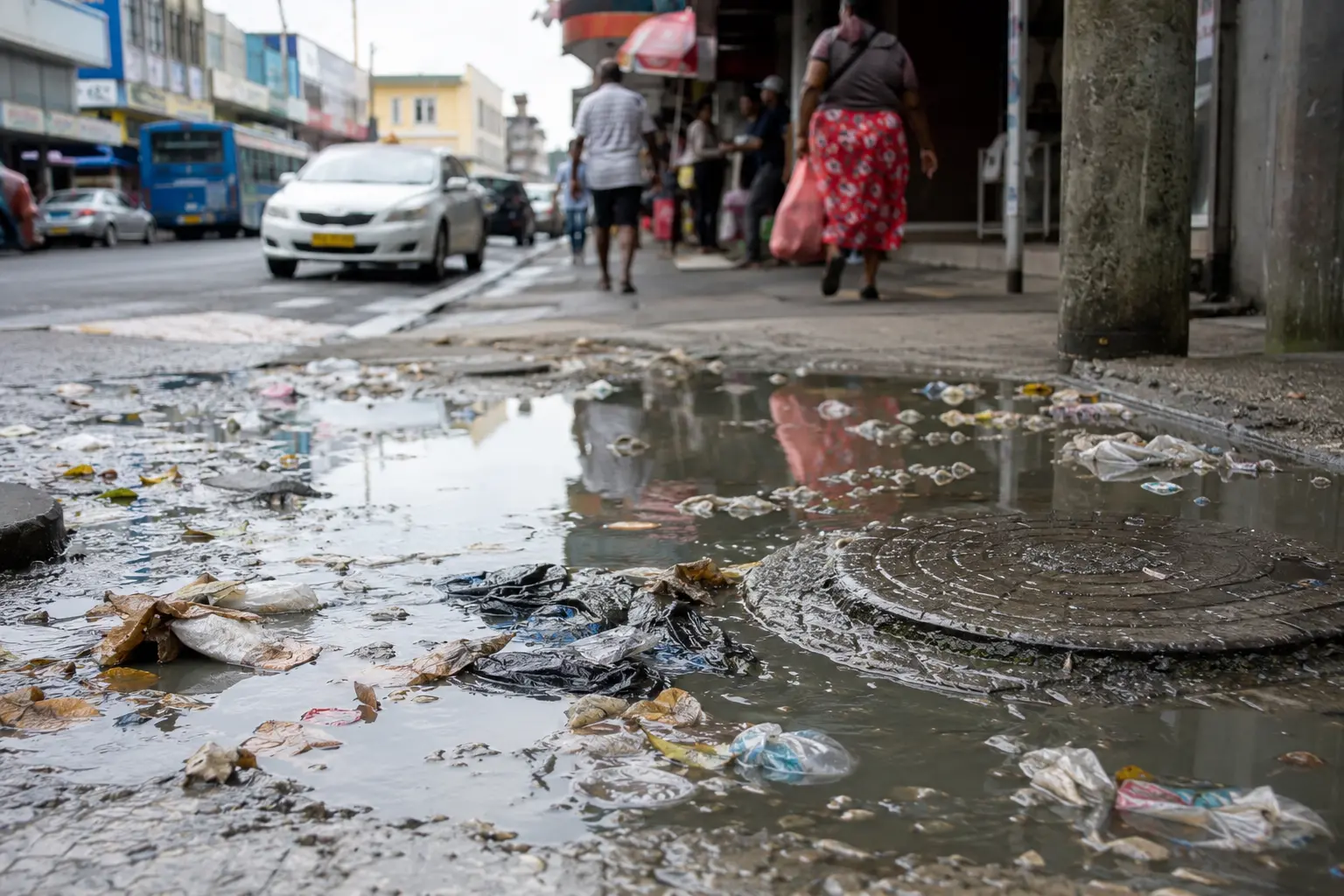
Waste and blocked drainage leave a Suva street awash with dirty water, highlighting the environmental and public health costs of poor waste disposal
There is a distinct, unmistakable odour that clings to the air of a bustling city when its underground veins violently rupture. It is the scent of our collective carelessness a sour, fetid ghost that rises from the concrete and grips the nostrils of everyone within a block.
On the morning of Monday, August 3, the residents and shopkeepers of Cummings Street in Suva were greeted not merely by a public health hazard, but by a stark, visceral lecture on the true cost of convenience.
The Water Authority of Fiji (WAF) responded within hours, isolating the fault, disinfecting the pavement, and issuing a polite, technically precise press release. But while WAF’s words were professional and measured, the foul sludge glistening on the footpath was screaming a far more profound and unsettling truth.
Related stories
According to the official statement, the culprit was a pump failure at the Robertson Road Pump Station. Let us strip away the engineering jargon, however, and look at the raw facts. The pumpdid not fail because of a mechanical defect, a power surge, or a design flaw. It choked. Its delicate control float switches became fatally entangled with a grotesque cocktail of “plastic bags, rags, wet wipes, clothing, and similar non-flushable items.”
The Robertson and Pratt Street stations; built and designed specifically to handle the natural byproducts of human biology, were instead force-fed the debris of our modern, lazy consumerism. This was a blockage caused not by a broken machine, but by our own collective, malfunctioning conscience.
Yet, this scourge does not confine itself to Suva’s commercial heart. It has quietly metastasized into a national epidemic, creeping far beyond the reach of WAF’s pipes. This urban problem has entered our rural areas.
Once-pristine rivers and streams, untouched by municipal plumbing, are now choked with poorly managed urban shopping refuse diapers, noodle wrappers, and red capped Paraquat plastic bottles bob merrily downstream, their toxic leaks silently killing fish, crabs, and prawns along the way.
Tragic outcome
Deforestation strips the banks of their natural filters, allowing silt to smother spawning grounds. What is the human cost of this rural neglect? At least one tragic outcome is already visible: children in these communities presenting with a new, foul smelling type of scabies on the crown of their heads a heartbreaking mirror of the filth on Cummings Street.
If we repeatedly harp about climate change and environmental stewardship to the global community to secure funding, we must remember that climate resilience starts in our own backyards, not merely in the boardrooms of international donors.
Despite the obvious crisis, our civic machinery remains paralyzed. It is a simmering public frustration that WAF sent draft regulations to empower prosecution to the government’s drafting office years ago and they have yet to see the light of day. Without these teeth, WAF can only respond, clean up, and plead. Meanwhile, Greig Street suffers even more frequently than Cummings, a testament to the sheer volume of abuse our infrastructure endures.
Zero tolerance
Stronger laws, zero-tolerance policies, and even serious discussions about privatization to upgrade our aging, decades-old networks are urgently needed. But laws mean nothing without prosecution, and prosecution means nothing without a public that is willing to be held accountable.
In this vacuum of enforcement, engineers rightly call for trench-less tech to avoid digging up our potholed roadsides—gadgets we envy in strict Singapore, with its zero-tolerance fines and advanced offshore landfills. Yet an unavoidable paradox remains even Singapore’s reverse osmosis fails if fed rags.
No robot can outsmart a daily avalanche of wet wipes. Before we spend millions on shiny technology, we must first buy into accountability; you simply cannot out engineer a culture that refuses to own its waste.
The refusal to own our waste carries visceral, tangible consequences that bleed directly into our economy and our health. Blocked drains breed vermin and disease, threatening the sanitary safety of our city centre eateries, our cart vendors, and our open markets.
The constant, costly clean-up operations divert valuable operational resources away from essential maintenance and badly needed infrastructure expansion across the country.
We demand that WAF fix the pump; we demand that our urban councils clean the streets; we demand clean water and reliable sewage services. Yet, we are unwilling to pay the moral price of that reliability by being conscious consumers.
We want the convenience of a flush without the slightest responsibility for what goes into it. We treat our plumbing, and by extension our environment, as a magical void. We flush and we forget. We assume that the moment an item disappears from our sight, it ceases to exist. But of course, it never does. It travels—to the pipes beneath our feet, to the pumps that labour tirelessly to keep our cities habitable, and eventually, to the rivers and oceans that sustain our very existence.
Nature retaliation
We operate under the delusion that nature has no recourse. We take from the earth, and we give back waste, expecting this transaction to remain perpetually one-way. But nature; as the sticky, brown mess on Cummings Street proves, does not suffer fools gladly. It has a way of returning our gifts. It speaks in the only language we seem to understand: the language of repugnant smell, of disrupted commerce, and of costly public health crises.
This is nature’s retaliation. It is not a meteor strike; it is far more insidious. It is sewage bubbling onto sidewalks because our pipes are too clogged with our “out of sight, out of mind” mentality.
Respect, in the end, must be mutual. We cannot expect the environment to absorb our waste indefinitely while we continue to treat it with impunity. The overflowing manhole on Cummings Street is not just a municipal issue; it is a mirror.
It reflects our collective unwillingness to be held accountable for the hidden consequences of our daily bad habits. If we continue down this path, the retaliation will only worsen.
The smell will linger longer, the floods will become more frequent, and the clean-up costs will drain the very resources we desperately need to build a resilient future for our next generation.
We have a choice. We can either look at that overflowing pipe and see a mere inconvenience, or we can see a glaring, hard-to-ignore warning. The pipes are crying out; the rivers are churning; our children’s health is paying the price. It is high time we stopped burying our heads in the sand—and finally listened.
Feedback: editorial@fijisun.com.fj