COP30 – COP31 – Will the Pacific deliver?
The Pacific’s leaders were unanimous in Honiara – the world was failing the Pacific.
Thursday 30 October 2025 | 06:00
Updated 03 November 2025 | 15:20 FJT
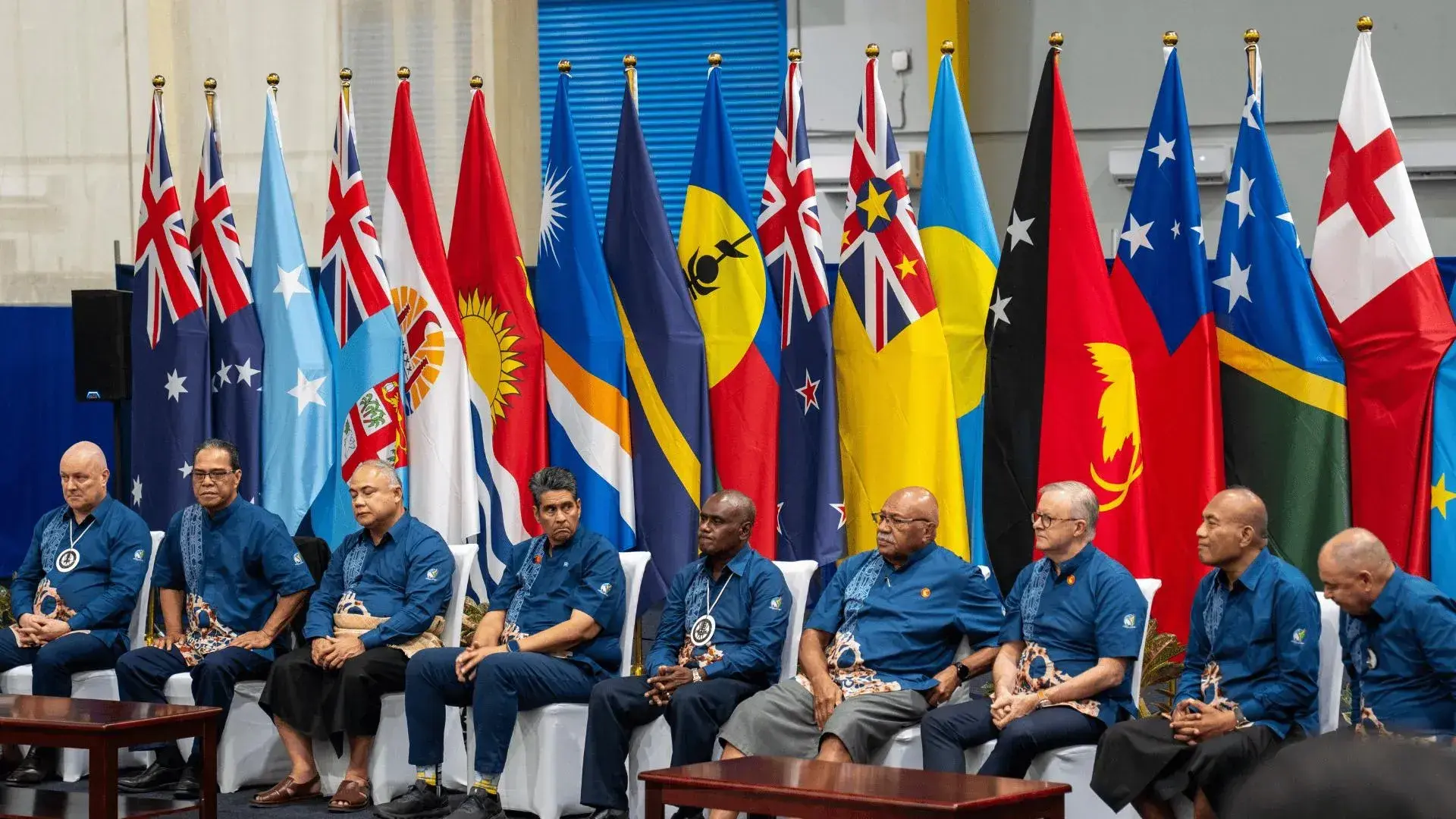
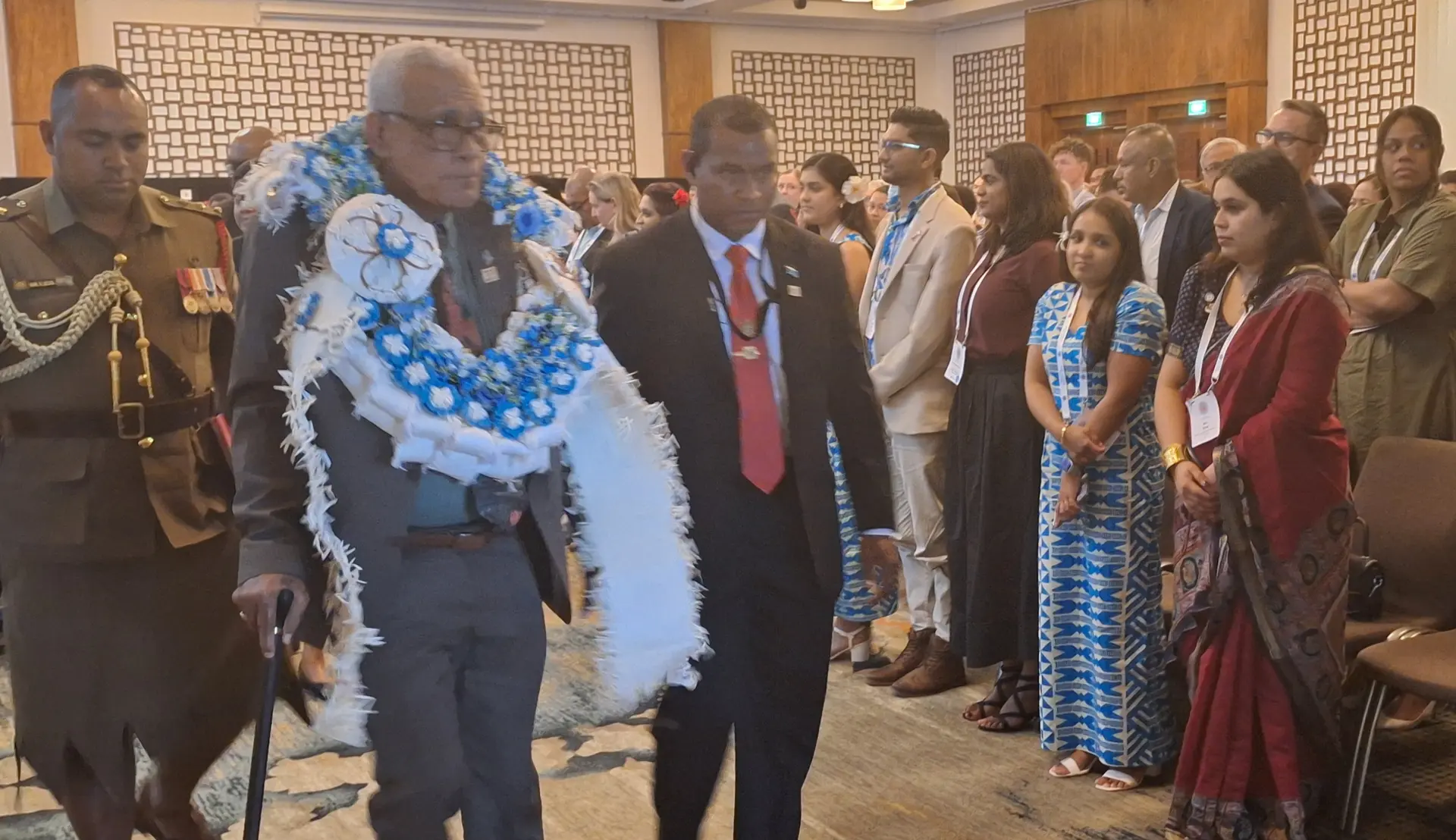
Leaders at the 54th Pacific Islands Forum Leaders’ Meeting in Solomon Islands.
Photo: Pacific Security College
As Pacific’s leaders and civil society prepare for the United Nations Climate Conference in Brazil (COP30), they also need to keep a line of sight to the subsequent COP31.
The Blue Pacific’s leaders were clear at the recently concluded Pacific Islands Forum Meeting in Honiara.
They want to speed up implementation of adaptation and mitigation programmes. But they said that finance and knowhow remain their binding constraints.
The Pacific’s leaders were unanimous in Honiara – the world was failing the Pacific.
A $1 billion plus infrastructure deficit
Pacific’s leaders spoke about their infrastructure deficit. The region today needs well in excess of $500 million annually to maintain its human and physical infrastructure in the face of rising seas and fiercer storms.
There are over 1000 primary and secondary schools, dozens of health centres across coastal areas in Solomon Islands, PNG, Vanuatu and Fiji that need to be repaired rehabilitated or relocated.
The region needs a additional $300-500 million annually for a decade to build and climate proof critical infrastructure – airports, wharves, jetties, water and electricity and telecommunications. The Blue Pacific’s infrastructure distress is a cocktail that poisons our human development progress. This has lethal consequences for our elderly, for children and the most vulnerable.
As a region, we often fail to tell the World with sufficient clarity that our region’s infrastructure distress is fundamentally and quintessentially a climate distress. This must change.
The constant cycle of catastrophe, recovery and debt are on autoplay repeat. The heart-braking images coming out of Jamaica and the Caribbean in the wake of Hurricane Mellissa makes this same point.
It does make our blood boil that the Pacific as a region attracts a woefully insufficient share of existing climate finance. Less than 1.5 percent of the total climate finances reaches the World’s most climate vulnerable region today. This is almost criminal.
Is our planet headed for a 3.0 celsius world?
At COP30, the World will see what the new climate commitments (NDC’s) add up to. Our best estimates today suggest that the planet is headed for a 3.0 Celsius plus temperature rise. Anything above 1.5 Celsius will be catastrophic for the Blue Pacific. That is where the line must be held.
Life across our coral reef systems will simply roast at 3.0 Celsius temperature increase. The regions economic lifeline and its food security will be harmed irreparably. This will have massive consequences for tourism dependent economies. Bleached reefs bleach tourism incomes.
The health consequences arising from climate change are set to worsen rapidly. As will the toll on children who will fall further behind in their learning as schools remain inaccessible for longer periods; or children spend long hours in hotter classrooms.
For Pacific’s women, the toll of runaway temperature increase will be heavy – on their health, on their livelihoods and on their security. It will be too heavy.
A deal for the Pacific at COP30
The World of climate change is becoming transactional. Short termism and deal making have become its norm.
As Pacific Leaders, its civil society, its science community and its young engage at COP30 in Brazil, they are reminded that the Blue Pacific needs more than anything else, a settled outlook climate finance that will be available to the region. Finance must be foremostly predictable.
The region should not feel like it is playing a lottery – as is the case today. Tonga must know broadly how much climate finance will be available to it over the next 5 years and so must PNG.
At Bele’m, the World will need to agree to a road map for how the climate financing short fall will be met. This is a must to restore trust and faith in the global process.
The weight on the shoulders of hosts Brazil is extraordinarily heavy. Brazil is the home of the famous Rio Conference in 1992 where the small island states first succeeded in placing climate change, biodiversity loss on the global agenda.
The Small Islands States grouping today is chaired by Palau. H.E. President Whipps Jnr will lead the islands to Brazil. He will no doubt remind the host that the World has failed the small states persistently since that moment of great hope at the Rio Conference in 1992.
Pace of Climate Finance
There are three principal reasons why climate finance must flow to the Pacific at speed. First, is that most countries in our region have less than a decade to adapt. Farms and family gardens, small businesses, tourist resorts, villages and livelihoods need to adapt now to meet a climate changed world.
Secondly, if adaptation is pushed into the future because of woefully insufficient finances – the window to adapt will close.
As more sectors of our economy fall beyond rehabilitation, the costs of loss and damage will rise. Time is of the essence. And on top of that Loss and Damage remains poorly funded. This too much change.
Everything for the Blue Pacific rests on a decent outcome on financing. The region needs to make its clearest argument that its share of climate finance must be ring-fenced. That is a share of climate finance that remains available to the region even if demand is slow to take shape.
The Pacific’s rightful share of climate finance over the next decade is between 3-5 percent of the total across all financing windows. This is fundamentally because based the adaptation window is so short in such a uniquely specific way.
This should mean that the Blue Pacific has access to a floor of $1.5 billion (USD) annually through to 2035.
Beyond Bele’m
COP30 in Brazil is an opportunity for the Pacific to begin to frame a larger consensus – well in time for COP31. It is my hope that Australia and Pacific’s leaders will have done enough to secure the hosting rights for COP31.
A “Circuit-Breaker” COP31
COP31 must “a circuit breaker moment” for the Blue Pacific. The reversals in our development story arising from the climate chaos have become too burdensome. Repeated recoveries means that every next recovery becomes that much harder.
Ask anyone in Jamaica and Caribbean today and you will hear this same message. Their finance ministers know too well that in no time they will be back at the mercy of international financial institutions to rebuild roads and bridges that have been washed away and water systems that have been destroyed by Hurricane Melissa.
Climate finance by its very nature therefore must involve deep changes to the architecture of international development and finance. The rich world is not yet ready to let go of privilege and power that it wields through an archaic financial international system.
But fundamental reform is a must. Fundamental reform is necessary if small states are to reclaim agency and begin to drive own destinies.
Future proofing our societies
Climate change erodes memories. It disrupts spiritual connections to land and oceans. It hurts our past. Equally, it threatens our future as geographically bounded communities, as viable states and as viable communities. We don’t talk about these enough.
The risks arising from climate change are so multi-faceted that economic, social and political stability cannot no longer be taken for granted.
Conflicts over land lost to rising seas, the strain on education, health and water infrastructure, deepening debt stress take their toll on institutions through which stability is maintained in our societies.
The Blue Pacific needs to work with this elevated risk of fragility and state failure. This reality must shape the Blue Pacific expectations from a Pacific COP.
Building on the excellent work underway in climate ministries in Fiji, Vanuatu, Samoa, PNG and across the region through the SPC, SPREP, OPOC, I have outlined what the Pacific’s expectations could be from a Pacific COP31.
COP31 must be about transformation and impact. The Blue Pacific’s leaders should seek a consensus that includes both the the rich industrial World and large developing countries such as China and India in support of a Pacific Package.
A Pacific COP 31 Package
The core elements of a Pacific package at COP31 are:
(i) Ensuring that the Loss and Damage Fund has become fully operational with a pipeline of investment ready projects from across the Blue Pacific.
(ii) Securing the Pacific Regional Infrastructure Facility (PRIF) as a fully funded and disbursement ready financing facility.
(iii) Securing defined and ring-fenced climate finance allocations for the Blue Pacific at the Green Climate Fund (GCF) and across international financial institutions.
(iv) Securing support for “lighthouse” multi-country (or region wide) transformative programs to advance marine protection, protect biodiversity and promote sustainability across the Blue Pacific Ocean.
(v) A COP decision that is unambiguous on quality and speed of climate and ocean finance that will be available to small states for the remainder of the decade.
(vi) Securing sufficient resources that can flow directly to communities and families to rapidly rebuild their resilience following disasters and catastrophes including through insurance and social protection vehicles.
(vii) Ensuring that knowhow, resources and mechanisms for disaster risk reduction are in place, are fully operational and are sustainable.
An Ocean of Peace for a climate changed world
Fiji’s Prime Minister, Hon Sitiveni Rabuka has introduced to the PIF the concept of the Blue Pacific Ocean of Peace. This has far reaching consequences for regions climate diplomacy.
The Pacific’s leaders accept that the Ocean of Peace anchors its stewardship of our marine environment to the highest principles of protection and conservation. An Ocean of Peace super-charges the Pacific’s efforts to take forward transboundary marine research and conservation, end plastic and harmful waste disposal, end harmful fisheries subsidies and decarbonise shipping.
It powerfully boosts the Pacific’s efforts to main-frame the ocean-climate nexus into the international climate change frameworks at COP30.
A window of hope
Between COP30 and COP31 lies a rare window of hope. The Blue Pacific must leverage this.
Both a Brazilian and an Australian Presidency offer supportive back-to-back opportunities and space to take forward the regions desire to project a solid foundation of programmes that are necessary to secure its future. Uniquely the ball may be in the Pacific’s court on how successfully we can harness this rare moment.
(Dr Satyendra Prasad is Non-Resident Senior Fellow at the Carnegie Endowment for International Peace and Fiji’s Former Ambassador to the UN. He is also the Climate Lead for Abt Global)