Editorial: Congenital Heart Defect, A Topic Worth Discussing
“We must advocate for increased research and funding to improve early detection and provide treatment options with long-term care for individuals living with these conditions.”
Tuesday 06 February 2024 | 11:55
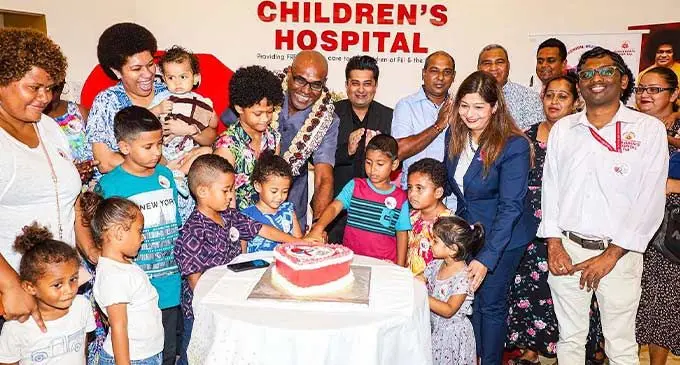
Minister for Health and Medical Services Dr Ratu Atonio Lalabalavu (garland), with children and Sai Prema Foundation Hospital representatives during the Congenital Heart Defect Awareness Week celebrations on February 5, 2024. Photo: Ministry of Health & Services Media
Let’s take a minute or two to remember the loved ones we’ve lost as a result of congenital heart defects (CHD).
This heart condition affects children at birth and is the most common birth defect among infants.
But with new and improved medical technology, there is more hope for our children to live longer if the defects are detected early.
Related stories
And its thanks to the Sai Prema Heart Foundation for enabling 260 children (as at December 2023) to undergo free successful surgeries that’s giving patients and parents alike, hope for the future.
The Sri Sathya Sai Sanjeevani Children’s Hospital in Nasese, Suva, stands as a beacon of hope for children since the hospital was inaugurated in 2022.
And while hospital is reliably managed by a foundation with thirst to help children, we know that its funders alone cannot do it alone given the cost of conducting surgeries for free and maintaining the hospital.
Yesterday, Government formalised a $4 million grant to the Sai Prema Foundation Fiji to support the work that they do.

Paid Advertisement | February 2024
Minister for Health and Medical Services Dr Ratu Atonio Lalabalavu rightly said that before the hospital, no treatments were readily available in the country.
It was either through medical visitations by specialised doctors or patients had to receive treatment overseas.
The entire procedure would cost as high as $100,000, which was a big ask for families, especially those from grassroots level and even the working class.
With no insurance and savings, it would have been hard for parents and guardians to see their loved-one’s health decline.
Government’s commitment to the foundation yesterday has secured hope for the future of the foundation.
It is also in the hope that more awareness can be created.
“It is crucial that we, as a society, work to raise awareness and support those affected by congenital heart defects,” he said.
“We must advocate for increased research and funding to improve early detection and provide treatment options with long-term care for individuals living with these conditions.”
The grant and call to action is timely given that this week (between February 7-14) is Congenital Heart Defect Awareness Week.
Some facts from Centres for Disease Control and Prevention:
- CHDs can vary from mild (such as a small hole in the heart) to severe (such as missing or poorly formed parts of the heart).
Some defects might have few or no signs or symptoms. Others might cause a baby to have the following symptoms:
- Blue-tinted nails or lips
- Fast or troubled breathing
- Tiredness when feeding
- Sleepiness
The causes of CHDs among most babies are unknown. Some babies have heart defects because of changes in their individual genes or chromosomes.
CHDs also are thought to be caused by a combination of genes and other factors, such as things in the environment, the mother’s diet, the mother’s health conditions, or the mother’s medication use during pregnancy.
This week, let’s take a moment to dig deeper and raise awareness on this heart condition to ensure that you and your loved ones make informed decisions.
Feedback: ranobab@fijisun.com.fj








