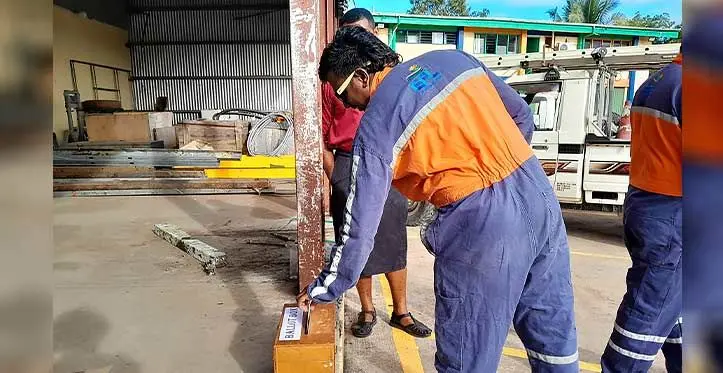
EFL workers cast their vote at the Labasa depot on June 4, 2023. Photo: Jone Salusalu
Fiji's economy rests in the hands of the Energy Fiji Limited employees who have and will be casting their votes.
This is concerning an industrial action initiated by their union, the Construction Energy and Timber Workers Union of Fiji (CETWUF).
As more decide in the upcoming days whether to vote in favour of the industrial action or otherwise, the magnitude of their decision goes well and beyond the secret ballot.
Related stories
Literally the whole of Fiji - businesses across the country, essential Government services such as hospitals and health centres, and even the works of the Water Authority of Fiji (WAF) - could be impacted should this vote turn in the workers' favour.
The union's general secretary, John Paul, says the union now represents more than 400 members, and is increasing by the day.
If this number is anything to go by then buckle up Fiji, because we just may have a crisis on our hands.
The union argues that their members' log of claims (LOC) have not been met by EFL, claiming that they have been seeking dialogue with favourable outcomes but to no avail.
Instead, they say that the recent five per cent increment announcement by EFL was not consulted through the union.
EFL has, since 2018, given 23 per cent increment to its employees in non-management positions. This is on top of the annual bonuses.
In contrast, the union argues that between 2020 and 2023 their request for increment, totalling 45 per cent excluding other essential demands have not been met.
Whether EFL's justification and the union's argument are valid, that is for them and the stakeholders, including the Ministry of Employment and Industrial Relations to decide.
Should the vote to strike goes ahead then people's livelihood and some their lives, hang in a balance. It is crucial for the union and employer to recognise the broader social responsibility they bear.
By engaging in constructive dialogue and seeking amicable solutions, they can ensure that the interests of workers are protected while also maintaining the continuity of this vital service.
Collaboration between the two parties can be fostered through several key measures.
Firstly, both parties should prioritise open and transparent communication channels.
Regular dialogue enables the identification of common objectives and shared challenges.
By engaging in honest and respectful conversations, unions and employers can bridge the gap and find mutually agreeable solutions.
Feedback: ranobab@fijisun.com.fj








