Ministerial Statement: Marking 139 Years Since The First Girmitiyas Arrived
-
Tuesday 15 May 2018 | 11:00
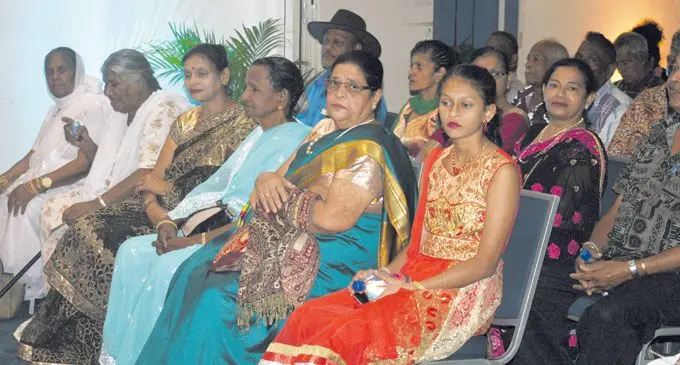
Girimitiya descendants at the ‘Remembering Fiji’s Girmit Heritage’ celebrations at Albert park on May 14,2018.Photo:Simione Haravanua.
Madam Speaker, I rise this morning to give a ministerial statement on this very significant day in Fijian history.
Today marks the anniversary of two major events in Fiji; most importantly, it is the 139th anniversary of the arrival of the first ship that carried indentured labourers from British India to Fiji.
Secondly, it is also 31 years to the day of one of the most traumatic and devastating moments in Fijian history, Fiji’s first military coup which was carried out by the current leader of SODELPA, Sitiveni Ligamamada Rabuka, in May of 1987, in this very Parliament where he discharged his firearms in that corner over there (pointing to ceiling), and herded Dr Bavadra and his government into trucks to be incarcerated.
Related stories
Madam Speaker, of course, one could say that we had our first constitutional coup prior to that, when a minority leader in Government was sworn in as Prime Minister before the leader of the then NFP Siddiq Koya went to get sworn in. Perhaps, there was some talk of being backstabbed by the gang of three.
Significance of the date
Madam Speaker, clearly, however, the date of 14 May represents a tragic and cruel reality. Because it does not only commemorate the beginning of the tremendous contribution that indentured labourers, or the girmitiyas, and their descendants have made in building the Fiji we know today.
On this day, we must also reckon with the lasting damage and division caused by the 1987 coup. Because due to the actions of Rabuka, 14 May marks a day that led tens of thousands of Fijians to flee our shores because they – as descendants of the girmitiyas – were made to feel unwelcome, like strangers in their own home, in their own country, as our country was driven back into an oppressive, divisive and destructive past.
Some may say it was a coincidence that the ‘87 coup fell on an anniversary of such historic importance for so many Fijians, others may say it was deliberate. And indeed, if you read his accounts of the ‘87 events, you would say it is deliberate.
Regardless, it has certainly marred and added a twist to what should solely be a solemn and respectful commemoration and indeed celebration of the arrival of that first ship, Leonidas, to bring women, men and children from British India here to Fiji.
So today, Madam Speaker, let us give that historic arrival of the first girmitiyas vessel the importance it merits; let us look back on the moment the girmitiyas first came to our country after travelling under inhumane, difficult and degrading conditions. Let us give the girmitiyas the recognition they deserve, pay tribute to their stories their struggles, their sacrifice, and, ultimately, their triumph and their magnificent contribution to the building of our nation.
Under the British indenture system
Madam Speaker, under the British indenture system, hundreds of thousands, if not millions of people from British India were transported across the world in small, crowded ships in the harshest of conditions, like the Africans who were shipped to the USA and the Caribbean.
Many taken from their families under false pretences with promises of milk and honey around the corner, and some, six months later, landed here in Fiji. No consent was sought from anybody, including the indigenous population then, anywhere, including in Fiji.
It was a decision made by the British colonisers alone to bring them to Fiji, and it was up to no one except the British. And after up to four months or six months at sea, the girmitiyas were herded into cramped living quarters known as “coolie lines”.
While living there, they cleared land, they built roads, and they toiled in the cane fields, and cotton fields and other fields under the crack of the overseer’s whip.
There are many accounts that exist from those early days. They tell of exploitation, they tell of mistreatment, they tell of routine and brutal beatings, they tell of rape and they tell of the excruciating hours of work, the pain, the suffering and the loneliness and the isolation of these girmitiyas.
They don’t make for easy reading. In fact those accounts tell of a harsh and demanding existence, and it is no surprise, tragically, that the rates of suicide among the indentured labourers was exceptionally high, along with high rates of disease and infection that claimed countless lives.
Madam Speaker, almost two years back, we heard many of the first-hand accounts from girmitiyas read aloud during our commemoration of the centennial of the arrival of the Sutlej Five, the final ship carrying indentured labourers to Fiji in 1916, thanks to Dr Ahmed Ali who actually interviewed these girmitiyas.
We heard the stories of girmitiyas in Fiji; the stories of Lakhpat, Abdul Aziz, Mahadeo, Mahabir, Lotan, and Pancham, all who were brought and made to work here in our country, and whose descendants live among us today. It was an important and emotional and indeed educational ceremony that this Government organised. We heard from many in attendance, who attended these functions, that, up until then, they did not fully understand the hardship those girmitiyas faced in the early days.
They did not know of that brutal chapter in Fijian history. And, of course, Madam Speaker we will be commemorating in a big way the 140 years of the arrival of the girmitiyas next year.
Another fact that some may not know is that many indentured labourers who, because of the harsh conditions, sought to escape from their overseers actually took refuge in iTaukei villages. This happened to such an extent that the British had to make a law banning villagers from hiding escaped girmitiyas and in fact if you check the Ordinances you will find that. The Colonial’s separation of course began then: it was illegal, in fact, to give refuge to a runaway girmitiya.
Indeed Madam Speaker, this lack of knowledge stems from the fact that the girmitiyas’ experience has been very much marginalised from the national narrative. Indeed Madam Speaker, one of probably the most honest intellectual academics in USP, Simione Durutalo, who unfortunately is not here with us, very poignantly highlighted that the bringing of the indentured labourers into Fiji helped buffer the indigenous population from the exploitation that actually took place in other countries by the Colonial powers.
Ethnicity and politics
And, somewhat ironically, because of the politicisation of their ethnicity, was subsequently seen as the greatest threat to their survival. Of course Madam Speaker, this is because of the fact many of these politicians still continue with that way of thinking, that our dynamics and politics is predicated on ethnicity.
They, of course, need to rid their minds of the colonial way of thinking, Madam Speaker.
Madam Speaker, and as highlighted, unfortunately, Fiji was subject to colonial social engineering, designed to keep the Indo-Fijians and the iTaukei separate, and even turn both groups against each other. And the consequences of those practices and policies led to over a century of exclusion for Indo-Fijians, even after the Girmit era ended.
Though they lived in Fiji, though they worked for Fiji and though they did their part – and more – in making Fiji stronger, the girmitiyas and their descendants remained on the margins of our society. They were seen as separate, even after generations in Fiji, they were seen as outsiders. They suffered under old colonial systems of oppression, their voices were silenced, and they felt unsafe in their own country, in the country of their birth, under discriminatory laws and policies of past Governments in Fiji.
But despite that great adversity, those indentured labourers always held onto the dream that, one day, their children, and their children’s children would find a better life in this country. That one day their voices would be heard equally and that one day, Fiji would truly become their home and could be called and considered their home.
Even a century ago, advocates in the Girmit community made very clear that all they wanted was equality, all they wanted was an equal voice and equal stake in our national life.
This was put by the famed advocate of common franchise, S.B. Patel, when he said: “All we want is the recognition of the principle of common and equal rights. We should not mind if we had only 100 Indian voters, provided we had a common franchise. We should not even mind if a European represented us, so long as he was elected on a common ticket.”
In other words, one man, one vote in those days because women were not allowed to vote until 1963 in Fiji.
Another advocate, Pundit Vishnu Deo, was one of the three Indo-Fijians allowed to be elected to the Legislative Council, and he moved a motion calling for common and equal citizenry back in 1929. The motion was defeated, and Mr Deo walked out of the Parliament with the other Indo-Fijian members, and when the next nominations were called to fill those Legislative Council vacancies, in a very powerful statement of national solidarity, no such nominations were made, right up to World War II.
In fact, in the early years it was the Federation Party, which later became the National Federation Party, that once championed those calls for a common roll and the one principle: common and equal citizenry and, indeed, a common name. A fact that many of our young people may not know, given that the NFP of today has fallen so far from the principles of its founders.
They even have hesitation in having all our citizens being called Fijians, they still struggle with that today.
It was an NFP Leader A.D. Patel, a principled leader, a leader with foresight and indeed a visionary and a resolute opponent of communal politics, who said that Fijian Independence should not move forward until there was common and equal citizenship, an equal voting system, that treated every Fijian citizen equally.
So, Madam Speaker, the dream for common and equal citizenry in Fiji had been a dream deferred for more than a century, until this Government finally made it happen. Until this Government realised the dreams of A.D. Patel, S.B. Patel, Pundit Vishnu Deo and all those indentured labourers brought to our shores those many years ago, along with their descendants.
So it really is cruel, Madam Speaker, that on this day meant to honour the dreams and legacy of those proud Fijian years ago, along with their descendants.
So it really is cruel, Madam Speaker, that on this day meant to honour the dreams and legacy of those proud Fijians, in 1987, SODELPA’s current leader chose to carry out the first military coup in Fiji, throwing this country into the throes of chaos and delivering a devastating blow to the campaign of justice and equality for all Fijians. Irrespective of ethnicity, gender, province, Madam Speaker.
Post-coup consequences
On May 14, 1987, Rabuka (the leader of SODELPA) ripped apart the social and political fabric of our nation, triggering the most disastrous political era in Fijian history.
His actions drove tens of thousands of our people away from our shores – many of our best and brightest – and, under his leadership, that day brought about nearly two decades of institutionalised racial supremacy and indeed ingrained provincialism through the 1990 and 1997 constitutions.
Where many of our people were treated as second-class citizens. It was not only bad for inter-ethnic injustice or relationships, but within the ethnic groups themselves, in other words obfuscating the injustices of the groups within those ethnic groups as well.
Because of that coup, innocent people were taken hostage, beaten, and threatened with their lives.
The media was actually not free then, and the Fiji Sun was actually burnt to the ground in Lami, as some would know, and it would appear some on the other side want that to happen today too, Madam Speaker.
There were attacks on places of worship, and high-ranking and senior civil servants were forcefully removed from their positions because they were Indo-Fijian, not because of lack of merit or capability. There is footage of Indo-Fijians crawling under cars to escape being attacked, as violence spread across the country, racial violence and attacks, some organised, some random and opportunistic.
It was hell on earth, it was chaos, and anyone who lived through that time can tell you what happened.
Madam Speaker, that coup wasn’t some momentary, impassioned action. It was an intentional attack on preserving the position of the elites but predicated on ethnicity. And, of course, we know what happened after that, Rabuka introduced a racist political and social structure in Fiji, beginning nearly two decades of divisive policies, entrenched provincialism, and ethnic discrimination.
Nearly two decades of corruption, reckless financial management, that cost us our only national bank, the National Bank of Fiji. And nearly two decades of Fiji falling behind the rest of the world.
That dark period only came to a real end under the Bainimarama Government, when finally this Government said: enough is enough.
While one would hope that we all have the good sense to do everything possible to prevent our nation from slipping back into that dark past, and from returning to Rabuka’s Fiji, those lessons of history have clearly been lost upon some of us in this House. Because the members of SODELPA now fall in line behind the same leader who single-handedly stained the Fijian calendar on this day 31 years ago.
The same leader who once dragged our nation, violently, back into the past. And the honourable members of SODELPA, can tell Rabuka that his regret for those actions is not enough, his regret alone cannot fix the damage he caused to our nation; the 20 years that this nation was stalled in its development, the families that were broken apart as Fijians fled the country, and the blood that was shed all because of his selfish, personal political ambition. His regret hasn’t fixed Fiji, this Government has had to do that.
And of course, Madam Speaker, we are now supposed to take his regret seriously because – once again – this leader does not believe in common and equal citizenry.
He takes issue with all of us being treated on a level playing field and all of us being called Fijian. To this day, he still fails to see the strength in our unity. He is blind to our progress, our nearly nine straight years of economic growth, the investment we’ve brought to our country, the development we’ve delivered, the record number of Fijian children in our schools and the pivotal leadership our Prime Minister is showing on the global stage.
Of course, some do not understand and make comments about his absence from Fiji.
Now he claims he seeks to “make Fiji free again”. When all ordinary Fijians want is to be free from his old style of politics and to be free of the culture of violent political upheavals that he began.
What the Fijian people want is to be free of the shackles he placed on our nation, when he tried to turn Fijian against Fijian, when he marched on the Parliament and drove those thousands of our countrymen and women from our shores. Madam Speaker, I assure you, that under this Government, under our Prime Minister, one day, when parties like SODELPA complete their journey into irrelevance, Fiji will finally be free.
Free from the bigotry, free from the fear-mongering, free from the lies and free from their old politics of division, discrimination and destruction. Free from Rabuka’s Fiji.
Madam Speaker, we on this side of the House recognise his actions for what they all are: evil and unjust. He claims in his books that he spoke to God. God does not tell you to oppress the weak, God does not tell you to bring about injustices.
While 31 years is some time ago, we are still paying for his mistakes. Quite literally, as the collapse of the National Bank of Fiji has resulted in inter-generational debt that Fijians are still paying for today.
It is we who have had to pick up the pieces, and finally right the wrongs that were done to the legacy of the girmitiyas and to their descendants, and to every Fijian.
And because of that, Madam Speaker, I assure you, it is we, who sit on this side of the House, under the leadership of our Honourable Prime Minister, who will sit on the right side of history.
Current Government and the dreams of early girmitiyas
It is this Government that is finally helping to realise the dreams of those early girmitiyas who so badly wanted greater things, and a greater life, for their descendants. And the basis for our great progress has been the vast array of rights and protections in the 2013 Fijian Constitution, a Constitution that finally recognises all of us as equal, and all of us as Fijians.
For the early girmitiyas, there was no access to education and their children grew up with no schooling, people in villages had no access to education, unable to read or write. It was across the board, it was across the socio-economic spectrum, it was not based on ethnicity.
But even then, they knew education was the key to a brighter future.
Today, every Fijian child can get access to education: every Fijian child whether the descendant of a girmitiya, whether they live in the maritime islands, whether they live in the villages, everybody is treated equally.
Everybody has free education, everybody has equal access to scholarships whether they are the son or daughter of a chief or not of a chief, even a commoner child can get access to education.
Madam Speaker, those days of the past are gone. Today, thanks to the leadership of our Honourable Prime Minister, primary and secondary education is now free in Fiji for all Fijians.
Madam Speaker I just wanted to say before I finish off that the vast majority of our young people know we are a nation of many cultures, many ethnicities and many perspectives.
They know those differences don’t make us weak, they make us stronger. They make our country stronger. They make each one of us better off. And that is the real positive change that has been brought by this Government; and that critical shift in our national mentality.
And that is the greatest tribute we can give to the legacy of the girmitiyas in Fiji.
And that vision of an equal, inclusive and prosperous country must continue, and it will continue under this Government under the leadership of our Honourable Prime Minister.
Madam Speaker, over the past 12 years our progress has shown that a united Fiji, and an equal Fiji, is a very strong Fiji. We have shown that when we empower every member of our society, we all succeed.
Young Fijians succeed, our landowners succeed, our civil servants succeed, Fijian women succeed, Fijian youth succeed, Fijians living with disabilities succeed, every Fijian succeeds.
And as we head into our ninth straight year of growing the Fijian economy, we’ve shown that we are all stronger working together, as Fijians, towards a common national goal.
It has taken unrelenting political will and it has required strong and decisive leadership to take us to where we are today. And, make no mistake, it will take the same quality of leadership to keep the old forces of division and communalism at bay.
Fiji will not be saved by those who sit in silence, like those in the NFP choose to do. Who do not display the stoic and visionary leadership that their old leaders showed. They perhaps are simply out driving the black cars (ministerial cars).
Our progress will only continue under the same bold and visionary leadership of our Hon. Prime Minister that this Government has supplied for over a decade.
Celebrating our progress
So as we celebrate our progress and commemorate the proud legacy of the girmitiyas in Fiji, let us also reaffirm our stand against bigotry, against discrimination and against divisiveness.
Let us reaffirm our stand against those old politicians and reaffirm our own commitment to each other, as Fijians.
Our commitment to working side-by-side to build a new and better Fiji. And that commitment, that camaraderie, and that brotherhood, that sisterhood and that unity in our society; that is the ultimate dream of the girmitiyas who were brought to Fiji 139 years ago today, and all those who followed them.
We are all living their dream today, irrespective of our backgrounds, and we will continue to honour their memories and their legacies in the years ahead.
Thank you, Madam Speaker.
Feedback: jyotip@fijisun.com.fj