Opinion: Your smartphone is the new front door for cybercriminals
Your smartphone is no longer just a phone. It is your wallet, your bank, your photo album, your personal diary, your email account, your workplace, and in many cases, your digital identity.
Sunday 14 June 2026 | 09:30
Updated 14 June 2026 | 15:15 FJT

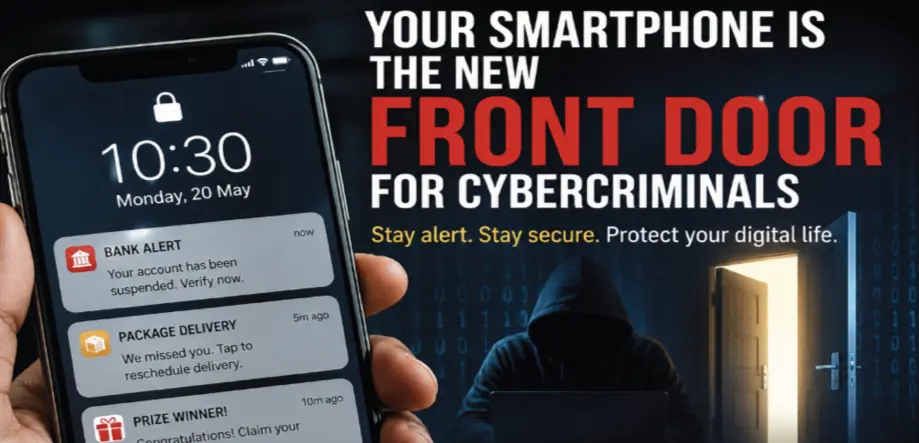
There was a time when cybercriminals primarily targeted desktop computers. Today, that has changed dramatically. The device most people carry in their pockets has become one of the most valuable targets for cyberattacks.
Your smartphone is no longer just a phone. It is your wallet, your bank, your photo album, your personal diary, your email account, your workplace, and in many cases, your digital identity. Unfortunately, this makes it extremely attractive to cybercriminals.
Related stories
Smartphone
In many ways, your smartphone has become the front door to your digital life. Every day, millions of people use their smartphones to access online banking, social media, shopping websites, work systems, and messaging applications. Most of us rarely think about the security risks involved because smartphones have become such an integral part of our daily routines.
Cybercriminals understand this. Rather than attempting sophisticated attacks against large organisations, many attackers now focus on ordinary individuals. Why? Because people are often the weakest link in cybersecurity.
One careless click on a malicious link can be enough. Consider a common scenario. You receive a text message claiming that your bank account has been locked, your parcel delivery has failed, or you have won a prize.
The message contains a link and urges immediate action. Out of curiosity or concern, you click. Within seconds, you may have unknowingly provided sensitive information to cybercriminals or downloaded malicious software onto your device.
Fake websites
These attacks are becoming increasingly sophisticated. Criminals now use fake websites that closely resemble legitimate ones. Some even use Artificial Intelligence to create convincing messages, voice recordings, and social engineering attacks that are difficult to distinguish from genuine communications.
Social media platforms have also become fertile hunting grounds for cybercriminals. Fake profiles, investment scams, romance scams, and fraudulent online marketplaces continue to grow. Many victims only realise they have been scammed after losing significant amounts of money or having their personal information stolen.
In Fiji, as internet access and smartphone usage continue to expand, so does the potential exposure to cyber threats. More citizens are using mobile banking, online shopping, and digital payment platforms than ever before. While this digital transformation brings tremendous benefits, it also creates new opportunities for cybercriminals.
Cybercrime
The reality is that cybercrime is no longer a problem affecting only large corporations or government agencies. It affects students, teachers, professionals, retirees, and small business owners. No one is immune.
One of the biggest misconceptions is that cybersecurity requires advanced technical knowledge. Some of the most effective security measures are surprisingly simple. Strong passwords remain essential. Yet many people continue to use easy to-guess passwords such as birthdays, names, or simple number combinations.
Even worse, many reuse the same password across multiple accounts. If one account becomes compromised, cybercriminals can potentially gain access to many others. Multi-factor authentication provides another critical layer of protection. Even if a password is stolen, an attacker would still need a secondary verification method to access the account.
Regular software updates are equally important. Many updates contain security patches designed to fix vulnerabilities that cybercriminals actively exploit. Delaying updates can leave devices exposed to known threats.
Users should also be cautious when downloading applications. Not every app available online is trustworthy. Some applications request excessive permissions, allowing access to contacts, photos, location data, microphones, and cameras. Before installing any application, users should carefully review its source and permissions.
Public wi-fi networks present another often-overlooked risk. While convenient, unsecured public networks can expose sensitive information to attackers. Users should avoid conducting financial transactions or accessing sensitive accounts on public wi-fi whenever possible.
Cybersecurity awareness
Cybersecurity awareness should become as important as teaching road safety or personal safety. Young people need to understand the risks of sharing personal information online and interacting with strangers through digital platforms. The fight against cybercrime is not solely the responsibility of governments, banks, telecommunications providers, or technology companies. Every smartphone user has a role to play.
Cybersecurity begins with awareness. As technology continues to evolve, cybercriminals will continue to develop new methods to exploit unsuspecting users.
The smartphone has become one of humanity’s most powerful tools. It connects us, educates us, entertains us, and enables economic growth. However, like any powerful tool, it must be used responsibly.
The next time you unlock your smartphone, remember this: you are not simply opening an app. You are opening the front door to your digital life.
Make sure that door is locked.