Endoscopic surgery success depends on systems, says specialist
Dr Sailosi Ratumaitavuki warns gains in surgical care must be supported to ensure long-term sustainability
Tuesday 21 April 2026 | 14:00
Updated 21 April 2026 | 15:03 FJT

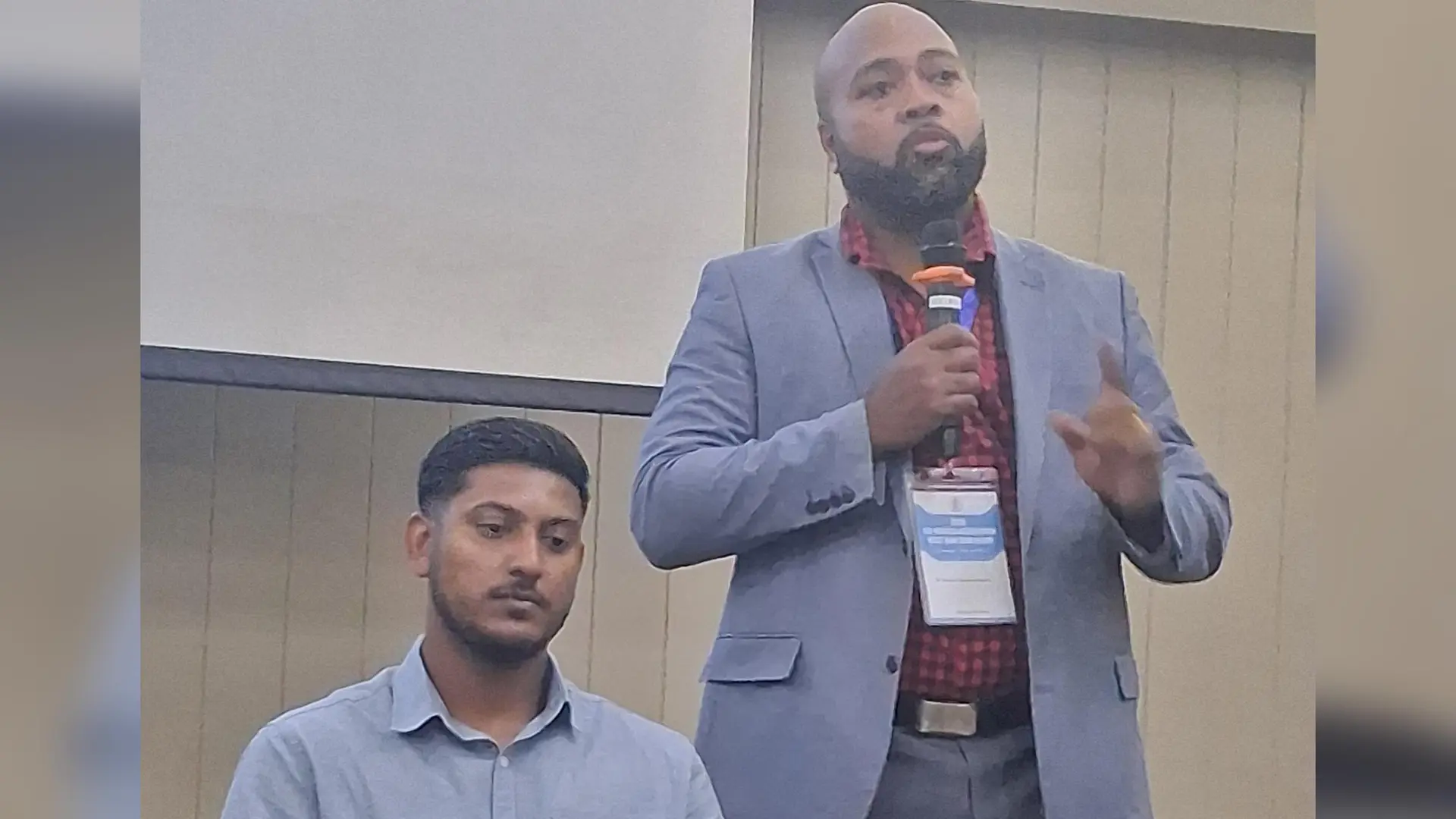
From left: Fiji Care assistant marketing manager Adarsh Prasad with gynaecologist Dr Sailosi Ratumaitavuki (standing) at the Fiji Medical Association West Conference at Novotel Nadi on April 18, 2026.
Photo: Waisea Nasokia
Fiji’s progress in modern gynaecological surgery will depend on building strong health systems rather than relying on individual skills, a medical conference heard last weekend.
Gynaecologist Dr Sailosi Ratumaitavuki said the future of specialist services, particularly endoscopic surgery, lies in creating systems that can consistently deliver, sustain and expand care.
He was speaking at the Fiji Medical Association (FMA) West Conference at Novotel Nadi last Saturday, where he reviewed advances in laparoscopic and hysteroscopic surgery and the reforms needed to secure their long-term future.
Related stories
Dr Ratumaitavuki said laparoscopic and hysteroscopic procedures are now a core part of modern gynaecology, offering clear benefits such as reduced post-operative pain, shorter hospital stays and faster recovery times.
“These procedures reduce disruption to patients’ lives and improve efficiency across the hospital and the wider health system, especially in a referral centre serving the Western Division,” he said.
He stressed that endoscopic services should no longer be treated as optional or dependent on individual doctors.
“The question is not whether endoscopic services are important,” he said. “The question is whether we are willing to do the work required to make them consistently available.”
Dr Ratumaitavuki said progress in recent years showed what could be achieved when systems were deliberately strengthened, shifting from fragmented capacity to structured and reliable service delivery.
He outlined earlier challenges, including limited equipment, delays in instrument readiness, theatre logistics problems, maintenance gaps and workforce training constraints.
“Endoscopic surgery is not dependent on one person or one unit,” he said. “It requires a prepared and confident theatre team, reliable sterilisation systems and an institutional environment that supports safe and consistent delivery.”
He said improvements were driven by strong clinical leadership, team development and a shift in mindset within the service.
“We moved from asking ‘Can we do this?’ to ‘How do we make this happen?’ That shift was critical,” he said.
Dr Ratumaitavuki also acknowledged collaboration with regional partners, including gynaecological societies and medical suppliers, as key to strengthening capability and maintaining service continuity.
He said the changes had led to measurable improvements, with conference figures showing an 80 per cent improvement in the consistency of endoscopic procedures. He said the service was now operating with full local independence.
“This is not aspiration. These are results,” he said. “This is what it looks like when a system moves from reporting activity to delivering outcomes.”
However, he cautioned that gains could be lost without sustained system-wide support.
“Advancement in any service requires resilience,” he said. “Systems must be strengthened as a whole, not in isolation.”
Dr Ratumaitavuki said the next phase of development must focus on consistency, sustainability and growth, supported by leadership, teamwork and institutional commitment.
He said the central lesson was clear: long-term success in health care depends on systems, not individuals.
“Less talk, more action. Less intention, more implementation,” he said.