Fiji unveils new polymer banknotes with most-advanced security features
New $5–$100 notes roll out from January 2, 2026, featuring tougher security, longer lifespan and refreshed designs celebrating Fiji’s identity.
Tuesday 02 December 2025 | 16:00


President Ratu Naiqama Lalabalavu and Reserve Bank Governor Ariff Ali unveil Fiji’s new family of polymer banknotes during the official launch at the Grand Pacific Hotel in Suva on December 2, 2025.
Photo: Laiseana Nasiga
Fijians will begin receiving new polymer banknotes from January 2, 2026, as the Reserve Bank of Fiji transitions to a complete family of polymer currency featuring enhanced security features and redesigned backs showcasing national identity.
President Ratu Naiqama Lalabalavu officially unveiled the new $5, $10, $20, $50 and $100 notes today at the Grand Pacific Hotel, marking a significant upgrade to Fiji’s currency with what experts describe as some of the most advanced security features in the Asia-Pacific region.
While the front designs featuring Fiji’s endemic flora and fauna remain unchanged, the backs now display images celebrating the nation's people, resources and values.
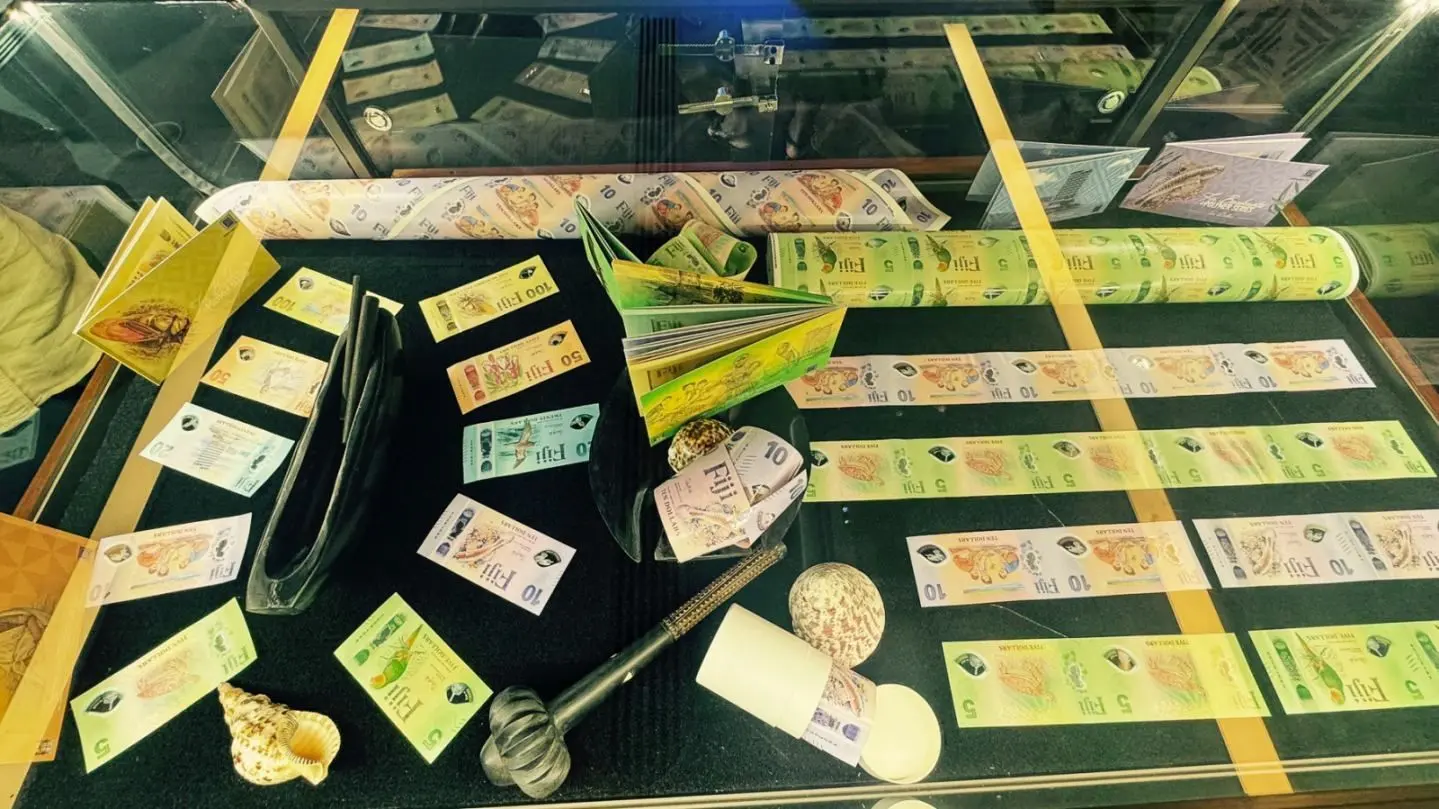
A display of Fiji’s new polymer banknotes, showing production sheets, security features and final designs, was showcased during the official unveiling at the Grand Pacific Hotel in Suva.
Photo: Laiseana Nasiga
The $5 note features the endangered green turtle, the $10 shows children planting mangroves, the $20 displays the Reserve Bank building, the $50 honors Girmitiya heritage with a lady and the Leonidas ship, and the $100 depicts an iTaukei man in traditional attire holding kava.
The polymer notes include tactile lines and dots for the visually impaired, with 4, 6, 8, 10 and 12 lines on each denomination respectively.
Reserve Bank Governor Ariff Ali said the new notes, produced by Crane Currency, feature a revolutionary “motion surface” security stripe visible from both sides—a world-first technology.
“The polymer banknotes last 2.5 times longer than paper notes, reducing replacement costs and environmental impact,” Mr Ali said.
The transition will see both old and new notes circulating together until December 31, 2026, when current notes must be exchanged at commercial banks.
As of Monday, total currency in circulation stood at $1.2 billion, or 8 per cent of GDP, compared to just $14 million at independence in 1970.
Deputy Governor Esala Masitabua confirmed counterfeiting in Fiji remains “negligible” but stressed staying ahead of technological threats drove the upgrade.
The complete polymer family cost approximately $11 million for a five-year supply, just 3 per cent more than previous paper notes due to longer durability.
Feedback: kaneta.naimatau@fijisun.com.fj