Shine A Light: Housing Dream a Work in Progress
FCCC also charged ex-PCN national director Semiti Qalowasa for failing to provide full information. A Fiji court later vacated his guilty plea.
Tuesday 17 December 2024 | 09:22

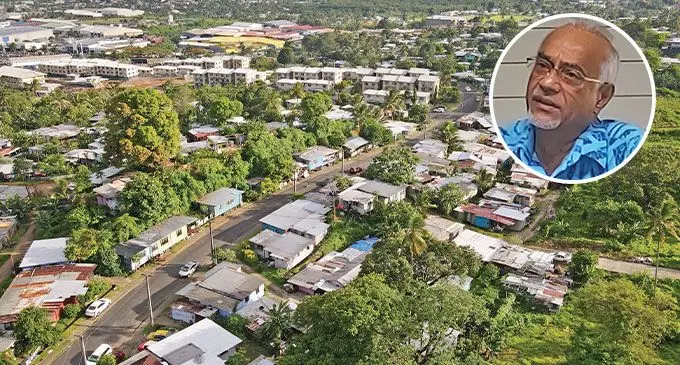
Jittu Estate informal settlement and Lagilagi Housing Project development in Suva. Photo: Leon Lord Inset photo: Professor Vijay Naidu
The Lagilagi Housing Project was supposed to address the lack of affordable and proper housing in Jittu Estate, one of the largest squatter communities in the country.
However, several unforeseen events reportedly delayed the project over the years and ultimately led to the demise of the NGO in charge.
Driving up the paved Lagilagi Housing Road at Jittu Estate in Suva, it's not hard to see the stark difference between the concrete housing development on one side and the squatter settlement on the other. Thirty-six residential units were recently completed, and works on a multipurpose facility outside continue.
Related stories
But opposite these new homes, many families still live in overcrowded conditions and in houses with poor, inadequate infrastructure.
When it was initiated by the People's Community Network (PCN), the hope was that the Lagilagi Housing Project would lead to housing upgrades across the rest of Jittu Estate and other squatter communities in Suva and beyond.
After PCN's exit from the project, Cabinet handed it over to the Public Rental Board (PRB), a Government-owned statutory body, to complete unfinished residential units. So, what went wrong?
BRIEF HISTORY
In 2009, the People's Community Network was established as a breakaway NGO from the Ecumenical Centre for Research, Education and Advocacy (ECREA). They were both led at one point by the late Father Kevin Barr to address poverty and other leading socio-economic issues in Fiji.
Social analysis workshops were conducted to help the NGOs and informal communities understand why people were living in squatter settlements and in poverty in the first place.
In Fiji, that poverty can often be linked to low wages, unemployment and challenges with raising large families, said long-time academic Professor Vijay Naidu in an interview this week. He was also on the Board at PCN. Government taxation policies and whether they encouraged the redistribution of wealth or not can also be a factor, he added.
ECREA slowly disappeared, and PCN became a de-registered charitable fund. But when it did exist, PCN played a significant role, helping the urban squatter communities secure land and better housing.
The Lagilagi Housing Project was PCN's first and only major housing upgrading project it oversaw which aimed to empower families in need who already lived on-site.
Fiji's Ministry of Local Government, Urban Development and Housing and PCN signed an agreement to build 153 affordable housing units at the estate.
The Lagilagi Housing Project was different from any other urban development in the city in that it was led for and by the residents of Jittu Estate.
When he opened the first 33 residential units in 2013, then Prime Minister Voreqe Bainimarama said in his speech that it was "a new way forward for housing the poorer members of our community" because it allowed them to take ownership of the project, unlike before.
Residents partially funded the Lagilagi Housing Project through savings groups and fundraising initiatives, while the Government and Misereor, the German Catholic Organisation, provided some financial assistance.
The project was part of the previous Government's Participatory Squatter Upgrading Projects, which involved a partnership between the Government, NGOs, development partners and everyday Fijians. The former Prime Minister said it was a "mammoth task" to get Lagilagi off the ground. Squatters situated within the project site had to be relocated to other parts of the Jittu Estate to allow for earth, water and sewerage works.
Former Attorney-General Aiyaz Sayed-Khaiyum said in Parliament in 2022 that those 33 units were completed at a total value of $2.9 million.
The Government also approved the leasing of the whole of Jittu Estate to the People's Community Network to provide proper housing for more than 10,000 poor squatter families in Jittu and other informal settlements within Suva City.
Mr Bainimarama said the project didn't just provide better homes for the poorest Fijians and their families; it also gave them hope for a better future.
By 2022, 117 residential units were fully completed at a total cost of $15.6 million.
WHAT WENT WRONG?
Professor Naidu said that it wasn't until "the Ministry of Local Government pulled the rug from under the People's Community Network" that things started to unravel.
"The Government never took responsibility for their part in the collapse of the project.
"NGOs can't build it on their own. So, when they pulled the rug from under our feet, we were left with the business of paying the construction cost and [making] delayed payments to Fortech Construction."
Fortech was the Fijian contractor involved.
In a June 2019 post on the online blog 'Croz Walsh's Blog', Father Barr talked about the 76 housing units that allegedly had not been built, and he blamed former Local Government Minister Parveen Bala for it, saying that he had failed to get the funding to PCN to build those 76 houses on time.
Father Barr also had concerns that families from other communities were occupying some of the homes at Lagilagi.
Professor Naidu said Father Barr was "very trusting of his staff", and that was another reason for the "collapse". Father Barr explained in the same blog post that he had discovered that a senior staff member at PCN had been stealing and abusing funds from residents.
The matter was reported to the police, and the staff member was subsequently sacked fromPCN.
After receiving a barrage of complaints from residents who had paid sums of money to PCN but failed to secure housing, the Fiji Competition and Commerce Commission (FCCC) launched an investigation.
The Board and Trustees of PCN, including Professor Naidu, got caught up in that controversy. FCCC charged Reverend Akuila Yabaki, Father Barr, Cama Raimuria, Aisake Casimira, Suliana Siwatibau, Samuela Alivereti Saumatua, Mere Krishna, Chantelle Khan, and Professor Naidu in 2019 with one count each of accepting payments without being able to supply in connection with the Lagilagi Housing Project. They were all acquitted of these charges in 2023.
FCCC also charged ex-PCN national director Semiti Qalowasa for failing to provide full information. A Fiji court later vacated his guilty plea.
"They charged us for taking money from the poor," Professor Naidu said, adding that the ordeal cost him a lot of money, time and stress.
"We were totally exonerated. It was a false charge, but one of the culprits who took money out of PCN was never charged."
But Professor Naidu admittedly said that, in hindsight, the PCN Board could have done more to prevent what had happened.
"We should have asked to look at everything the staff did. All the expenses that were incurred for various projects ... the small assistance to people and micro savings all the way to the Lagilagi Project and hurricane relief.
''A number of us said that we were going to narrow the scope of our work, but we ourselves never critically evaluated anything that had been done."
He noted that auditors provided them with good reports and that one point, the Fiji Independent Commission Against Corruption (FICAC) gave PCN a "clean bill of health".
Professor Naidu said that Father Barr felt that he had let his friends down. He died in 2020 at the age of 84.
The previous Government took notice of the predicament facing hundreds of Lagilagi Housing applicants and allocated $2.27 million in the 2021/2022 revised National Budget to refund deposits paid by Fijians to PCN.
The Housing Ministry said in August 2022 that it had received more than 600 applications and had refunded more than $2 million to 278 applicants. The Government allocated a further $1.9 million in the 2022/2023 National Budget to refund the remaining applicants.
Later that year, the Ministry said that 408 out of the 643 applicants had met the criteria and had, therefore, been refunded more than $3 million.
WHAT NEXT FOR THE LAGILAGI HOUSING PROJECT?
The remaining 36 housing flats were just completed this year at a cost of $1.6 million. Public Rental Board (PRB) general manager Timoci Naleba told Shine a Light that the official opening was expected to take place "no later than early January" next year.
There are currently 117 families residing at Lagilagi Housing Estate, and they, along with an additional 36 families, are set to benefit from a new recreational space currently under development, as announced by the Minister for Housing and Local Government Maciu Nalumisa in Parliament earlier this month.
And there are efforts underway by the PRB to house even more families who reside in inadequate housing on both sides of Jittu Estate.
But there are still some challenges. Mr Nalumisa noted that some families residing at Lagilagi weren't residents of Jittu Estate, so they would continue to enforce the policy of Jittu- only tenants at Lagilagi.
While it is understood that families living in a certain zone of Jittu Estate will move into the 36 residentiall units, it is unclear what other requirements there are to apply for a home at the Lagilagi Housing Estate and the rental fees that need to be paid. In response to emailed questions, Mr Naleba said he would "reserve all comments on Lagilagi after it is officially opened".
Feedback: jernese.macanawai@fijisun.com.fj
- This is part one of a two-part series on the Lagilagi Housing Project. The conclusion of this article will be published in next weekend's Shine A Light column








