Opinion: Fiji’s drug war, the cost of confronting a national crisis
Pressure mounts as Fiji expands anti-drug operations nationwide
Thursday 14 May 2026 | 12:30
Updated 14 May 2026 | 13:39 FJT

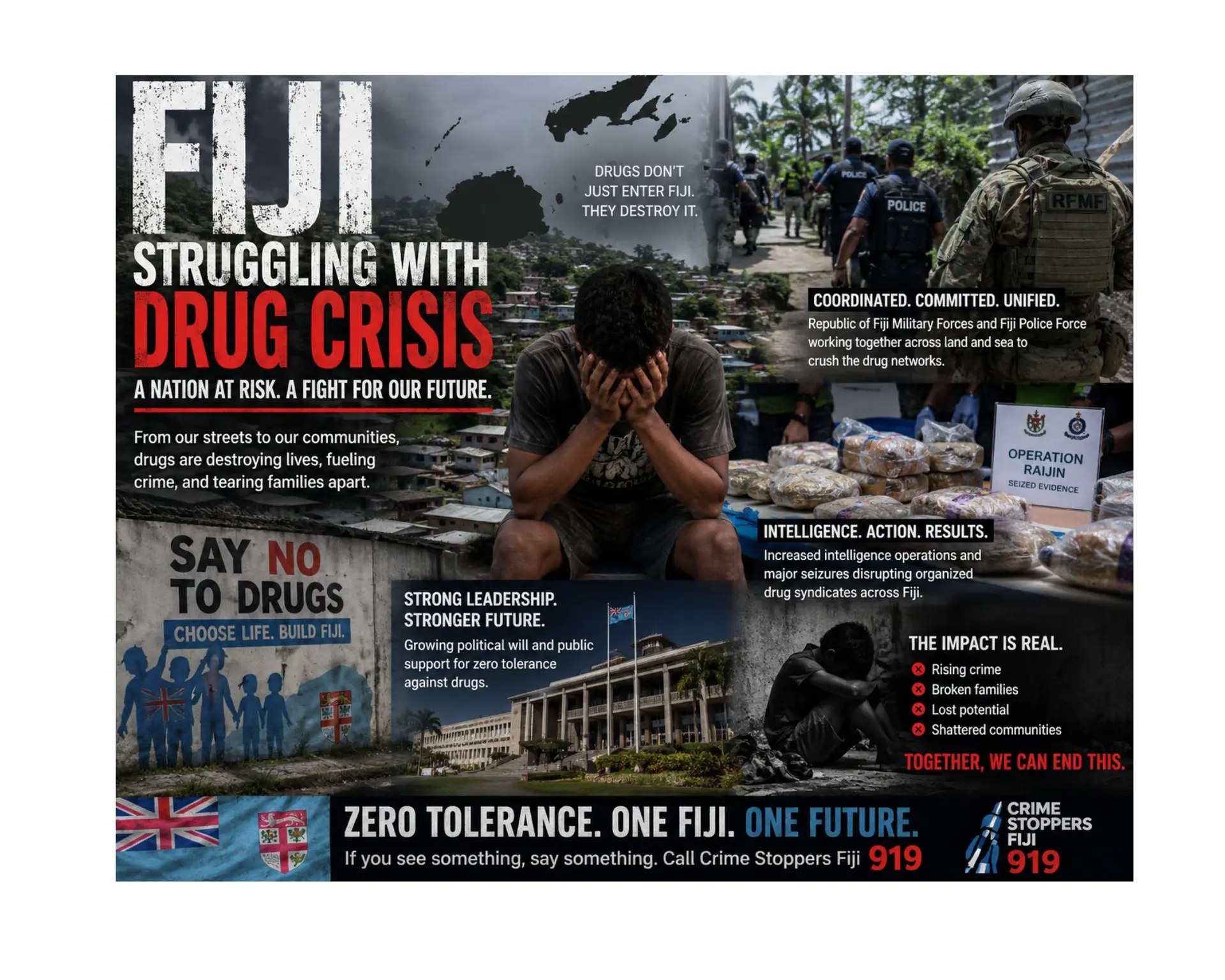
This is an AI generated image of information that Fiji is entering one of the most aggressive anti-drug campaigns in its modern history.
By all indications, Fiji is entering one of the most aggressive anti-drug campaigns in its modern history.
The signs are unmistakable, coordinated operations between the Republic of Fiji Military Forces (RFMF) and the Fiji Police Force, intensified intelligence activity, growing political backing, and increasingly public discussion about the reach of organised drug networks across the country.
This is no longer viewed as a routine policing issue. It is being coined as a national security crisis.
Related stories
Behind closed doors and increasingly in public conversations, many Fijians believe the drug trade has penetrated deeper into society than previously understood.
Communities are seeing the social consequences first hand, rising addiction, youth involvement, violence, family breakdown, and criminal influence spreading into places once considered insulated from such activity.
Now, prominent names are beginning to surface. Allegations, investigations, and intelligence reports are creating an atmosphere of uncertainty and anticipation.
Many believe the coming months could expose uncomfortable truths involving individuals with influence, money, or connections.
The Government has clearly signalled support for a stronger response to the point of considering a state of emergency to be imposed.
Security agencies appear determined to pursue the campaign with urgency and intensity. Public sentiment, at least broadly, also appears supportive.
Many ordinary citizens are tired of the growing visibility of drugs in communities and believe stronger action is overdue.
But history both globally and regionally shows that wars against drugs are never simple. There is always more then what the eye actually meets.
They are costly, politically dangerous, socially divisive, and often accompanied by serious moral and legal questions. The answer is simple.
The challenge for Fiji is not merely whether it can fight drugs effectively. The deeper question is whether it can do so without damaging the democratic principles and human rights protections that the nation also claims to defend. It is a case of being caught between a rock and a hard place.
A Crisis That Reaches Beyond Crime
Drug trafficking today is not confined to street-level dealing or isolated criminal groups. Internationally, narcotics networks are highly organised, financially sophisticated, and capable of exploiting weak institutions, porous borders, corruption, and poverty.
Fiji’s geographic position in the Pacific places it in a vulnerable transit corridor. Authorities have repeatedly warned that transnational criminal syndicates increasingly view Pacific Island states as attractive operational zones because of limited enforcement resources and expanding regional connectivity.
Locally, the social impact has become impossible to ignore.
Communities speak openly about the spread of methamphetamine and marijuana. Parents fear recruitment of unemployed youth into criminal networks.
Teachers and church leaders express concern over declining social discipline and growing desperation among vulnerable families.
For many citizens, the state’s tougher approach is therefore understandable. There is a growing belief that the country delayed confronting the problem for too long. It has been left to fester and like a time bomb ready to explode.
Supporters of the crackdown argue that extraordinary threats sometimes require extraordinary measures.
They point to examples around the world where governments mobilized security forces alongside police to dismantle organized criminal structures.
From this perspective, Fiji’s response is not an overreaction but a delayed correction.
The Danger of “Any Means Necessary”
Yet this is where the national conversation becomes more complicated.
Whenever governments declare war whether on terror, corruption, gangs, or drugs there is a risk that urgency begins to override restraint.
Public fear can gradually normalize actions that would otherwise be unacceptable in ordinary democratic conditions.
Already, some voices are warning that human rights violations may occur “along the way” and should be viewed as unfortunate but necessary consequences of restoring order.
That reasoning is dangerous.
A state cannot defend the rule of law by abandoning the rule of law.
This does not mean security forces should be weak, passive, or indecisive. Criminal networks exploit hesitation and institutional weakness. Police and military personnel operating against dangerous organizations face enormous pressure and real risks.
However, democratic societies are ultimately judged not only by how they confront threats, but by the limits they impose upon themselves while doing so.
If unlawful detentions, excessive force, intimidation, politically selective targeting, or abuses of authority become normalized under the justification of fighting drugs, the long-term damage to public trust may exceed the gains of the operation itself.
History offers many examples where anti-drug campaigns initially enjoyed overwhelming public support before later generating controversy over disappearances, abuse, corruption, and weakened civil liberties.
Once exceptional powers become politically convenient, they are rarely surrendered easily.
The Military-Police Partnership
The joint involvement of the military and police is itself significant.
Supporters argue that the scale of the drug problem requires national mobilization and coordinated operational capacity. They believe the military brings discipline, intelligence capability, logistics, and deterrent value.
Reports indicate "overwhelming support" for the joint operations from the public, according to statements made by the Fiji Police Force. The collaboration, known under initiatives such as Operation Sasamaki, involves the Republic of Fiji Military Forces.
Critics, however, worry about the blurring of institutional boundaries.
Traditionally, police forces are trained for civilian law enforcement while militaries are designed primarily for national defense and security threats. Combining the two in domestic operations requires careful oversight, legal clarity, and accountability mechanisms to prevent overreach.
Fiji’s political history also means any expanded military role in internal affairs will inevitably attract scrutiny, both locally and internationally. For this reason, transparency matters.
The public must understand the legal basis of operations, the safeguards in place, and the mechanisms available for investigating misconduct if it occurs. Without that transparency, rumours and fear can quickly replace confidence.
The statement by the Land Force Commander is politically and psychologically significant because it goes beyond ordinary law-enforcement language. The phrase “We are coming for you” is designed to project resolve, deterrence, and institutional force. It signals that the military sees the drug problem not merely as criminal activity, but as a threat to national stability and social order...
The military is sending a message of zero tolerance. The wording is intentionally uncompromising. By addressing not only drug dealers but also users, enablers, and financiers, the statement broadens responsibility beyond street-level offenders to the wider ecosystem surrounding narcotics. That framing suggests the issue is being treated as systemic rather than isolated.
Second, the statement communicates that the Republic of Fiji Military Forces is prepared to play an assertive role in national security discussions.
In Fiji’s political context, military language carries historical weight because the RFMF has long seen itself not only as a defence institution but also as a guardian of national stability.
When a senior commander uses language about the “anger and wrath of this nation,” it invokes moral authority as much as operational enforcement.
Over the past few weeks, it has been a challenging time for the Republic of Fiji Military Forces due to joint operations with the Fiji Police Force and the death of an individual in military custody, for which the military must be held accountable. Notwithstanding this, the Commander’s acceptance of fault in the death is significant because it affects three interconnected spheres at once:
- For the family, it is an acknowledgment of suffering and a potential doorway to justice and reconciliation.
- For the nation, it is a test of whether Fiji’s institutions can confront painful truths honestly.
- Politically, it places pressure on leaders and institutions to show that accountability is substantive rather than symbolic.
Many people in Fiji see it as a significant and unusual step toward accountability and transparency and viewed by some as courageous leadership and an attempt to restore public trust in the RFMF.
Ultimately, the lasting impact will not depend solely on the admission itself, but on whether Fiji responds with integrity, fairness, and moral seriousness afterward.
Exposure Is Coming
One reason this campaign may become politically explosive is because drug networks rarely operate in isolation.
As investigations deepen, there is widespread expectation that individuals with status, influence, or institutional connections could become implicated.
If that happens, Fiji may enter a volatile phase where anti-drug enforcement intersects with politics, business, and public credibility.
This is often the moment when anti-drug campaigns face their greatest test. Will enforcement remain impartial?
Will investigations proceed consistently regardless of status or political alignment?
Or will public confidence erode if people begin to believe certain individuals are protected while others are sacrificed?
The answers to those questions will determine whether the campaign is remembered as a genuine national clean-up effort or merely another political episode shaped by selective accountability.
The Price Fiji Must Be Careful Not to Pay
There is indeed a price to confronting entrenched drug networks. Financially, socially, and politically, the cost will be high.
Security operations require resources. Court systems become strained. Communities experience tension and fear. Families are disrupted. Reputations are destroyed, sometimes before guilt is legally established.
But there is another price Fiji must be careful not to pay: the erosion of democratic culture itself.
A frightened public may temporarily tolerate excesses in exchange for promises of security. Yet nations that sacrifice accountability for short-term control often discover later that rebuilding trust is far harder than restoring order.
Fiji’s leaders therefore face a delicate balance. They must show strength without recklessness. Resolve without vengeance. Authority without impunity.
The public understandably wants action against those poisoning communities and profiting from social destruction. Few would dispute the seriousness of the threat. But the legitimacy of the campaign will ultimately depend not only on arrests and seizures, but on whether justice is pursued within the boundaries of law and human dignity.
Conclusion
Fiji’s war against drugs may become one of the defining national challenges of this political era. The public mood suggests many people are ready for decisive action, even if the process becomes uncomfortable and politically destabilizing.
Prominent names surfacing will intensify pressure. Exposure appears inevitable. Institutions will be tested. Political loyalties may shift. Social tensions may deepen before they improve.
But the true measure of success will not simply be how aggressively the state fights drugs.
It will be whether Fiji can confront a serious criminal threat without losing sight of the democratic values and legal protections that distinguish justice from raw power.
Because in the end, a nation must defeat both the drug trade and the temptation to believe that legality, accountability, and human rights are obstacles to security rather than the very foundation of it.