Deep-sea mining could start soon, but not in Fiji waters
A marine scientist says commercial deep-sea mining may begin within years, but Fiji’s seabed minerals are not yet considered viable for extraction.
Wednesday 18 February 2026 | 12:30
Updated 18 February 2026 | 14:17 FJT

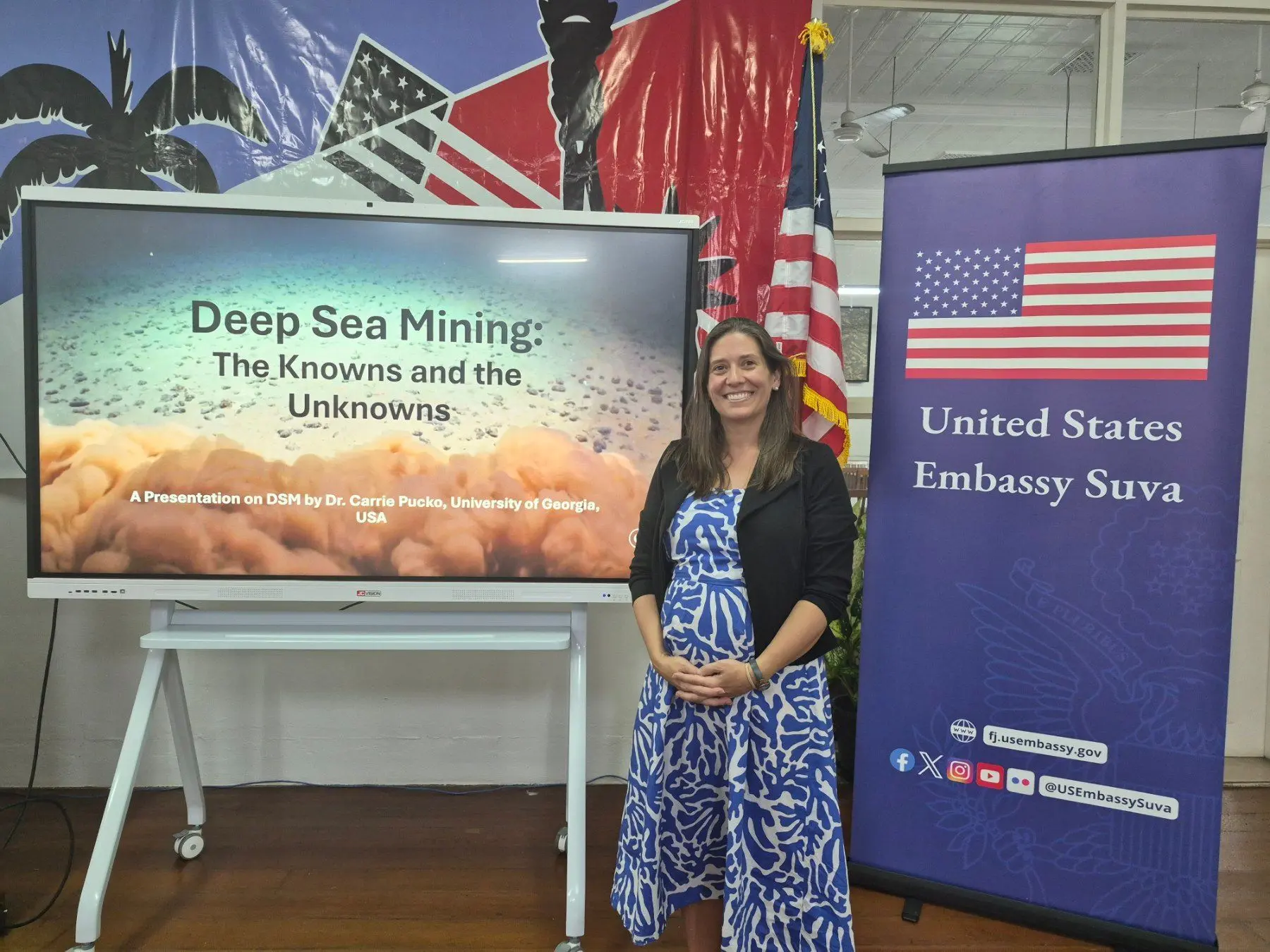
University of Georgia biology lecturer Dr Carrie Pucko during her presentation to media at the Suva City Carnegie Library on February 13, 2026.
Photo: Kaneta Naimatau
Deep-sea mining in the Pacific Ocean could begin commercially within the next few years.
This was revealed by Dr Carrie Pucko, a biology lecturer from the University of Georgia during her presentation to the media last week at the Suva Carnegie Library.
Dr Pucko said an estimated 21.1 billion tons of critical minerals lie at the bottom of the Clarion-Clipperton Zone (CCZ), a vast area between Hawaii and Mexico.
Related stories
“Deep sea mining is going to probably start happening on a commercial scale in the next few years,” she said.
The minerals — manganese, cobalt, nickel, and copper — are essential for electric vehicle batteries and renewable energy technologies.
The mining process involves autonomous underwater crawlers collecting potato-sized nodules from the ocean floor at depths of 4,000 to 6,000 metres.
“It’s not mining like we traditionally think with blasting or digging. Instead, what we’re doing is really just picking up nodules off the bottom of the ocean,” Dr Pucko explained.
While Fiji has deep-sea minerals in its exclusive economic zone, Dr Pucko confirmed these are different from the commercially viable nodules being targeted in the CCZ.
“There are other kinds of minerals in Fiji’s waters, but that’s not the mining that companies are interested in pursuing right now,” she said.
Canadian company TMC (The Metals Company) is leading commercial efforts, establishing subsidiaries in several Pacific nations including Tonga.
Dr Pucko acknowledged environmental concerns but said “carefully crafted regulations can help minimize damage” to deep ocean ecosystems.
US Embassy public relations officer Strader Payton stressed that Dr Pucko’s views do not represent official U.S government policy, though critical minerals remain a top priority for the Trump administration.
Pacific island countries with mining agreements could receive development funding, scholarships, and revenue shares, though specific financial details remain confidential.
Feedback: kaneta.naimatau@fijisun.com.fj