Tailevu, Naitasiri tell of their struggle to comply with FRU requirements
"You cannot successfully run a sporting organisation without sponsorship. Without sponsors, you will struggle."
Thursday 29 January 2026 | 20:30

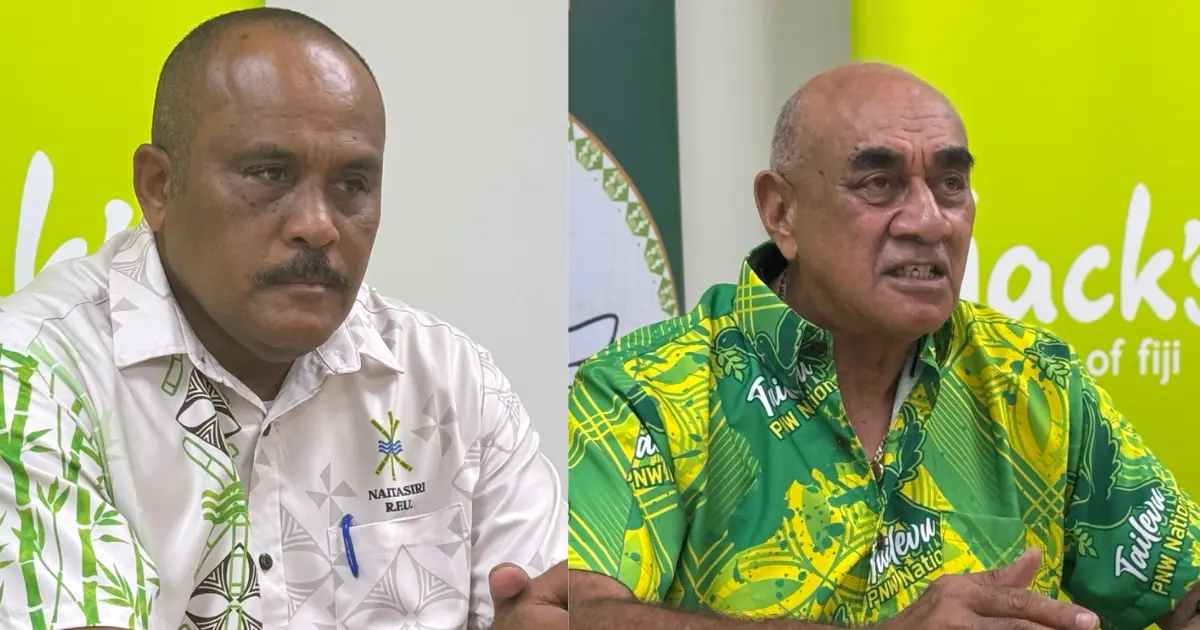
From Left: Naitasiri Rugby Union president Aseri Rokoura and Tailevu Rugby Football Union (TRFU) president Joseph Rodan (Snr) on January 28, 2026.
Photo: Talei Roko
Financial challenge is what many provincial union teams are facing as they try to comply with the Terms of Participation (TOP) of this season's domestic competition.
The TOP is set by the Fiji Rugby Union (FRU), which teams must comply with before the domestic competition kicks-off.
It costs about $225,000 to run Tailevu Rugby each year, but our annual income is around $195,000, leaving a shortfall of about $30,000
Joe Rodan (Snr)
Related stories
The TOP includes governance structures, financial accounts, provincial club games, player registration, conducting union AGMs (annual general meeting) and constitutions.
It is understood that last season only Nadi and Ba had complied with all the requirements.
Tailevu Rugby Football Union (TRFU) president Joseph Rodan (Snr) told SUNsports their recent partnership with Jacks of Fiji is a major boost to their financial stability and long-term development.
Rodan said the TRFU faced serious financial challenges when the current administration took over last year.
"We started with just $200 in the bank," he said.
"It costs about $225,000 to run Tailevu Rugby each year, but our annual income is around $195,000, leaving a shortfall of about $30,000."
Rodan said the gap was previously covered through fundraising and support from loyal fans, but the Jacks of Fiji sponsorship would now ease that burden.
"You cannot successfully run a sporting organisation without sponsorship. Without sponsors, you will struggle."
He noted that operating costs have increased due to stricter competition requirements, including medical staff and an ambulance at every match venue, mainly for player safety.
This partnership will also help promote Tailevu Rugby merchandise, especially team t-shirts, creating another source of income for TRFU.
"Visibility is important. The more merchandise we sell, the better the returns for the union," he said.
For the past three years we have been going through a governance phase. Governance is not something you can instill in one season, it's a change of mindset and culture
Aseri Rokorua
Despite limited sponsorship last year, Tailevu reached the semifinals of the Skipper Cup. Rodan is confident the team can go further this season with Jacks of Fiji's support.
"We believe we can push for the finals and challenge both the Skipper Cup and the Farebrother Trophy, he said.
Rodan added that strong performances by the team attracts sponsors and that the partnership also supports the TRFU's focus on developing young players aged between 18 and 23.
Naitasiri Rugby Union president Aseri Rokoura said one of the key challenges last seasons, was the full registration of clubs, particularly those based in rural areas.
"For the past three years we have been going through a governance phase. Governance is not something you can instill in one season, it's a change of mindset and culture," he said.
"Clubs need to understand their constitutions and ensure proper registrations."
He said proper registration is crucial, not just for the union but also at national level. "Registrations go right up to the Fiji Rugby Union (FRU). That is one area we will continue to improve on, alongside auditing and other governance requirements set by FRU, which the union has managed to meet."
Rokoura added that club competitions have steadily improved over recent years.
"Last year we saw challenges such as the Qaranivalu Shield and double-header fixtures among clubs, and we expect the number of clubs to increase."
He said more than 40 clubs are expected to register in 2026, although only 20 met the requirements last year.
"Clubs need to meet criteria under our Koi Colo Rugby Cooperative programmes, particularly in agriculture and resource development. Rugby is also a tool for social and economic development in rural communities."
In terms of preparations, Rokoura confirmed that teams are yet to begin collective training.
"We haven't started our post-offseason programme yet. Some players are training individually, and once the FRU calendar is approved, we will begin our collective preparations and pre-season games," he said.
Rokoura said a few senior players are also expected to leave, though the union hopes to retain key positions as the season approaches.
Explore more on these topics





Advertisement
Advertise with Fiji Sun