Opinion: Constitution Bill rift puts coalition under pressure
Commentary argues coalition partners should resign if they oppose the Government's Constitution Amendment Bill.
Wednesday 04 November 2026 | 07:00
Updated 04 November 2026 | 11:11 FJT
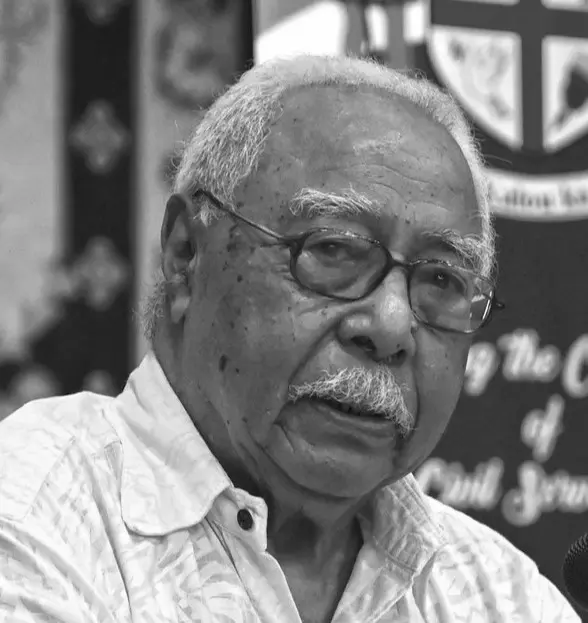

National Federation Party (NFP) leader Biman Prasad, Prime Minister Sitiveni Rabuka, SODELPA leader Aseri Radrodro.
Photos: Ronald Kumar/Leon Lord
The National Federation Party (NFP) and Social Democratic Liberal Party (SODELPA) have publicly announced that they do not, and cannot, support the People’s Alliance Government’s Constitution [Amendment] Bill 2026 in all its current provisions.
If this is so, then, according to the principle of collective Cabinet responsibility, they should do the right thing and resign from Cabinet.
Prime Minister Sitiveni Rabuka has enough MPs from his own People’s Alliance Party (21) and the 10 or 11 cross-party or independent MPs who have joined his Government to form a majority in Parliament and continue as the People’s Coalition Government.
Related stories
Alternatively, if the NFP and SODELPA choose to remain part of the People’s Coalition Government but vote against the Government’s Constitution [Amendment] Bill 2026 during its third reading in Parliament, contributing to its defeat, Mr Rabuka will have no choice but to advise the President of the Republic of Fiji to dissolve Parliament and issue the writ for new elections.
The Constitution [Amendment] Bill 2026, like the Government’s annual Budget Bill, is a major piece of legislation. It concerns our Constitution, the supreme law of Fiji.
If the Bill is defeated at its third reading because it fails to attain the required two-thirds majority of all MPs present and voting, the parliamentary convention is that the Government must resign immediately, allowing fresh parliamentary elections to be held.
In the last General Election, held in December 2022, the People’s Alliance Party polled 168,581 votes. This represented 35.82 per cent of the total votes cast.
Mr Rabuka alone won more than 79,000 votes. The PAP was allocated 21 seats.
The NFP won 41,830 votes, or 8.89 per cent of the total votes cast, and was allocated five seats.
SODELPA won 24,172 votes, or 5.14 per cent of the total votes cast. It was allocated three seats.
An online survey conducted by the Centre for Democracy and Dialogue reported that Mr Rabuka was the most preferred Prime Minister and that his People’s Alliance Party was the most popular political party among voters.
The next General Election will be held under the provisions of the 2013 Constitution.
There is a high probability that this will enable the People’s Alliance Party to win enough seats to form the next Government on its own, BUT STILL NOT ENOUGH TO SECURE THE TWO-THIRDS MAJORITY REQUIRED FOR A PAP GOVERNMENT-SPONSORED CONSTITUTION [AMENDMENT] BILL TO PASS IN PARLIAMENT.
In these circumstances, the alternative approach available to Prime Minister Sitiveni Rabuka is to adopt a statesmanlike approach and invite the parliamentary Opposition to form a Joint Government-Opposition Parliamentary Select Committee on the Constitution Review.
The committee could resume work on reviewing the 2013 Constitution through a national bipartisan approach. This was the same approach that produced the 1997 Constitution through a unanimous parliamentary vote.
Such a united, bipartisan approach in Parliament would also help maximise public support for the new Constitution in the public referendum that would follow.
[Jioji Kotobalavu was a long serving Permanent Secretary in the Civil Service and is currently a lecturer in public law and in international relations and diplomacy at the University of Fiji’s JDP School of Law. The views expressed in the article are of the author alone and not of Fiji Sun and/or its employees.]