Opinion: Hidden in plain sight and rewritten by Government
Tuesday 20 October 2026 | 16:30
The CRC reviewed the 2013 Constitution and produced a complete constitutional draft. The Government has now tabled a different text. Who drafted each version, and who authorised the changes?
Fiji’s constitutional debate has moved beyond the Constitution Review Commission’s report.
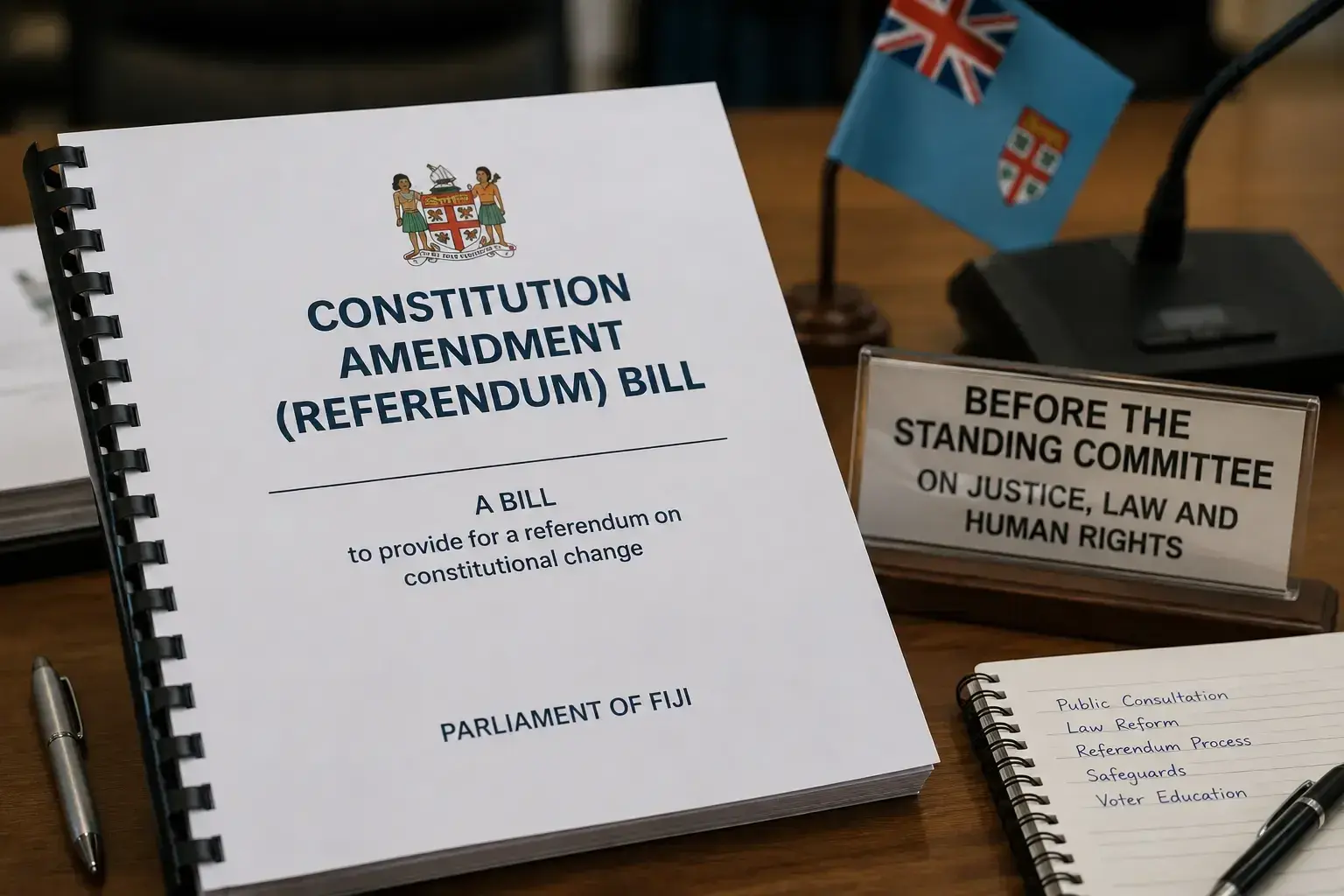
Prime Minister Sitiveni Rabuka has tabled a Constitution Amendment Bill, and the Government’s text differs materially from the draft attached to the CRC’s recommendations. Yet the question raised by that original document remains unanswered: who wrote it?
Turn to Appendix A of the CRC’s report and a fully written Constitution of the Republic of Fiji 2026 appears, dated 31 August 2026. The Commission had been appointed to review the 2013 Constitution. It nevertheless presented a complete constitutional text.
Related stories
It is not a list of recommendations. It is not a schedule identifying sections of the 2013 Constitution that should be amended. Nor is it simply a set of drafting instructions for Parliament.
It is a complete alternative constitution, with its own preamble, Bill of Rights, two Houses of Parliament, executive, judiciary, electoral system, Great Council of Chiefs, Military Court, constitutional offices, amendment procedures, transitional arrangements and official oaths.
The subsequent Government Bill makes the history of that document more important. Fiji needs to know how the Commission’s recommendations became a draft, and how that draft became the different text now before Parliament.
This raises an obvious question. Was the Commission appointed merely to review the 2013 Constitution, or was it authorised to write a new Constitution for Fiji?
The Commission itself provides part of the answer.
It acknowledges that its role was to inquire into and report on the provisions of the 2013 Constitution, taking account of public submissions and the priorities in its Terms of Reference.
More importantly, the Commission expressly states that it was tasked only to review the 2013 Constitution.
Because of that limited mandate and the short period available, it says it recommends revision by amendment rather than wholesale constitutional change.
Yet attached to the same report is a document that looks, reads and presents itself as a replacement Constitution.
A commission may use a consolidated draft to show how extensive amendments would work together. The existence of a complete text does not, by itself, establish that the Commission acted unlawfully. But the CRC must explain how producing this document fell within its authority, particularly when its own report emphasises the limits of its mandate.
There is a significant difference between reviewing a constitution and writing one.
A review commission examines the operation of existing provisions. It identifies weaknesses, receives submissions and recommends which sections should be retained, repealed or amended.
A constitution-making body performs a much wider task. It determines the future structure of the state and writes the supreme law under which every citizen and institution will be governed.
The scale of the resulting document makes that explanation necessary. Whatever legal mechanism is used to enact it, the CRC proposed a substantial reconstruction of Fiji’s constitutional order.
The proposed document would reconstruct major parts of Fiji’s political system.
It recommends a 60-seat bicameral Parliament consisting of 41 members in a House of Representatives and 19 senators.
The single national constituency would disappear. It would be replaced by a mixed-member proportional electoral system, with 26 constituency seats decided by first-past-the-post voting and 15 seats allocated from party lists.
There would be a Constituency Boundaries Commission, a caretaker government during the election period and restrictions on major electoral law changes during the nine months before the end of a parliamentary term.
The Supervisor of Elections would become the chief executive of the elections office, reporting to a five-member Electoral Commission.
These are not minor amendments designed merely to repair the democratic deficit identified by the Supreme Court. They redesign the institutions through which political power is contested and exercised.
The draft also introduces constitutional provisions on land and the environment, group rights, local government, the Bose Levu Vakaturaga, independent institutions, codes of conduct, Rotuma and the removal of state office holders.
It proposes two-term limits for the President and Prime Minister. Cabinet would be restricted to 15 members, including the Prime Minister.
An enforceable Code of Conduct would be administered by the Ombudsman. A National Consultative Land Forum would be created, while the Bose Levu Vakaturaga would return as a constitutional institution.
Some proposals may be welcomed. Others will be controversial. Each deserves careful scrutiny.
But that is separate from the preliminary question of whether the Commission was authorised to write them into a new constitutional document.
Two drafts and two sets of questions
The Government’s Bill must now be distinguished from the CRC draft. The Commission proposed a 41-member House of Representatives and a 19-member Senate.
As reported by fijivillage on 1 October, the Government Bill instead retains a 55-member House, with 33 constituency seats and 22 party-list seats. Its proposed electoral structure should not be attributed to the CRC.
Other differences concern restraints on executive power. In its preliminary assessment, reported on 1 October, the Centre for Democracy and Dialogue says the Government text removes the CRC’s proposed two-term limit for the Prime Minister and its ceiling of 15 Cabinet members, including the Prime Minister. The Centre also identifies changes to the Constitutional Offices Commission and the removal of constitutional provisions on political finance and campaigning.
The Government should publish the two texts side by side and explain its changes. Which recommendations did Cabinet accept? Which did it reject? Who instructed the Government’s drafter, and what reasons were recorded for those decisions?
The CRC’s report cannot serve as a substitute for consultation on provisions subsequently altered by Government. Ministers are entitled to propose changes, but they must take responsibility for them and explain their substance. A recommendation to constrain executive power and a decision to remove that constraint represent different constitutional choices.
The unnamed drafter
For years, Fijileaks and others have demanded to know who drafted the 2013 Constitution after the military-backed government discarded the draft produced by the Yash Ghai-led Constitution Commission.
The identity of the principal author or authors of the Constitution imposed upon Fiji in 2013 has never been satisfactorily disclosed.
The present process requires the same scrutiny, now at two stages: the preparation of the CRC draft and the preparation of the Government Bill.
The CRC report says that during the final phase of its work, the Commission prepared drafting instructions for a drafter who remained “just ahead” of the commissioners’ decisions.
But it does not identify that drafter in the passage.
Who was the drafter?
Who appointed and paid that person? Was the drafter attached to the Commission, the Office of the Attorney-General, the Office of the Solicitor-General or some other institution?
Were successive drafts circulated to every commissioner? Did the commissioners approve the final document clause by clause?
Which provisions came directly from public submissions, and which originated with commissioners, government officials, advisers or the drafter?
Were any significant clauses introduced after the public consultations had ended?
These are not mischievous questions. Fiji has already suffered from constitutions of disputed origin.
The CRC itself criticises the 2013 Constitution for replacing the Ghai Commission draft with a document produced by what it describes as a small group of officials.
That history imposed a special duty of transparency upon the present Commission. It should identify the principal drafter, publish the drafting instructions and explain how the final constitutional text was approved.
We should not have to spend the next decade asking who drafted the Constitution of the Republic of Fiji 2026, just as we have spent years asking who actually drafted the 2013 Constitution.
A proposed new constitution cannot condemn its predecessor for being of uncertain provenance while leaving unanswered questions about its own authorship.
The Commission says that 3,873 citizens participated in consultations at 105 venues and that it received 1,220 submissions.
Those figures show that consultations took place. They do not tell us whether the public saw and considered the actual clauses now contained in the draft.
Were citizens shown the proposed powers and composition of the Senate?
Were they asked to examine the 41-seat House of Representatives, the 19-seat Senate and the mixture of constituency and party-list seats?
Did they see the provisions establishing the Military Court, the Presidential Appointment Commission and the constitutional role of the Bose Levu Vakaturaga?
There is a difference between asking people whether they favour a Senate and asking them to examine the legal powers of that Senate.
There is also a difference between consulting the public about broad constitutional ideas and seeking its views on the actual words that could become Fiji’s supreme law.
Faith, identity and the military
The CRC draft also moves into other sensitive areas. These proposals must be examined separately from the Government’s subsequent text.
The 2013 Constitution expressly describes Fiji as a secular state. The CRC draft instead contains a provision headed “Religious liberty”.
Its preamble seeks the blessing of God, recalls the conversion of many indigenous inhabitants to Christianity and recognises the contribution of Christianity and other faiths to Fiji’s spiritual life.
Religious liberty must be protected. So must the rights of Hindus, Muslims, Sikhs, members of other faiths and citizens who profess no religion.
Any departure from the express secular-state provision requires open national debate. It should not be treated as a routine drafting change.
The Commission also failed to reach a final settlement on the use of “Fijian” as the common national identity.
Its draft contemplates an interim arrangement followed by another referendum on national identity. Some commissioners themselves warned that such a referendum could be expensive, unpredictable and potentially divisive.
On the military, the Commission proposes placing the Republic of Fiji Military Forces under elected civilian authority and defining its role principally in relation to external threats.
That recommendation deserves serious consideration in a country that has endured four coups.
But the draft also proposes a Military Court with standing equivalent to the High Court. Why serious offences involving military personnel require a separate constitutionally entrenched court, rather than the ordinary courts, must be fully explained.
The election timetable and the proposed transition
The Government Bill also clarifies the electoral timetable. Fijivillage reported on 1 October that the next general election remains governed by the 2013 Constitution, with 24 December 2026 as the last date for issuing the writ and 6 February 2027 as the latest polling date.
The proposed commencement date is 31 March 2028, although an earlier date could be fixed by presidential proclamation.
Those dates should be stated carefully. A proposed commencement provision is not an enacted change to Fiji’s supreme law. Nor should constitutional reform be presented as an automatic extension of the present Government’s electoral mandate.
The Government Bill also proposes repealing the FICAC Act and omits FICAC from its proposed constitutional text, according to fijivillage’s report of 30 September. That raises a further question for the transition: what provisions will preserve investigations, pending prosecutions, records and responsibility for unresolved complaints? Publication of a proposal does not itself abolish the Commission.
For citizens who have lodged complaints or supplied evidence, these questions are far from academic. They are entitled to know who will take responsibility for their cases and what will happen to the records.
Not yet Fiji’s Constitution
Let us be clear. The 2026 draft is not yet Fiji’s Constitution. It has no force of law merely because it appears in the CRC report.
The Government has now brought its own Bill before Parliament. Parliamentary consideration and the applicable referendum requirements remain essential; neither the CRC report nor the tabling of the Bill makes the proposed text law.
The CRC draft and the Government Bill should be published separately, alongside an accurate comparison. Accessible translations into iTaukei, Fiji Hindi and Rotuman should enable citizens to examine the proposals themselves.
A comparative document should show what each proposed clause would change in the 2013 Constitution. The public should also be told which proposals came from public submissions, which came from the Electoral Law Reform Commission and which were introduced by the CRC or its drafter.
There are proposals worthy of serious discussion: civilian supremacy, the prohibition of future coup immunity, constituency representation, electoral independence, limits on executive power and enforceable standards of conduct.
But worthy proposals cannot repair a process if the authority for producing the document remains uncertain.
Fiji’s constitutional history is littered with constitutions that were imposed, abrogated, replaced or later disowned.
The country does not merely need a better constitutional text. It needs a transparent and lawful process that commands public confidence.
The immediate question is not whether every provision in the 2026 draft is good or bad.
It is whether a Commission appointed to review the 2013 Constitution was empowered to produce an entirely new one.
The CRC says that its mandate was limited to review and that it favoured amendment rather than wholesale replacement.
Appendix A tells a different story.
The Commission’s gazetted Terms of Reference must be placed beside its draft Constitution, and the Government must publish an account of the changes made before tabling its Bill.
The people of Fiji can then decide whether the CRC reviewed the existing Constitution, as it says it was appointed to do, or quietly transformed itself into a constitution-making body.
Before Fiji is asked to approve another constitutional settlement, the CRC and the Government should answer the question that has haunted the 2013 Constitution for years: who drafted it? This time the answer must account for both texts and the decisions that separate them.
(Victor Lal is the Oxford-based Founding Editor-in-Chief of Fijileaks, a veteran Fijian journalist and commentator. He is the author of Fiji: Coups in Paradise: Race, Politics and Military Intervention and specialises in race, ethnicity, conflict and constitutionalism in deeply divided multi-ethnic states. He is a co-winner, with the late Fiji Sun publisher Russell Hunter, of the 2008 Robert Keith-Reid Award for Outstanding Journalism. The views and opinions expressed in this column are those of the author and do not necessarily reflect the views of the Fiji Sun.)