Government Adopts Australia-New Zealand Wind Load Standards
“It assists in determining the design of the building to allow it to withstand cyclones, and in Fiji’s case, Category 5 cyclones. The same rules cannot be applied for a house built on the top of a hill or that in the valley.”
Wednesday 24 August 2022 | 12:55
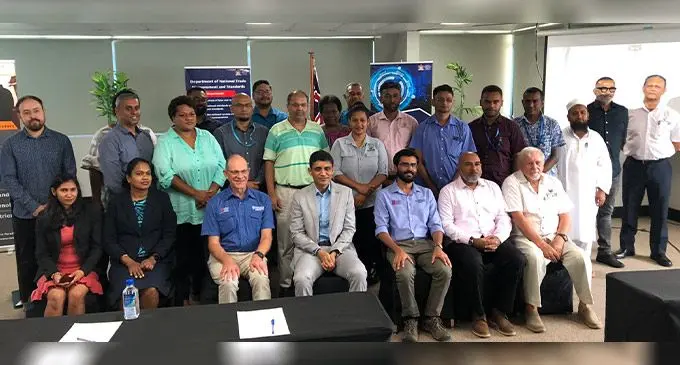
Participants at the Information Session for the Wind Load Standards with the permanent secretary for the Ministry of Commerce, Tourism, Trade and Transport, Shaheem Ali (sitting fourth from left) on August 23,2022. Photo: Josefa Babitu
The Ministry of Commerce, Trade, Tourism and Transport is adopting the Wind Loads Standards – a policy instrument that aids in future-proofing buildings and homes.
While addressing stakeholders at the product’s information session yesterday, permanent secretary, Shaheen Ali, said it was working on localising the guidebook to suit the Fijian context.
It has been mostly used in New Zealand and Australia.
Related stories
“This Standard simply provides the procedures to determine the loads on specific structures in specific locations for specific conditions and needs,” he said.
“It assists in determining the design of the building to allow it to withstand cyclones, and in Fiji’s case, Category 5 cyclones. The same rules cannot be applied for a house built on the top of a hill or that in the valley.”
There have been key guidelines and standards that have been published to address climate change issues, including Steel Reinforcement Materials Standard and Guideline for Improving Building Safety and Resilience of New Single Storey Houses and Schools in Rural Areas of Fiji.
Mr Ali said the localization of the framework would be codified in Fiji National Building Code (FNBC) to ensure compliance with the requirements and that we have disaster resilient buildings.
“The engineers and designers are expected to follow the Wind Loads Standards as it is referenced under the FNBC,” he said.
“We are not only creating standards but are putting in place various policies, laws, strategies, and incentives to mitigate climate change challenges.”
Experts from James Cook University and local experts from Fiji Meteorological Services, Fiji Institute of Engineers, Habitat for Humanity Fiji, Ministry of Infrastructure and Meteorological Services, Fiji Association of Architects, Fiji Manufacturers Association and other agencies have provided their expertise to modify the Australian Wind Loads Standards.
“The Pacific Island nations contribute less than 0.03 per cent of the world’s total greenhouse gas (GHG) emissions, but are amongst the most vulnerable to the impacts of climate change,” he said.
“This is why the Ministry is working to create standards and guidelines to address the challenges of climate change.”
Mr Ali said there had been a series of standards that had been either updated or adopted as Fijian Standards, in our efforts to have climate resilient buildings since 2016.
Feedback: josefa.babitu@fijisun.com.fj