New free guides help Fijians understand and compare constitutions
Dialogue Fiji launches two free publications designed to help citizens understand constitutional provisions without telling them which framework is best.
Tuesday 11 August 2026 | 15:00

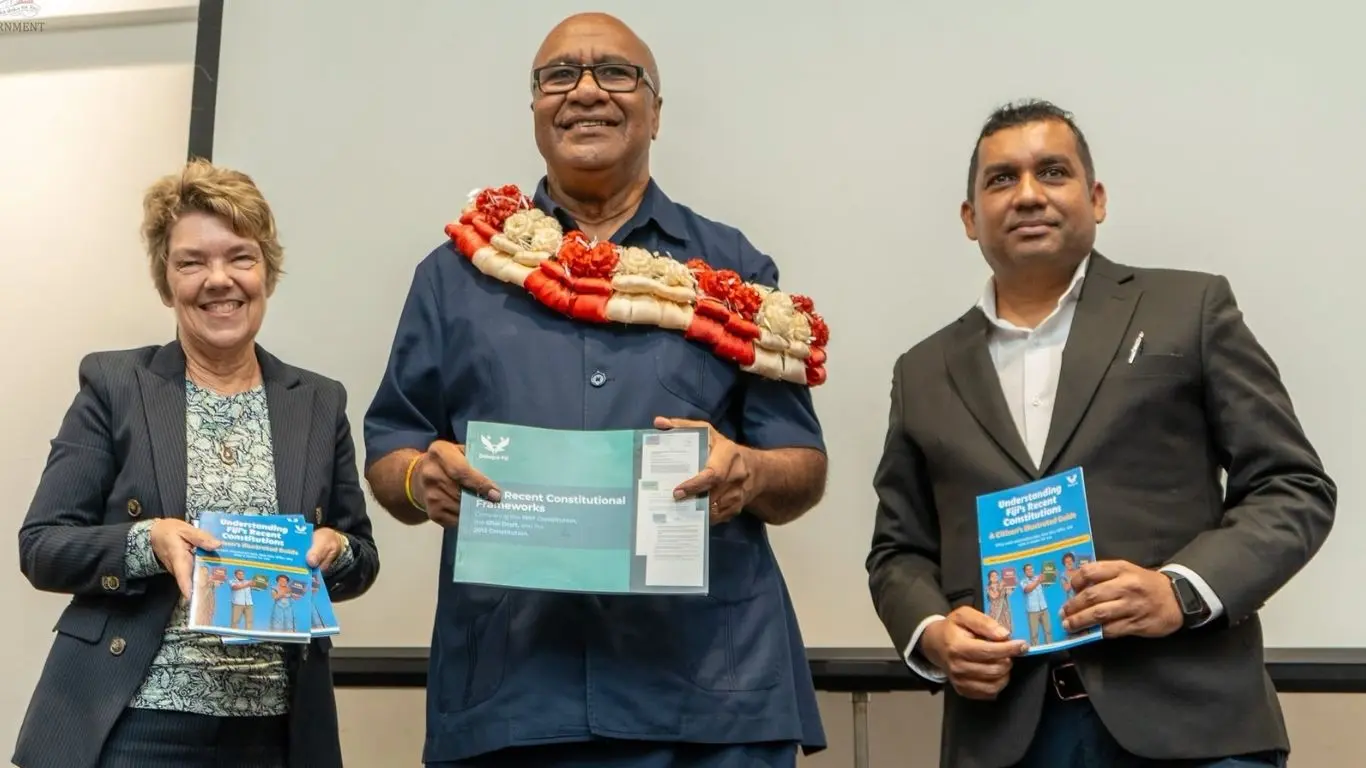
From left: University of the South Pacific academic Associate Professor Sandra Tarte, Deputy Prime Minister Manoa Kamikamica and Dialogue Fiji executive director Nilesh Lal.
Photo: Kaneta Naimatau
Fijians can now compare the 1997 Constitution, the Ghai Draft and the 2013 Constitution side by side after Dialogue Fiji launched two new civic education publications at Tanoa Plaza in Suva on Monday night.
Deputy Prime Minister Manoa Kamikamica officially launched the two books, Fiji’s Recent Constitutional Frameworks and Understanding Fiji’s Recent Constitutions: A Citizen’s Illustrated Guide.
The publications are free to download from Dialogue Fiji’s website http://www.dialoguefiji.org/constitutional-publications
Dialogue Fiji executive director Nilesh Lal said the publications were created because most Fijians did not understand what a constitution actually contained, even though many held strong opinions about which one was good or bad.
“They cannot tell you what the Constitution says about executive power, the appointment of independent institutions, the limitation of rights, the electoral system or the amendment process,” Mr Lal said.
He said the guides compared bills of rights, electoral systems, Parliament, the executive, the judiciary and the role of the Bose Levu Vakaturaga (Great Council of Chiefs), without telling readers which constitution was best.
“It allows people to assess the different provisions individually,” he said, adding that students, teachers, journalists, lawyers and ordinary citizens could all use the resource.
Mr Kamikamica praised the restraint shown in the books.
“They do not tell readers which constitution is best,” he said.
“That restraint is not a weakness. It is the publication’s greatest strength.”
He said the books would reach classrooms, community halls and provincial council meetings, helping farmers in Tailevu, fishermen in Kadavu and market vendors in Ba engage in future constitutional discussions with confidence.
The foreword was written by Professor Steven Ratuva, with the project reviewed by Associate Professor Sandra Tarte and supported by German group Brot für die Welt.