CDD launches campaign hub for aspiring candidates
The resources cover eligibility, nominations, campaign finance, messaging and safety as Fiji prepares for its next general election.
Tuesday 13 October 2026 | 18:30

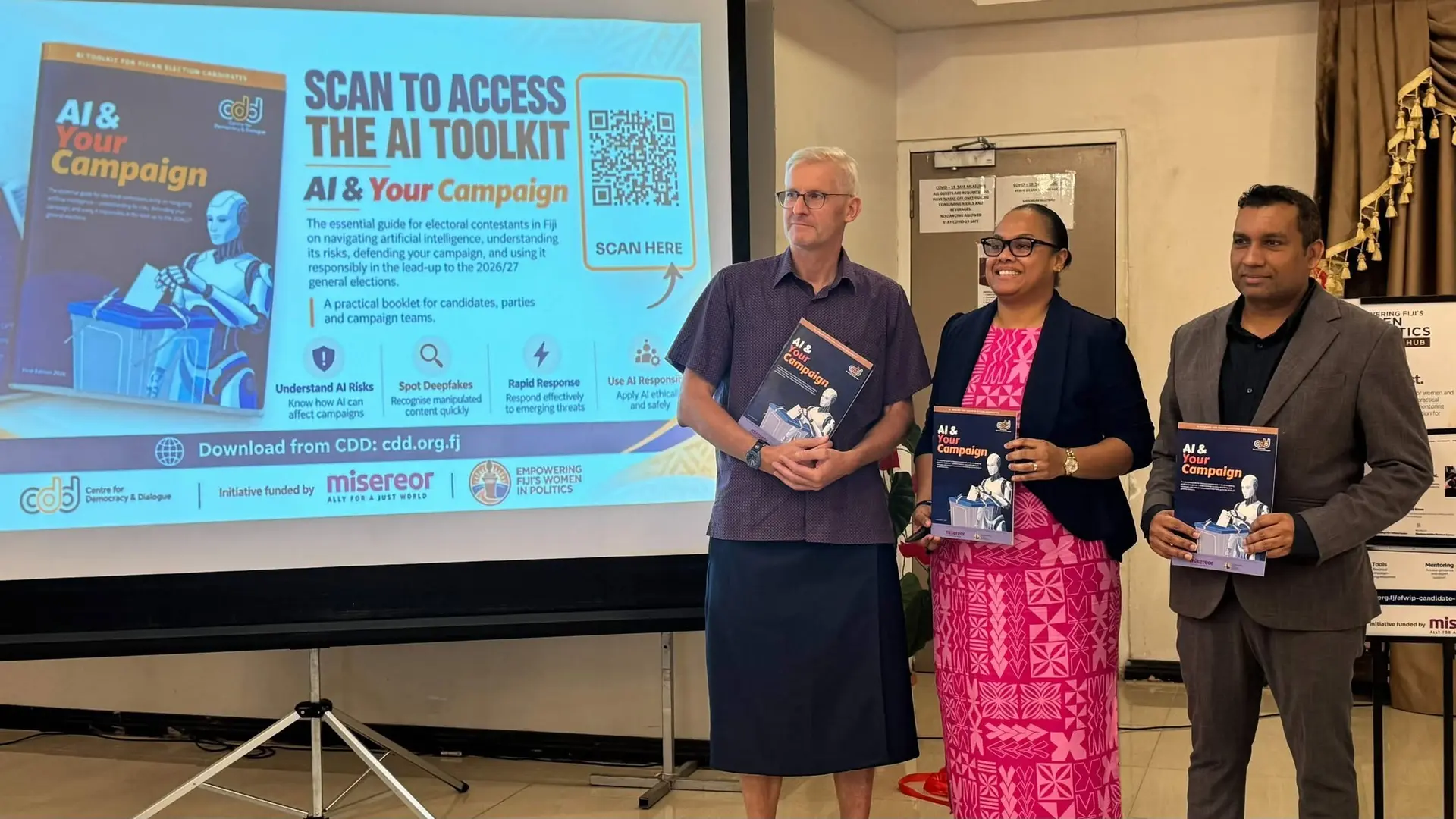
Supervisor of Election Ana Mataiciwa (middle) and Centre for Democracy and Dialogue chief executive officer Nilesh Lal during the official launch of the Electoral Integrity Toolkit- AI & Your Campaign.
Photo: Centre of Democracy & Dialogue
The Centre for Democracy and Dialogue (CDD) has launched new resources to help prospective candidates prepare for Fiji’s next general election and protect themselves against Artificial Intelligence (AI)-generated misinformation.
Speaking at the launch of the Electoral Integrity Toolkit – AI & Your Campaign and the Empowering Fiji’s Women in Politics (EFWiP) Candidates Hub today, CDD chief executive officer Nilesh Lal said the resources would help candidates understand the electoral process, prepare effective campaigns and respond to challenges posed by AI.
Mr Lal said women remained significantly underrepresented in Parliament, despite making up roughly half of Fiji’s population and electorate.
Related stories
“We began the current Parliament with six women elected out of 55 members, itself only 10.9 per cent, and we have since regressed,” he said.
He said CDD, formerly known as Dialogue Fiji, had been working to improve women’s prospects of contesting and winning elections, rather than simply encouraging them to enter politics.
The EFWiP Candidates Hub is an online campaign preparation centre featuring six learning modules covering Fiji’s political system, electoral system, candidacy, communications, campaign finance, leadership and policy.
It also includes practical tools such as an election timeline calculator, eligibility self-check, nomination checklist, campaign budget builder, campaign strategy builder, campaign message builder, women’s candidate safety planner and personal vote target calculator.
Candidates can also access experienced mentors and submit questions to experts to help them make informed campaign decisions.
Mr Lal said although the hub was developed primarily to strengthen women’s political participation, much of its content was available to all prospective candidates, including men.
He said better-prepared candidates could run stronger campaigns, improve compliance with electoral laws and contribute to better-quality electoral competition.
The second resource, a booklet titled AI & Your Campaign, addresses the growing threat of AI-generated deepfakes, voice clones and fabricated political content.
Mr Lal said convincing fake videos, photographs and voice recordings could be produced cheaply and distributed to thousands of voters within minutes. Such content could impersonate candidates, fabricate scandals or spread false voting information.
He said Fiji had laws addressing false electoral statements, online harm and some forms of digital manipulation, but lacked a dedicated regulatory framework requiring AI-generated political content to be identified or labelled.
The booklet teaches candidates how to recognise deepfakes and voice clones, verify suspicious information, respond to attacks, report harmful content and use AI responsibly and ethically in their campaigns.
Mr Lal said the resources were being launched amid uncertainty surrounding the forthcoming general election, including discussions about the constitutional process, a referendum and the Prime Minister’s request concerning the suspension of general election campaigning.
He said the uncertainty particularly affected challenger parties and new candidates, who needed sufficient time to build recognition, organise supporters and plan their campaigns.
CDD hoped the electoral environment would remain as clear, stable and predictable as possible.
Mr Lal acknowledged the longstanding support of Misereor, particularly its partnership in investing in women’s political leadership and strengthening democratic participation.
He also thanked Supervisor of Elections Ana Mataiciwa for formally launching the resources and acknowledged the constructive engagement between the Fijian Elections Office, civil society organisations, political actors and citizens.
“Open communication among these groups was important for maintaining public confidence in the electoral process as Fiji moves towards its next general election,” he said.