Fiji launches new counter-terrorism strategy to target criminal networks
U.S Chargé d’Affaires warns criminal networks could create pathways for terrorism
Saturday 26 September 2026 | 08:30

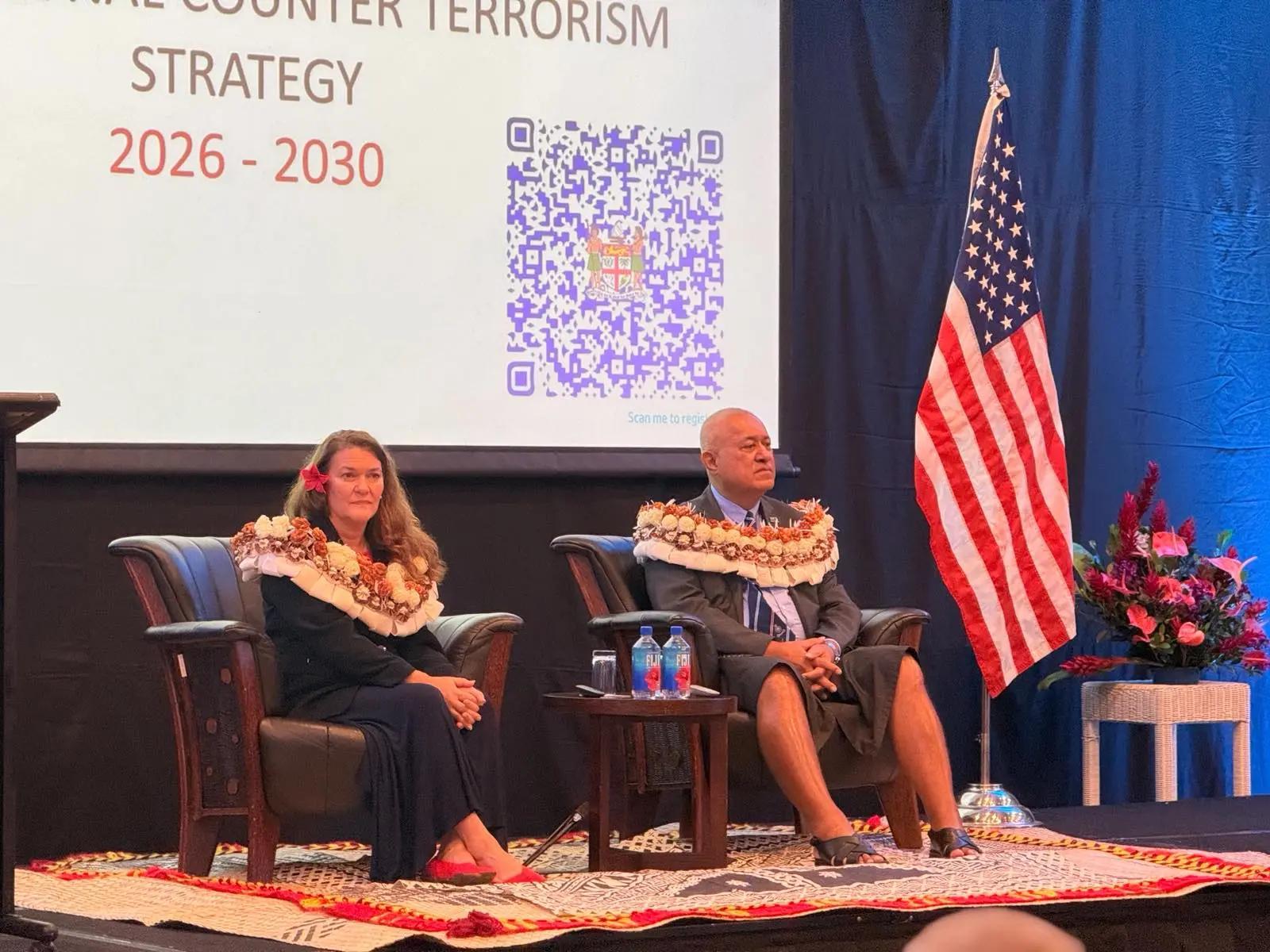
United States Chargé d’Affaires Christina Cavallo and Minister for Policing and Communications Ioane Naivalurua during the launch of the National Counter Terrorism Strategy 2026–2030 at the Grand Pacific Hotel in Suva.
Photo: Asenaca Ratu
Fiji’s new counter-terrorism strategy will target criminal and financial networks that could be exploited to finance terrorism.
Speaking at the launch of the strategy yesterday, United States Chargé d’Affaires Christina Cavallo said transnational crime networks were creating pathways that could be used to support terrorism.
“Terrorism today rarely looks like it did 20 years ago. It is no longer confined to organised cells with political goals,” she said.
Related stories
She said terrorism was increasingly connected to criminal enterprises involving narcotics trafficking, illicit finance, human smuggling and organised transnational crime.
“These networks move through the same maritime choke points and financial systems that touch the Pacific every day.”
Ms Cavallo said strengthening border controls, financial intelligence, maritime domain awareness and interagency coordination would help close criminal pathways that could be exploited by extremists.
“Fiji is not simply preparing for a hypothetical terrorist attack, it is closing off the criminal pathways that could someday be exploited by those with far more destructive intent if left unaddressed,” she said.
Minister for Policing and Communications Ioane Naivalurua said Fiji remained at peace but could not ignore the threat of terrorism.
“Radicalisation can occur online, extremist ideas can spread rapidly and violence can emerge from individual differences with little warning at all,” he said.
Mr Naivalurua said Fiji’s response must address the intersection of illicit drugs, firearms, money laundering, cyber-enabled crime, trafficking and extremist activity across physical, financial, maritime and digital domains.
The United States provided US$500,000 (about FJ$1.1 million) for secure communications capabilities for the Republic of Fiji Navy to help track and disrupt transnational crime and illegal fishing.
It has also committed US$5.14 million over five years for infectious disease detection and containment, and a US$12 million (FJ$26 million) Millennium Challenge Corporation grant for Fiji’s long-term economic development.