Fiji’s ‘farming ants’ face threat from invasive species
USP PhD research highlights spread of invasive ants in Vanua Levu and Taveuni upland forests
Thursday 17 September 2026 | 12:30
Updated 17 September 2026 | 13:45 FJT

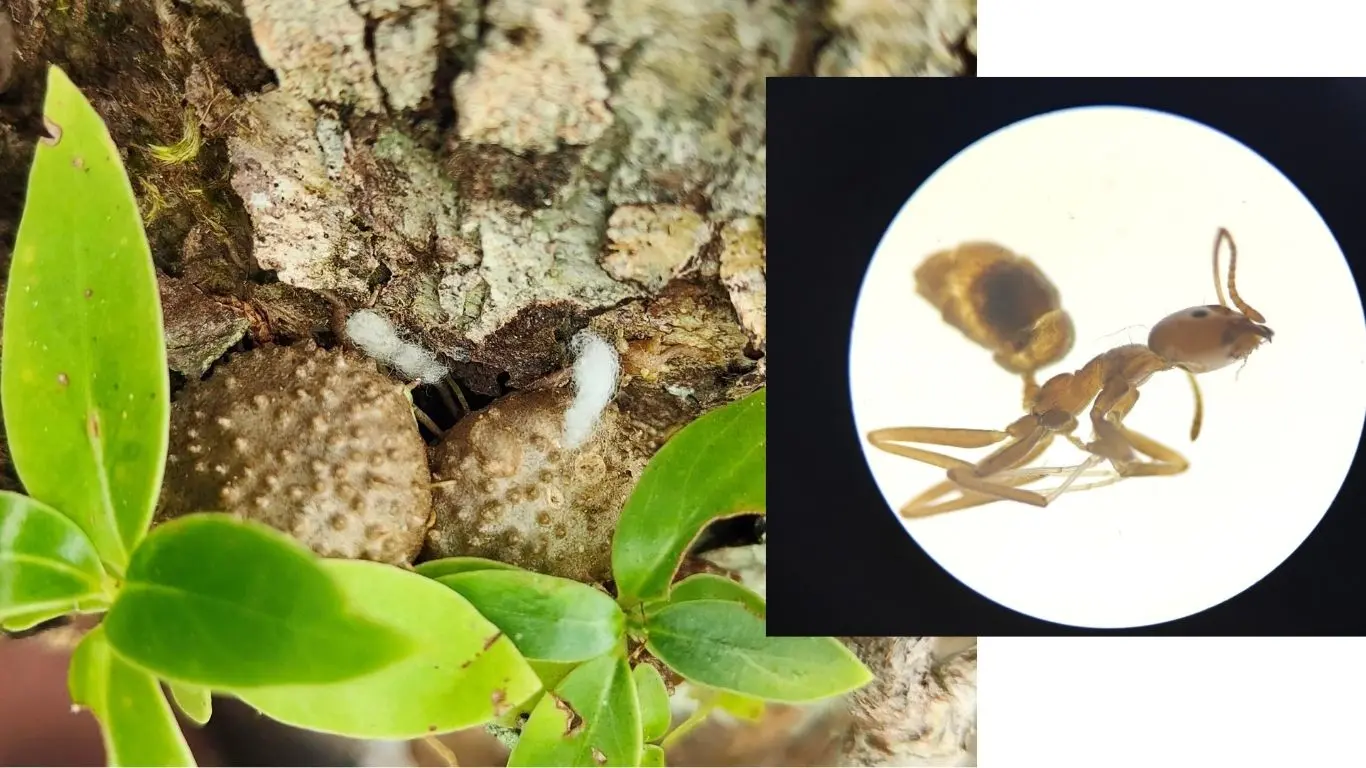
Two young Squamellaria imberbis growing on host tree. Inset: White-footed ant (Technomyrmex vitiensis).
Fiji’s unique ant-farming system, which has existed for millions of years, is under threat from invasive ants that are displacing the native species that helps six plant species found nowhere else on Earth survive.
University of the South Pacific PhD candidate Umar Diarra has raised concerns over the spread of the white-footed ant (Technomyrmex vitiensis) in the upland forests of Vanua Levu and Taveuni.
The invasive species threatens the native farming ant (Philidris nagasau), which maintains a remarkable partnership with plants in the coffee family known as Squamellaria.
Related stories
Mr Diarra said the disappearance of the farming ants could lead to the loss of an entire evolutionary system unique to Fiji.
“When Philidris nagasau disappears, the plants lose everything, seed dispersal, fertilisation, and protection,” he said. “And without those services, they die.”
The discovery forms part of Mr Diarra’s research into why some ecological partnerships survive for millions of years while others break down.
Fiji provides a rare research setting, with different types of ant-plant relationships occurring in the same forests, allowing scientists to compare how these systems function and respond to environmental changes.
Among the plants studied are six obligate Squamellaria species, which depend entirely on Philidris nagasau for survival.
The ants plant the seeds, care for the plants as they grow and fertilise them using their waste, while the plants provide shelter and food for the ants.
Mr Diarra said the relationship represented agriculture carried out by a non-human animal.
“These ants don’t just live in the plants, they depend on them completely,” he said.
“They expand their colonies by farming new plants. It’s agriculture in every sense of the word.”
Potential for medicine and agriculture
Beyond documenting the ants’ farming practices, Mr Diarra’s research has identified diverse microbial communities within the plants’ waste chambers, including previously unknown bacteria with potentially valuable properties.
He said some bacteria appeared to produce antibiotics that could suppress harmful pathogens and protect the plants from disease.
“One of my most important findings is the discovery of antibiotic-producing bacteria living inside these plants,” he said.
“Many of these bacteria appear to be new to science.”
The findings could offer opportunities for developing natural antibiotics and supporting sustainable agriculture, with some bacteria also showing plant growth-promoting properties.
However, Mr Diarra said the spread of invasive ants was closely linked to forest disturbance, highlighting the need for careful land management.
“The spread of invasive ants is strongly linked to forest disturbance,” he said.
“Protecting these species means thinking carefully about how we use and manage our land.”
Through his research, Mr Diarra hopes to encourage greater awareness of Fiji’s natural heritage and inspire young Fijians to pursue scientific research.
“Some of the biggest questions in biology may already have their answers right here at home,” he said.