KOICA-Funded Project To Strengthen Disaster Response And Evacuation Center’s
Korea will provide US$6 million (about FJ$12 million) between 2022 and 2025 to fund the project, which will be led by International Organization for Migration (IOM) in partnership with the Save the Children Fiji and National Disaster Management Office (NDMO).
Sunday 21 August 2022 | 23:49
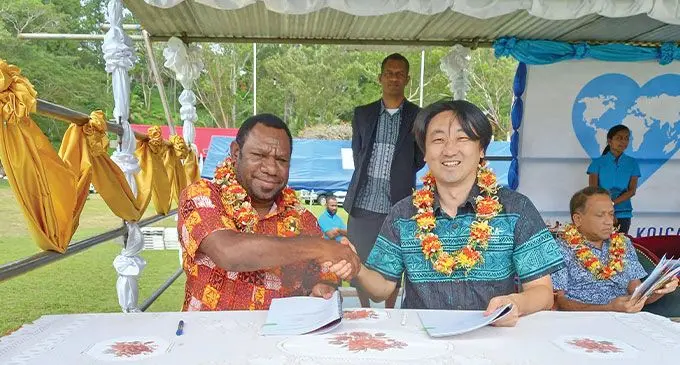
KOICA Fiji Country Director a Kap-chae Ra and the Chief of Mission for IOM Fiji Solomon Kantha sign the Funding Agreement at CATD Nadave in Tailevu in commemoration of the World Humanitarian Day.
Korea will provide US$6 million (about FJ$12 million) between 2022 and 2025 to fund the project, which will be led by International Organization for Migration (IOM) in partnership with the Save the Children Fiji and National Disaster Management Office (NDMO).
The capacity of communities and national level authorities to respond to disasters will be strengthened through improved disaster response systems, and the construction of four evacuation centres and retrofit of existing shelters.
The Korea International Cooperation Agency (KOICA) will provide US$6 million between 2022 and 2025 to fund the project, which will be led by International Organization for Migration (IOM) in partnership with the Save the Children Fiji and National Disaster Management Office (NDMO).
Related stories
“The Korean Government is proud to support Fiji through KOICA to improve its national management responses, which will benefit the people of Fiji, wherever disasters occur,” said Ambassador of the Republic of Korea to Fiji, Young-Kyu Park, at the event launch.
The project has two outcomes. Firstly, it will strengthen the Government of Fiji’s ability to prevent, respond to and manage disaster and displacement risks.
IOM and NDMO will work together to develop a national evacuation centre management guideline.
This will ensure clear roles and responsibilities for community and government during crisis.
IOM will provide training on Evacuation Management and Community-based Disaster Risk Management, ensuring strong attention on gender and protection issues during emergencies.
NDMO’s information management systems will be updated so that Fiji can efficiently predict, understand, and respond to humanitarian needs data, and therefore respond quickly and effectively.
“IOM is the lead agency on the Evacuation Centre Management & Displacement (ECMD) cluster in the Pacific Humanitarian Team and has global expertise on issues related to displacement management in humanitarian contexts, so we look forward to working closely with NDMO in this project on improving national response procedures,” said IOM chief of mission in Fiji, Solomon Kantha.
The second outcome provides improved evacuation facilities and management processes in four locations.
Evacuation centres will be built or refurbished in remote and high-risk locations.
The locations will be determined early in the project in coordination with NDMO, community and provincial authorities.
The evacuation centres will be designed to serve as a venue for community activities, including for income generating activities for women.
“This project will provide a blueprint for future evacuation centre refurbishment and construction across Fiji. Multi-purpose evacuation centres will provide both protection and economic benefit to communities,” said NDMO director Vasiti Soko.
Community-based committees will be identified or established to oversee project activities, to develop Community-based Disaster Response Management Plans, and improve systems and training on preparedness, early warning systems, and response.
This will include training on protection for women and people with disabilities.
Save the Children Fiji chief executive officer, Shairana Ali, noted that market vendor, financial, and social empowerment training and resources will be provided by Save the Children Fiji.
“We know that women’s empowerment and collaborative community involvement are always critical to long-term resilience and to improve children’s well-being,” Ali said.