$1,085,302 for Lamini Seawall Project, Taveuni
Sea-level rise, coastal erosion and cyclones are occurring at an increasing frequency, an inevitable force that we haven’t experienced before.
Saturday 23 March 2019 | 14:40

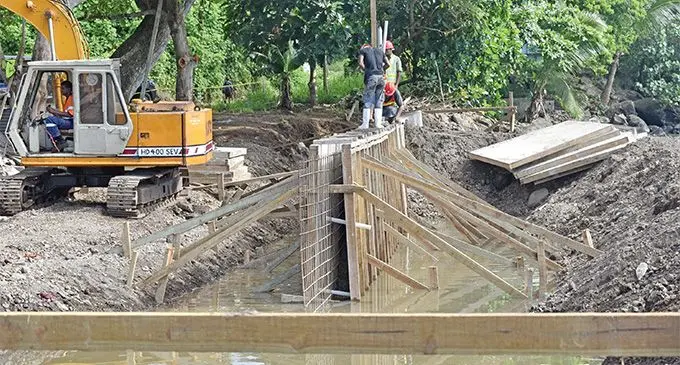
The construction of the seawall at Lamini Village in Taveuni Island underway. Photo: Ministry of Agriculture, Rural and Maritime Development, Waterways and Environment
The Minister for Agriculture, Rural and Maritime Development, Waterways and Environment Mahendra Reddy commissioned the project for a stone masonry seawall at Lamini Village, Taveuni on Wednesday.
Through its contractor they will retrofit the deteriorating seawall by constructing a stone masonry seawall in front of the existing seawall.
“The existing seawall at Lamini Village was built in 1995 with a boulder masonry wall,” Mr Reddy said.
Related stories
“Over the years, the seawall has been affected by the waves causing damage to it.
Moreover, the height of the existing seawall was approximately the same level of the village ground, tides and waves during cyclones led to the inundation of the village ground and homes.”
“To address the above, the proposed coastal protection works consists of 315 metres long stone masonry seawall,” he said.
“Furthermore, the height of the new seawall has been designed 2.5 metres to cater for waves associated with extreme events such as cyclones.
“Also included in this project are drainage systems, boat landing, culvert crossing, and footpaths.
“The work will be undertaken by Viti Vanua Holding at a cost of $1,085,302 for the period of 180 calendar days.”
“We live in a part of the world where sea-level rise, coastal erosion, and cyclones are occurring at an increasing frequency, an inevitable force that we haven’t experienced before,” he said.
“It is obvious that despite all our efforts, we have a long way to go to keep the sea at bay and our livelihood intact.
“While this intervention would reduce the exposure of the community and increase your adaptive capacity, this measure would keep you safe of events within its design capacity.
“As such I humbly request all of you to also invest in ecosystem-based approaches to further increase your resilience.
“We need to learn to co-exist with nature.”
Edited by Susana Tuilau
Feedback: shratika.naidu@fijisun.com.fj