Australia commits $23.5m to Fiji's HIV response, says there's no quick fix
Australia's total HIV support for Fiji now exceeds $40 million.
Friday 07 August 2026 | 09:00
Updated 07 August 2026 | 11:13 FJT
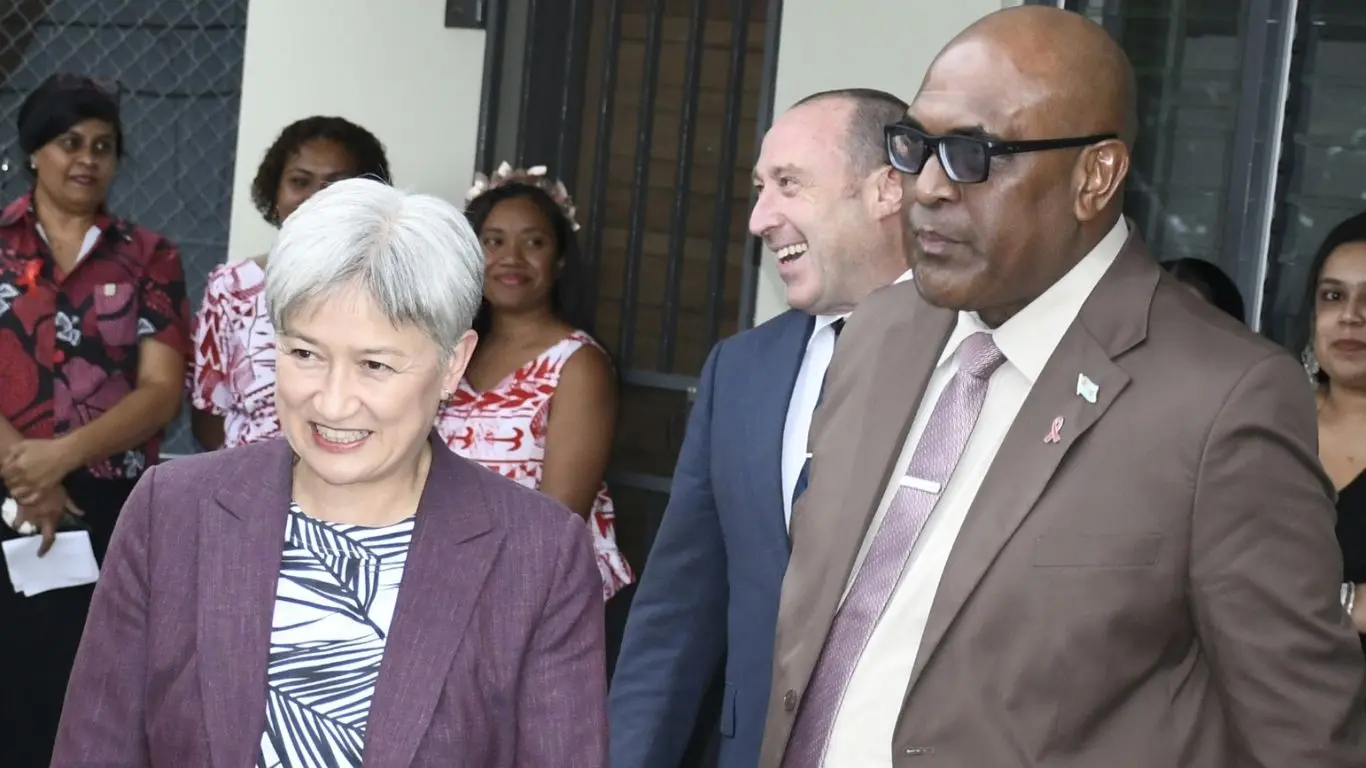
Australian Foreign Minister Senator Penny Wong and Minister for Health Dr Ratu Atonio Lalabalavu during the opening of the Sexual and Reproductive Health (SRH) and HIV Unit office in Suva on August 6, 2026.
Photo: Ronald Kumar
Australia has committed a further $23.5 million to Fiji's HIV response, warning there is no quick fix to the country's escalating outbreak.
Speaking at the opening of Fiji's National Sexual and Reproductive Health and HIV Office in Suva yesterday, Australia's Foreign Minister, Senator Penny Wong, said the funding would strengthen HIV prevention, health worker training, workplace support, community outreach, and the supply of essential medicines and equipment.
"I hope it makes a difference, and we believe it will make a difference, but we also know this is a very serious challenge," she said.
Related stories
"This is a whole-of-community response that is required. No single leader, no single programme will deal with this challenge. The whole community has to be engaged."
The latest commitment is in addition to Australia's earlier AU$12m (about FJ$18.6m) contribution, taking its total support for Fiji's HIV response to more than FJ$40m.
Ms Wong said Fiji was facing the fastest-growing HIV outbreak in the world, making it not only a public health issue but also a regional security concern.
"Our support recognises that this is a health challenge, but it is also a security challenge," she said.
She said Australia remained committed to supporting Fiji's health system while assisting efforts to combat transnational crime and illicit drug trafficking, which have contributed to the spread of HIV through unsafe injecting drug use.
Asked whether Australia would support the establishment of more drug rehabilitation centres, Ms Wong said Fiji was best placed to determine how assistance should be directed.
"We respond to Fiji's priorities," she said.
"Communities are partners in the fight against HIV. It is important to work in partnership with community leaders, health leaders, and faith leaders because they know what will work best."
Ms Wong also praised frontline health workers and community organisations, saying stigma remained one of the biggest barriers to controlling HIV.
"I thought the minister's comments about stigma not protecting people were a very powerful act of leadership," she said.
Fiji's HIV outbreak has escalated sharply over the past three years, with more than 2,000 new cases recorded in 2025, compared with 1,583 in 2024 and 415 in 2023.
Health officials say about 80 per cent of new infections are among people aged 15 to 34, with the highest number recorded in the 20 to 24 age group.
The Central Division continues to account for most infections, while unsafe injecting drug use and mother-to-child transmission remain major drivers of the outbreak.
Head of Fiji's HIV Taskforce Dr Jason Mitchell said Australia's assistance would strengthen Fiji's ability to respond to the epidemic.
"It will make a whole lot of difference in terms of delivering services," Dr Mitchell said.
"The support we get from the Australian Government really helps us in terms of technical assistance.
"What we're trying to build here in response in Fiji is quite new to the country, so the support coming from the Australian Government really helps build that."
Dr Mitchell said the funding was not direct budget support for the Ministry of Health but focused on technical expertise and strengthening Fiji's HIV response systems.
"It's not money that comes directly to the ministry for us to use. This support, really, is about technical assistance to the country," he said.