Students know HIV basics but lack knowledge of testing, treatment
Survey involving more than 1,600 students highlights need for stronger school education
Tuesday 25 August 2026 | 17:00

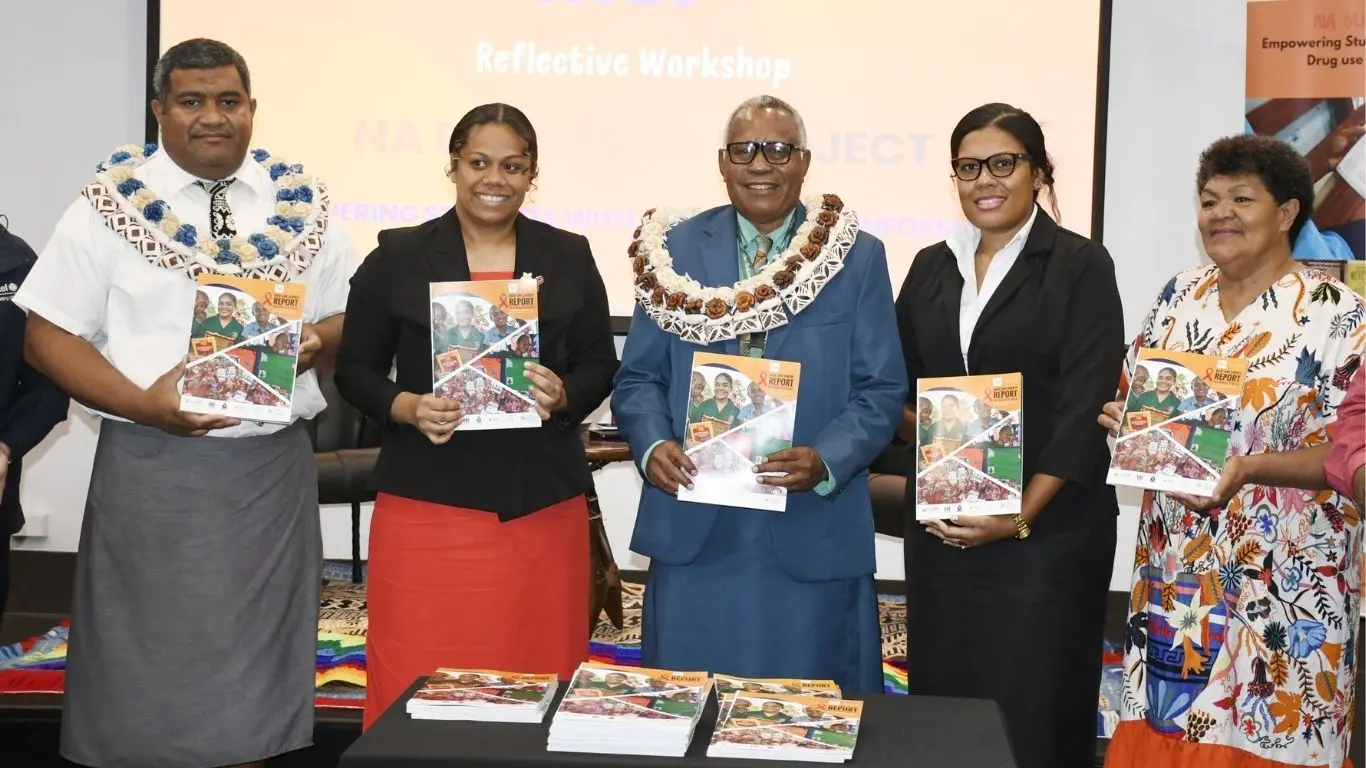
Assistant Minister for Education Iliesa Vanawalu (centre) during the launch of the Empowering Students with HIV and Drug Use Information Reflective Workshop and Baseline Survey Report on August 25, 2026.
Photo: Ronald Kumar
More than 1,600 students in six schools across the Central and Western divisions have been reached through a year-long initiative aimed at strengthening young people’s understanding of HIV and drug use.
Medical Services Pacific (MSP) country director Kesaia Tuidraki said the Na Bula E Dua – Empowering Students with HIV and Drug Use Information project provided an opportunity to assess students’ knowledge of HIV and substance abuse and identify areas where further education was needed.
She made the comments during the Reflective Workshop and Baseline Survey Report Launch at the Holiday Inn in Suva today.
Related stories
Ms Tuidraki said the initiative focused on young people, who faced risks related to HIV, drugs and other health concerns.
The baseline survey showed that while many students understood the basic facts about HIV and how it could be prevented, gaps remained in their knowledge of testing, treatment, available support services and HIV-related stigma.
“These findings tell us that awareness alone is not enough,” Ms Tuidraki said.
She said students needed to know where they could safely obtain information, testing, treatment and other forms of assistance.
Ms Tuidraki also called for stronger Family Life Education in schools and better preparation for teachers so they could confidently provide age-appropriate information on HIV prevention, sexual and reproductive health and drug use.
She said the project had also strengthened partnerships between schools, Government agencies, parents, teachers and organisations working in health and community development.
The initiative was supported by The Church of Jesus Christ of Latter-day Saints, with assistance from the Ministry of Health and Medical Services, Ministry of Education, National Substance Abuse Advisory Council and other development and technical partners.
Ms Tuidraki said the support would allow MSP to continue the initiative next year and reach additional schools, particularly in the Central and Western divisions.
Assistant Minister for Education Iliesa Vanawalu officially launched the baseline survey report and said the findings provided useful evidence for strengthening the education sector’s response.
He said prevention needed to start early, with students receiving accurate, age-appropriate and sustained information throughout their education.
Mr Vanawalu said the Ministry of Education was reviewing its national policy framework for the management of HIV and AIDS in schools.
He said the review would consider school-level procedures, confidentiality, non-discrimination, training and referral pathways to ensure students and their families knew where support was available.
Mr Vanawalu said schools could not address HIV and substance abuse alone and called for continued cooperation between Government agencies, parents, communities, civil society organisations and young people.