Editorial: Choose Wisely Which Party You Want To Govern Country In Next 4 Years
-
Wednesday 14 March 2018 | 09:00
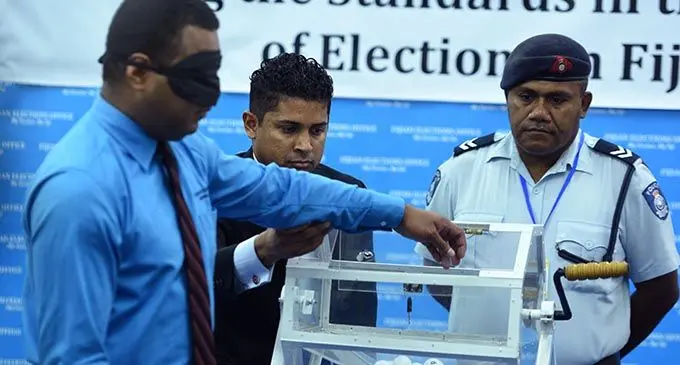
Supervisor of Elections Mohammed Saneem (second from left), supports the arm of a blindfolded man towards the box to draw a number on Monday, May 15, 2017. Photo: Jone Luvenitoga
The time is nigh when the people of Fiji should start considering who they want to run the country and its affairs for the next four years.
Soon we will go to the polls to choose the party that will form the next government.
It is time we start looking at the provisional candidates named by the political parties to contest the election. So far only the National Federation Party and SODELPA have released their first batches of provisional candidates.
Related stories
Other parties are expected to announce their provisional candidates soon.
Voters should start scrutinising the provisional candidates. Candidates can be judged in two ways – the positions they take on issues and the leadership qualities and experience they would bring to the office.
The League of Women Voters (LWV) in the United States says both are important. Your first step is to decide which issues you care about and the qualities you want in a leader. When you consider issues, think about community, state and national problems that you want people in the Government to address. No one can doubt that what the FijiFirst Government has done to uplift the living standards of all the people of Fiji is unprecedented.
Politics and criticisms aside – the development, especially in the rural areas will carry on as the Government continues to level the playing field between those living in the urban areas and those striving to make ends meet in the rural and maritime areas.
Sure the Government may have its downsides but which Government does not have any?
When you consider leadership qualities, think about the characteristics you believe an effective leader would have.
Do you look for intelligence, honesty, an ability to communicate? What else?
Gather as much information on them as possible.
LWV says pamphlets and flyers slipped under your door or handed to you at the store may contain valid substantive information or it may be full of superficial imagery or even lies, distortions, or evasions.
Read it critically. Does it tell you more about the candidate’s devotion to family than about qualifications or stands on issues? Be on the lookout for accusations or other statements about opponents, especially if made so close to election day that they can’t be answered or denied.
Don’t be side-tracked, either, by attacks on a candidate based on family, ethnicity, gender, race, or personal characteristics that don’t make a difference in performance. Politics is a tough game, but badgering and intimidation are unfair campaign tactics.
Think twice about a candidate who tries to make an opponent look weak or out of control by harassment until she or he flies off the handle or says something rash.
Promising the sky — There are promises that one in an elective office can fulfill and problems that are beyond the reach of political solutions.
Public officials can accomplish realistic goals, but voters shouldn’t expect miracles and candidates shouldn’t promise them. When you hear nothing but “promises, promises,” consider how realistic those promises really are.
Examine the issues that are important to you. Decide what changes you feel that your community and country need most. Which of your interests are served by the programmes each candidate is proposing? Many candidates work very hard to avoid giving direct answers to direct questions and the candidate who claims to have a secret, easy plan to solve a tough problem is just copping out.
Watch out for candidates who talk about benefits and never mention costs or how the nuts and bolts of a programme will work. Deciding if a candidate will be a good leader is difficult. How can you know if someone will be honest, open and able to act under pressure if elected to office? Here are some ways to read between the lines:
Look at the candidates’ background and experience. How well prepared are they for the job?
Watch the candidates in action. Do they accept speaking engagements or participate in debates before diverse groups, even groups that may not be sympathetic? Read the campaign material carefully to find any insights into the candidates’ personalities. Do they emphasize issues or just image? Are they accurate? All these ideas will help you make an intelligent choice.
Charles Chambers
Feedback: charles.chambers@fijisun.com.fj