Pacific leaders told: Enough talk, act on security
Palau’s Minister for Justice Jennifer S. Olegeriil said the Pacific already had a clear vision but needed sustained political commitment to deliver it.
Thursday 03 September 2026 | 07:00
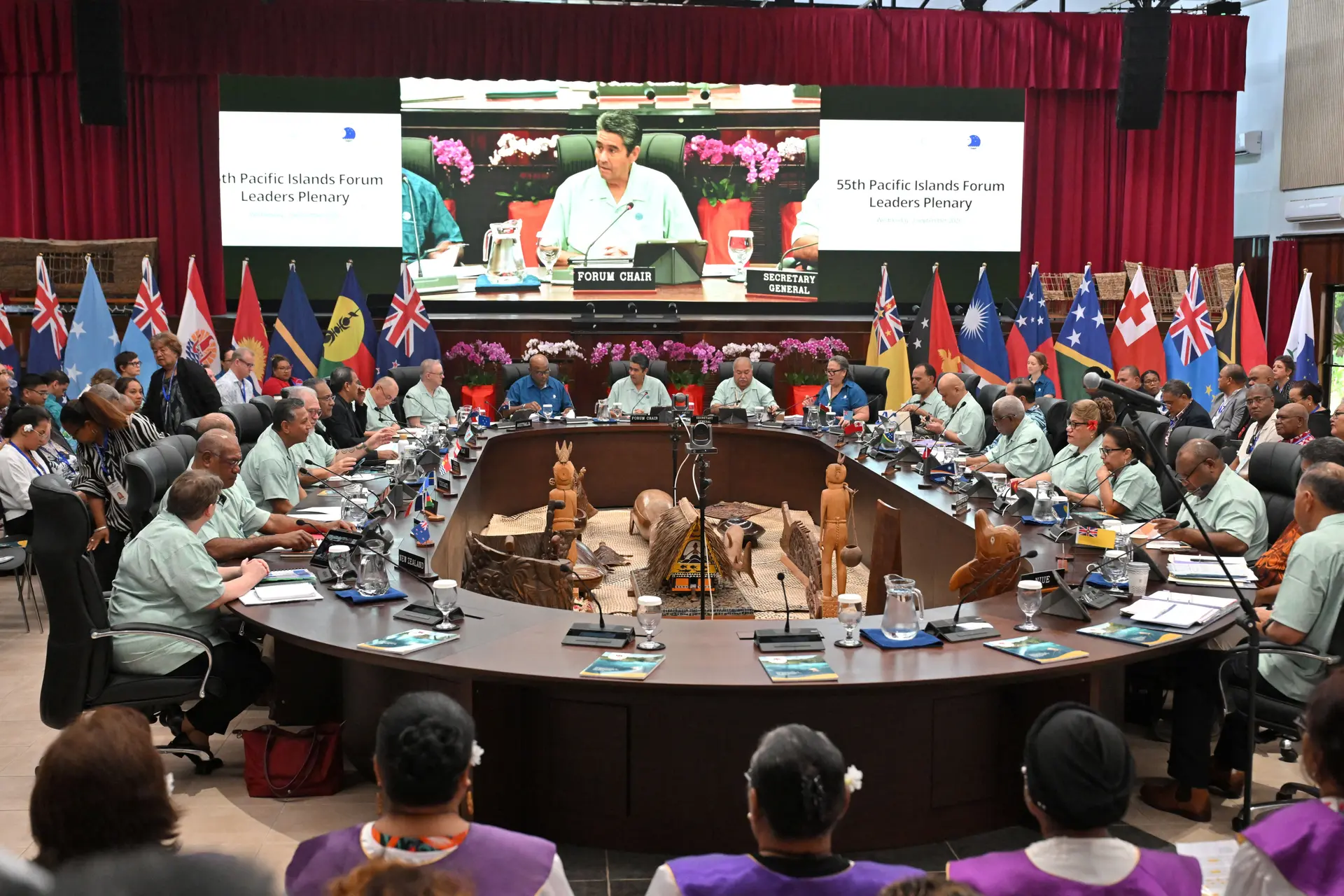
Pacific Island Forum leaders during the Pacific Island Forum leaders meeting in Koror, Palau.
AAP IMAGE
Pacific governments have been challenged to turn years of regional security commitments into tangible results, with leaders warned that political declarations mean little unless communities see changes in their daily lives.
The call emerged during a security dialogue on the margins of the 55th Pacific Islands Forum Leaders’ Meeting, where government, civil society, education and regional representatives identified political will and better coordination as critical to addressing growing threats including transnational crime, drugs, cyber threats, climate change and online harms.
Palau’s Minister for Justice Jennifer S. Olegeriil said the Pacific already had a clear vision but needed sustained political commitment to deliver it.
Related stories
“The Pacific has been very clear about the region we want it to be. We certainly have the vision. It’s about turning those visions into heartfelt, tangible outcomes. It must start with political will, and perhaps even more importantly, for that political will to continue,” she said.
She said countries had different capabilities, making regional cooperation critical when confronting threats that crossed national borders.
“The Pacific is not a one-size-fits-all. We don't all need to have the same capabilities, but we do need to know what we can do ourselves, where we have gaps, and where we can rely on one another. Regionalism – that to me is the value of being a region,” Minister Olegeriil said.
“How do we build the relationships that allow us to respond together when a challenge crosses our borders? Because the threats we are dealing with today do not respect those borders. Whether we are talking about transnational organised crime, cyber threats, maritime security, climate-related challenges, or other emerging risks – no single country can address all of these issues alone.”
‘Commitments must be executed’
Tuvalu’s Minister of Foreign Affairs, Labour and Trade Paulson Panapa said political will meant maintaining Pacific unity despite pressure created by geopolitical competition.
“Political will is expressed when leaders deliberately prioritise regional solidarity, even when geopolitical competition pressures countries to act alone,” he said.
“The region has strong frameworks. We have the Boe Declaration, the 2050 Strategy, Blue Pacific Ocean of Peace, but political will means ensuring that these commitments are executed, not just referenced.
“Political will is shown when leaders ensure security decisions reflect Pacific values, community voices, and holistic definitions of security.”
Mr Panapa said implementation should continue throughout the year instead of relying on annual leaders’ meetings.
“Momentum requires structure, predictable political engagement through the year…to keep leaders connected to implementation, rather than waiting for the annual summit,” he said.
Fiji expert: Use what we have
Dr Manu Tupou-Roosen, head of the School of Ecology and Resilience Development at the Pasifika Communities University in Fiji, said creating more regional institutions was not the answer.
“As Pacific people, we've shown consistently that when we work together, we can achieve anything, as long as we have a common purpose and common will,” she said.
“The Pacific already benefits from very rich, diverse and capable regional mechanism organisations, so I don't think that the primary challenge is a lack of institutions. Rather, it's ensuring that our regional architecture operates in a coherent and connected way and ensuring that regional architecture continues to work in support of the priorities established not just by our leaders but by our people at any level, including in the community.”
She identified maritime, food, energy and economic security, gender-based violence, drugs, health crises and online harms among the interconnected challenges facing the region.
“[It’s] not about creating more institutions, [but] making the best use of what we’ve got,” she said.
‘Enough of talking’
Palauan disability rights advocate Villaney Remengesau delivered one of the strongest calls for action, saying Pacific people needed to see results from regional commitments.
“If we meet again in three to five years, we want to see real changes in our lives, in our daily lives. Enough of talking. We need action,” she said.
“We want to see a stronger community that is resilient, better prepared for climate change and disaster. We also want to see stronger economic and energy security, more opportunities for our people. We also want to see safer communities, that is that we have protection for our people against online and offline threats and organised crimes.
“And we want to see more younger people involved in the decision-making process because the decisions made today will impact their future.”
She also called for regional organisations and development partners to improve coordination.
“We need to ensure that our regional organisations and development partners work closely together, are better coordinated, so they can deliver better results for the people,” she said.
“We have many priorities, but we don't see the results affecting the lives of our people. So, we want actions. We want to see the results.”
The discussion coincided with the launch of the 2026 Pacific Peace and Security Dialogue Report, which describes the interconnected security challenges facing the region as a “polycrisis”.