President warns Pacific must be better prepared for drug, injecting challenges
Ratu Naiqama Lalabalavu puts prevention, testing and human rights at centre of HIV response
Tuesday 18 August 2026 | 05:00

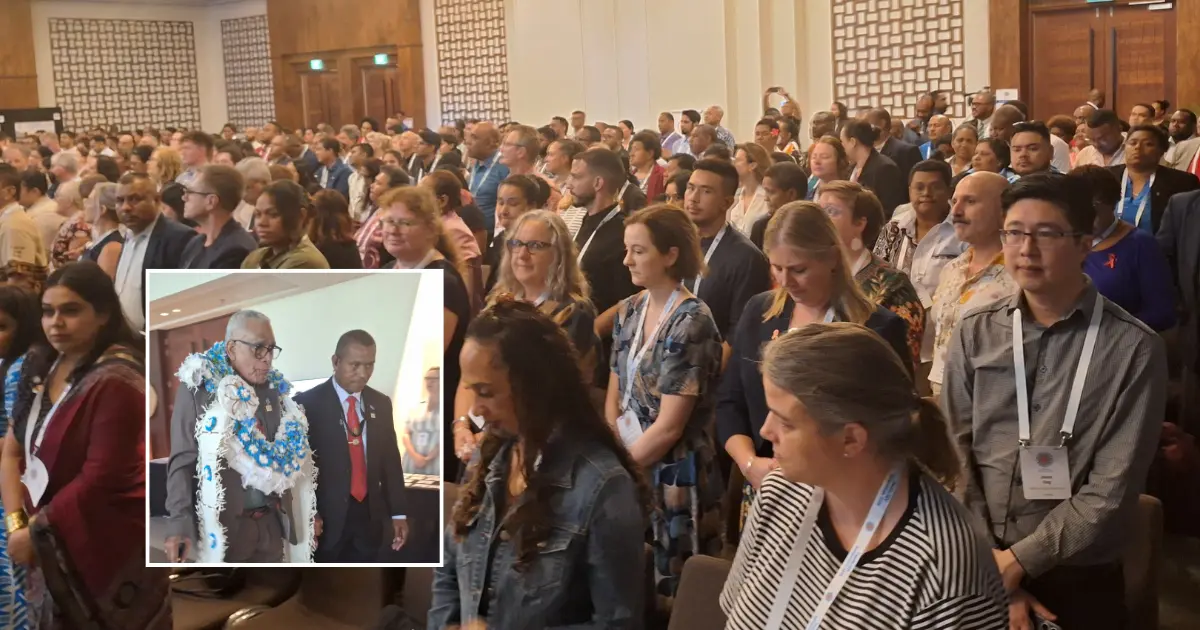
President Ratu Naiqama Lalabalavu (inset) and delegates at the inaugural Pacific HIV Symposium 2026 at the Sheraton Fiji Golf and Beach Resort, Denarau, Nadi, on August 17, 2026.
Photo: Waisea Nasokia
Pacific countries, including Fiji, must strengthen their collective response to HIV by placing prevention, accessible testing, treatment and human rights at the centre of their health systems, says President Ratu Naiqama Lalabalavu.
Speaking at the inaugural Pacific HIV Symposium 2026 at the Sheraton Fiji Golf and Beach Resort in Denarau, Nadi yesterday, Ratu Naiqama proposed seven practical commitments to guide the region’s response to the 2030 global HIV targets.
He said the symposium was more than a conference, describing it as a gathering focused on human rights, dignity, health-system strength, community resilience and the future security of the Pacific.
Related stories
The first commitment is to put prevention at the centre through biomedical, behavioural and community-led approaches, including evidence-based harm reduction.
The second is to make HIV testing routine, accessible and confidential while ensuring every diagnosis is rapidly linked to treatment.
He also called for stronger retention in care, medicine security, viral-load monitoring and greater public understanding of effective treatment.
Ratu Naiqama said eliminating mother-to-child transmission must become a regional priority, with particular attention to antenatal care, infants, children and adolescents.
He further called for stronger action against stigma and discrimination and greater protection of confidentiality, human dignity and equitable access to services.
Community leaders, people living with HIV, peer-support groups and community organisations, he said, must have a greater role in designing and delivering the regional response.
The seventh commitment focuses on a sustained and coordinated response covering prevention, treatment, human rights, mental health, co-infections, drug use, harm reduction and care for children and adolescents.
“We are different parts of one human journey, a journey from risk to prevention, from uncertainty to testing, from diagnosis to treatment, and from treatment to virus suppression, and from fear and stigma to hope,” he said.
Ratu Naiqama also highlighted the growing drug challenge and injecting practices in the Pacific, saying countries had not been adequately prepared.
“The ocean that surrounds us connects our people and carries our hope,” he said.
“Let us equip ourselves. Let us equip the frontline. Let us learn from one another. The urgency at this moment demands it.”