CRC report was never a draft Constitution: A-G
Mr Valenitabua said the recommendations were submitted to the President, who then presented them to Government for consideration.
Thursday 05 November 2026 | 09:30

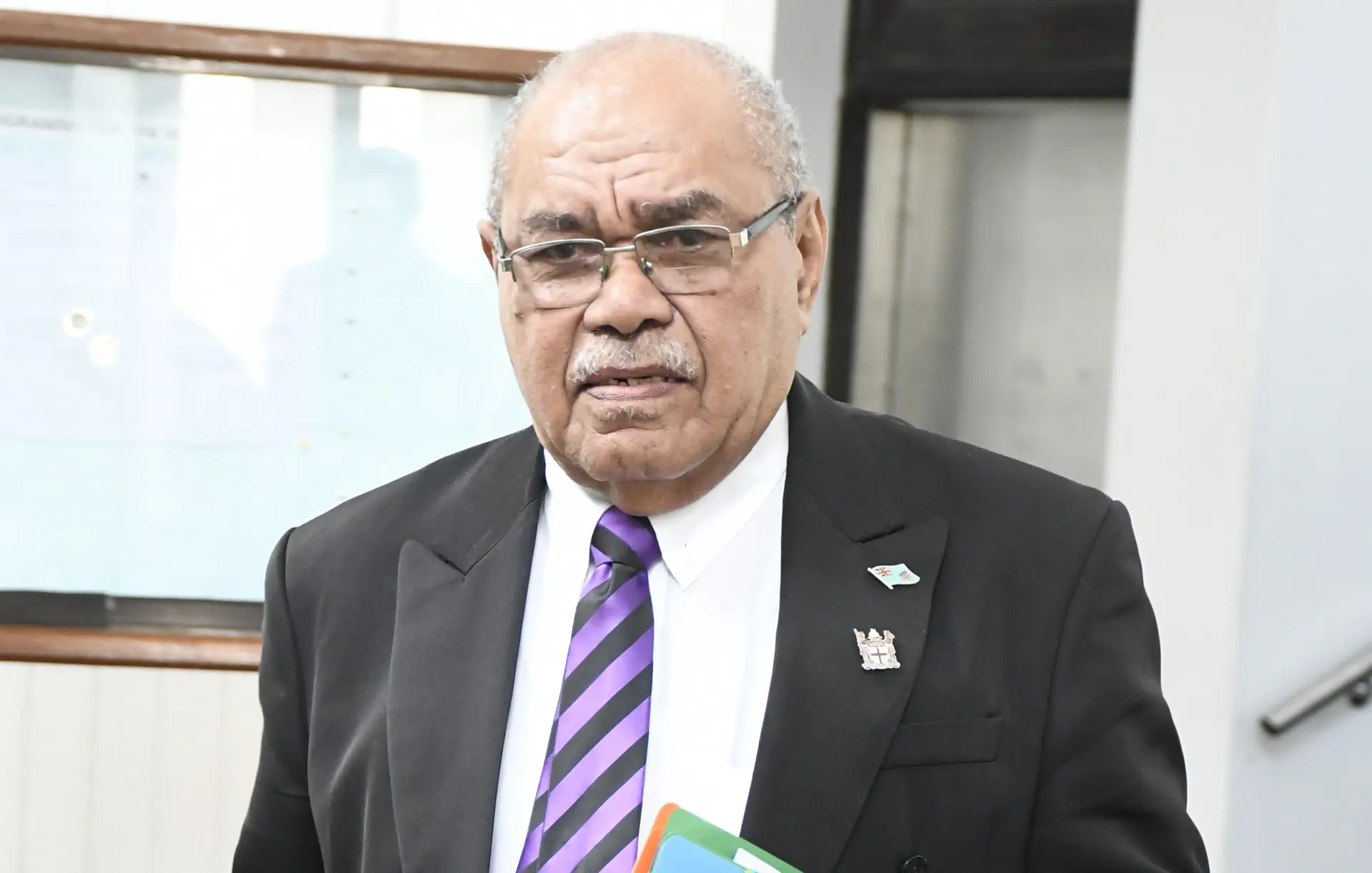
Attorney-General Sevuloni Valenitabua says the Constitution Review Commission’s (CRC) Report should not be regarded as a draft Constitution.
He said the commission was mandated to present recommendations based on public consultations.
Mr Valenitabua, who chaired the CRC, made the clarification amid questions about whether the commission’s proposed draft had been incorporated into the Constitution (Amendment) Bill 32.
Related stories
He said the commission’s role was to consult the public, identify what people wanted and present its findings and recommendations.
“Whether it was accepted or not, that’s alright because it was only a recommendation,” he said.
“Some people are thinking that our draft should have been used. No, we did not have that mandate.”
Mr Valenitabua said the recommendations were submitted to the President, who then presented them to Government for consideration.
He said about 75 per cent of the CRC’s recommendations had been included in Bill 32. However, the Centre for Democratic Dialogue (CDD), in its quantitative assessment, found that only 52 recommendations, or 44.83 per cent, had been fully reflected in the Government’s draft.
A further 33 recommendations, or 28.45 per cent, had been partially reflected, often with significant changes to their substance, while 31 recommendations, or 26.72 per cent, had been omitted or reversed.
Key areas of comparison:
National identity
The CRC recommended retaining Fijians as the common identity temporarily, followed by further consultation and potentially a referendum to determine the majority view on a common identity.
Bill 32 provides for all citizens of Fiji to continue to be known as Fijians, while indigenous Fijians may be referred to as iTaukei ni vanua (landowners) o Viti.
Religion
The CRC recommended that religious liberty be recognised as a founding principle of the State, with religious beliefs regarded as personal. It also recommended protecting freedom of religion, conscience and belief.
Bill 32 states that the Republic of Fiji is a sovereign democratic State founded on the values of Christianity. It also recognises religious liberty as a founding principle of the State and religious beliefs as personal.
Immunity
The CRC recommended prohibiting future immunity for people involved in unconstitutional attempts to establish a government.
It also recommended repealing existing immunity provisions, subject to the constitutional and legal difficulties identified by the Supreme Court. If repeal proved unsuccessful, it proposed an Oath of Reconciliation and Allegiance as a harm-reduction measure.
The commission also proposed a pathway for seeking another Supreme Court determination.
Bill 32, however, contains a chapter on immunity. Chapter 14 includes Section 204, which provides for the continuation of immunity granted under the 1990 Constitution; Section 205, covering immunity under the Limitation of Liability for Prescribed Political Events Act 2010; Section 206 on further immunity; and Section 207 on the entrenchment of immunity.
Parliament
The CRC proposed a bicameral Parliament comprising a 41-member House of Representatives and a revived 19-member Senate, replacing the current 55-seat, single-chamber Parliament.
Bill 32 provides for a Parliament comprising a House of Representatives and a Senate. The Senate would be able to review legislation and reject a Bill once, subject to the procedures set out in the Bill.
The Bill provides for a 23-member Senate, with 14 members appointed by the President on the advice of the Bose Levu Vakaturaga, six on the advice of the Prime Minister, two on the advice of the Leader of the Opposition and one on the advice of the Rotuma Island Council.
Electoral system
The CRC proposed a Mixed Member Proportional system, with 26 seats decided directly by voters in constituencies, including five reserved for Rotuma, Yasawa, Kadavu, Lomaiviti and Lau.
The remaining 15 seats would be allocated to political parties according to their share of the national vote.
Bill 32 provides for 33 constituency seats and 22 party-list seats, with a five per cent threshold for proportional representation.