Military backs civilian control
RFMF Commander says the proposed constitutional change would strengthen civilian oversight without weakening the military.
Friday 25 September 2026 | 10:00

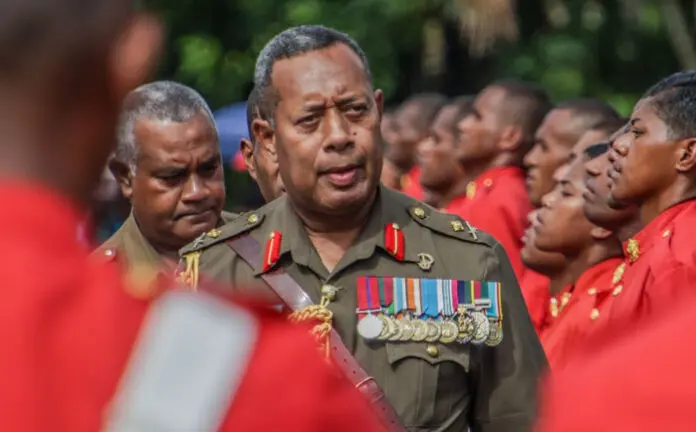
Republic of Fiji Military Forces Commander Major-General Ro Jone Kalouniwai.
Photo: RFMF Media Cell
The military has backed recommended constitutional changes that would place its domestic operations under civilian authority.
The proposed shift is supported by the Republic of Fiji Military Forces (RFMF) Commander Major-General Ro Jone Kalouniwai and Defence Minister Pio Tikoduadua.
The RFMF has accepted that its role in domestic operations should be subject to civilian control, as recommended by the Constitution Review Commission (CRC) and reflected in public submissions.
Related stories
Constitution Review Commission report
The CRC’s report, tabled in Parliament on Tuesday, recommends that the Constitution make clear that the RFMF’s primary role is external defence.
It says the military should only act as an aid to civil power domestically when authorised by Parliament.
The recommendation reflects public submissions, including one from the RFMF, and addresses what the commission described as the “constitutional guardianship” loophole historically used to justify military intervention in political processes.
Section 131(2) of the 2013 Constitution currently states that the overall responsibility of the RFMF is to ensure at all times the security, defence and well-being of Fiji and all Fijians.
Major-General Kalouniwai said the proposed change would not weaken the military but would place it in its proper role.
“That’s under civilian leadership,” he said.
He said under the proposed arrangement, the RFMF would require authorisation from Parliament to operate domestically, which was not required under the current Constitution.
“If we want to go, we’ll just go. We’ll just talk with whoever we want to talk to, and we’ll just walk out.
“We’re going to civilian street and that’s the danger.”
Major-General Kalouniwai said requiring civilian authorisation would ensure the RFMF remained within its constitutional role.
“When we’re working with the police, when we’re doing any other thing that requires us to bear arms in the country, in the responsibility that we play, it has to have a ministerial consent. It has to go through Parliament.”
Ministerial support
Minister for Defence Pio Tikoduadua said the CRC recommendations complemented the Government’s current work.
“Essentially what they are recommending is that the RFMF aligns itself properly under the democratic framework from which a nation like Fiji is governed and that has to be supported in all respect,” he said.
“I can assure our nation also that the RFMF is fully cognisant of and is supportive of that.”
Other recommendations
The CRC also recommended establishing an independent Director of Military Prosecutions and a Military Court in the Constitution.
The court would be open to the public and staffed by military judges who are sitting High Court judges.
It would deal with major offences committed by military personnel and ensure they remain subject to the Constitution and protected by the Bill of Rights as accused persons.
The Cabinet Subcommittee will reconsider the CRC’s recommendations before tabling its own recommendations in Parliament, which begins debating the report on September 28.