Opinion: Who Gets to Be Fijian?
"Fiji Islander" is an entirely inappropriate and outdated label for the nationality of a modern republic.
Sunday 25 October 2026 | 15:00
Updated 26 October 2026 | 15:58 FJT
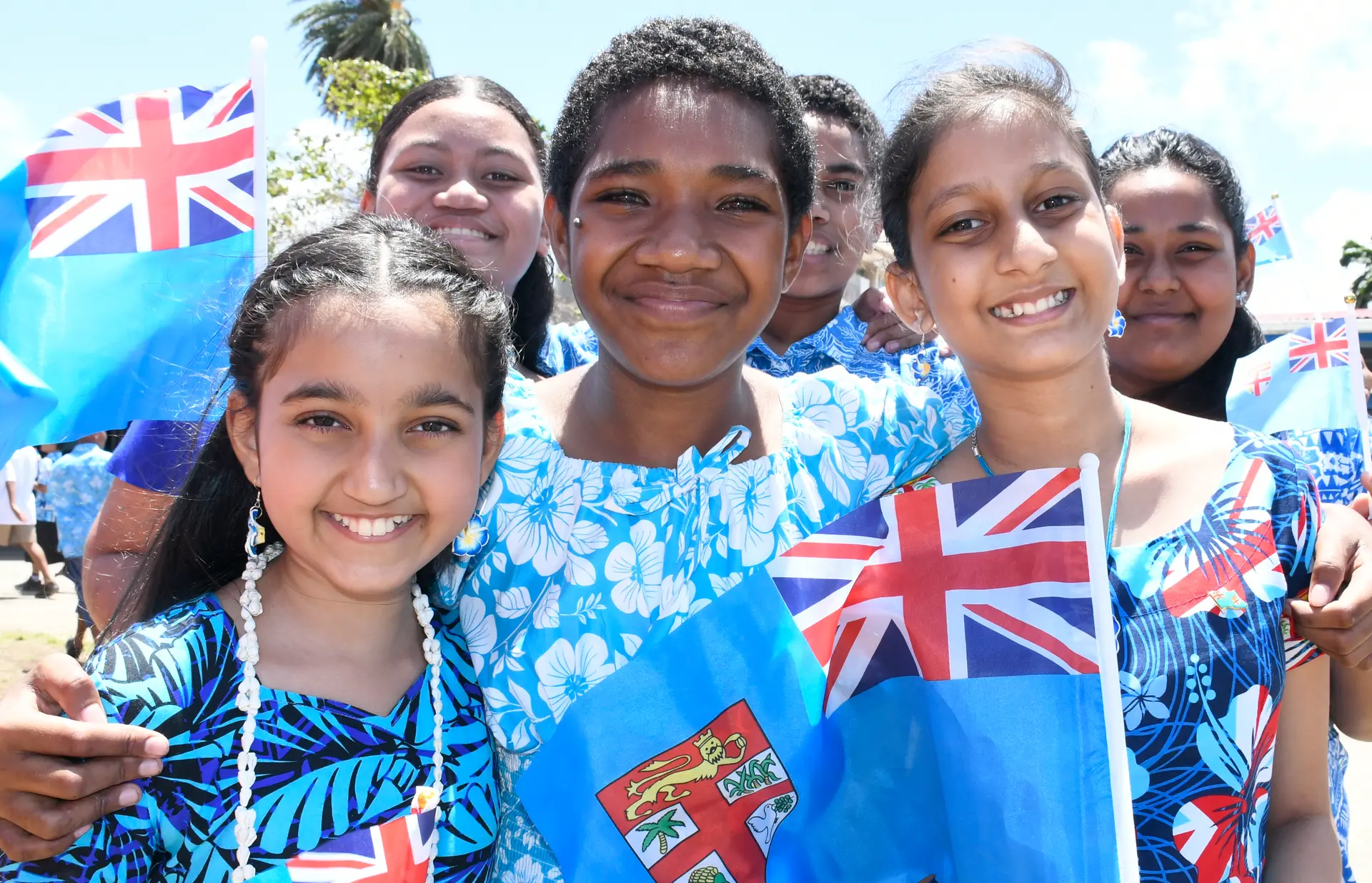
Students of Holy Trinity Primary School in Flagstaff, Suva, celebrate Fiji Day in their blue colours at the school on October 9, 2026.
Photo: Ronald Kumar
I am exhausted by the endless, divisive, and deeply destructive debate over our common national identity. A national identity is meant to unite us, binding together all those who were born here and call this country home. It should be the foundation for building the vital social capital required to uplift a developing nation with scarce resources.
Instead, this identity has been weaponised, turning into a source of bitter division rather than a unifying force.
Regardless of whatever cultural, historical, or emotional arguments people come up with, the undeniable reality is that the most accurate and globally standard word to describe a citizen of the Republic of Fiji is "Fijian."
Related stories
There is also a persistent suggestion that, if "Fijian" cannot be used for all citizens, perhaps we should use "Fiji Islander". But "Fiji Islander" is an extraordinarily poor description of nationality.
The proud name of this sovereign nation is Fiji. It is not "the Fiji Islands". That older formulation belongs to a colonial vocabulary in which distant archipelagos were often described by outsiders as collections of islands somewhere in the far reaches of the world, rather than as nations possessing their own political identity and sovereignty.
Fiji is not some remote collection of islands in the backwaters of the world waiting to be geographically described by somebody looking at a map. It is a sovereign republic. "Fiji Islander" is an entirely inappropriate and outdated label for the nationality of a modern republic.
The country is Fiji. Its citizens are Fijians. That is how national identities ordinarily work. Germany has Germans. Brazil has Brazilians. Samoa has Samoans. Australia has Australians. By establishing Fijian as the nationality for all citizens, Fiji simply adopted the most standard, globally recognised naming convention for a unified republic.
This civic framework is mathematically the cleanest way to run a modern democracy:
- The State: Republic of Fiji
- The Nationality: Fijian (applied equally to all passport holders)
- Ethnicity Labels: iTaukei, lndo
- Fijian, Rotuman, Banaban, etc.
I have tried in vain to explain this fundamental difference between nationality and ethnicity, but many remain genuinely confused or willfully refuse to listen.
I understand why some iTaukei feel strongly about this issue. For generations, the English word "Fijian" was used primarily to refer to the indigenous people of these islands. A change in terminology can therefore feel like something has been taken away. That concern should not be mocked or dismissed. Identity is deeply emotional, and indigenous identity in particular carries history, land, culture, language and memory.
But recognising every citizen as Fijian does not require the erasure of indigenous identity. Quite the opposite. A closer look reveals that this shift is not a loss of identityit is actually a profound decolonial victory and a reclamation of true indigenous power.
iTaukei possesses a specificity that the English word "Fijian" never could. It identifies the indigenous people of Fiji and their unique relationship with the vanua, customary land, chiefly institutions, culture, traditions and ancestral inheritance.
First, there is the decolonial reality: "Fijian" is a colonial relic. It is not actually an indigenous word; it is an English adaptation of a Tongan mispronunciation of the island's true name, Viti. Fijian is, therefore, essentially a name given by British colonizers and Tongan rivals. For over a century, the British Empire grouped the diverse tribes and confederacies of the islands under the blanket English term "Fijians" for administrative convenience. There is therefore something profoundly decolonising about allowing the English nationality word to belong to the modern State while indigenous people increasingly identify themselves through their own language and their own cultural vocabulary. Why should indigenous
identity depend upon an English word? Why should a term inherited through colonial usage carry more weight than one grounded in the language and worldview of the people themselves?
Second, there is the power of translation. The English word "Fijian" simply means "a person from Fiji," implying mere geography. In contrast, the word iTaukei translates conceptually to "the owners of the land" or "the original inhabitants." Sharing the word "Fijian" with minorities merely acknowledges a shared geographic state. But by adopting iTaukei as your exclusive identifier, you force the state and all minority groups to refer to you daily by a title that acknowledges your supreme, unalienable ownership of the ancestral land (vanua). You trade a weak geographic noun for a powerful title of sovereignty.
Third, it creates what might be called the "Two Realms" of Viti versus Fiji. Fiji is the State: it issues passports, collects taxes, builds roads, and manages the economy. "Fijians" are the participants in this modern economic system. Viti is the Vanua: it is the land, the ocean, the chiefly system, the bloodlines, and the ancestors. The iTaukei are the guardians of Viti. By accepting minorities to be "Fijians," the iTaukei welcome them into the State of Fiji to help build the economy. But minorities can never be i Ta ukei, meaning they can never enter the spiritual and ancestral realm of Viti. This framework allows for absolute national unity without sacrificing an inch of indigenous heritage.
Yet, despite all logic and legal clarity, the debate rages on, and the human cost is immeasurable. And nowhere is the human cost of this debate more apparent than among Inda-Fijians. For an Inda-Fijian, it is deeply agonising to have their fundamental connection to Fiji constantly questioned, fractured, and rejected.
An Inda-Fijian is not an "Indian." The word "Indian" means a citizen of the Republic of India. Fourth- or fifth-generation Inda-Fijians have absolutely no connection to India. They do not vote in Indian elections. They do not hold political membership in the Indian state. Most have never set foot there, nor do they have any surviving family ties or relatives on the subcontinent. The only country they belong to is Fiji. The only country their hearts beat for is Fiji.
Their childhoods are here. Their memories are here. Their dead are buried here. Their families, friendships, work, hopes and futures are here. When Fiji wins, they celebrate. When Fiji suffers, they suffer. When cyclones destroy homes, when the economy struggles, when our rugby teams play, when elections are held, when governments succeed or fail, this is the country whose fortunes shape their lives.
Yet generation after generation has been required to answer, explicitly or implicitly, the same question: But where are you really from? For many Inda-Fijians, that question is profoundly painful because the truthful answer is simply: Fiji.
But despite this profound love and unwavering loyalty, I have come to believe that Inda-Fijians should stop fighting for the nationality label. We cannot force a sense of belonging onto a framework where our very presence is treated as a trespass. Instead, we should simply accept whatever the majority, the iTaukei, decides. If claiming the nationality of the only home we have ever known is too offensive, then let us strip away the pretense entirely. Perhaps a far more accurate and sobering label for us would simply be the "great-great-great-grandchildren of Indians." Maybe then, this painful debate can finally end.
By: Nilesh Lal
- Nilesh Lal is a fourth-generation IndaFijian with a deep patriotic attachment to Fiji and an unwavering commitment to its future. He writes from a place of profound frustration at the continuing and divisive debate over Fiji's common national identity, and the damage it continues to inflict on social cohesion and a shared sense of belonging. The views expressed in this article are entirely his own and do not represent those of the organisation with which he is affiliated, nor the Fiji Sun and/or its employees.