Pacific stands together to strengthen global voice
But on the proposed statement over China’s ballistic missile testing, Forum chair Rick Houenipwela says: “There was no blocking.”
Monday 10 August 2026 | 15:00
Updated 10 August 2026 | 17:20 FJT

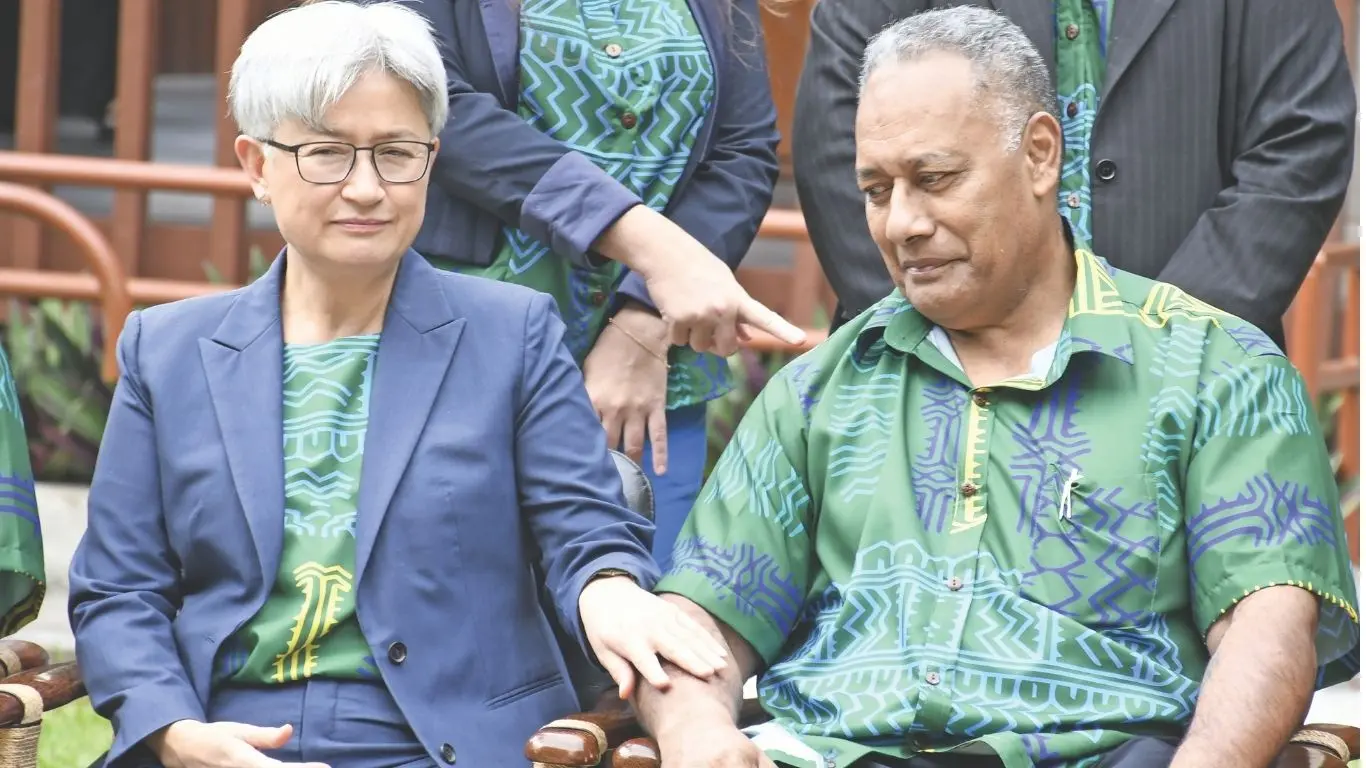
Australian Foreign Affairs Minister Penny Wong (left), with Minister for Foreign Affairs Sakiasi Ditoka during the Foreign Ministers meeting on August 7, 2026.
Photo: Ronald Kumar
Standing together to present the Pacific’s interests to the world was the key takeaway for Fiji’s Minister for Foreign Affairs and External Trade Sakiasi Ditoka at the Forum Foreign Ministers Meeting in Suva last Friday.
Mr Ditoka said the consensus among the 18 members was that the region must work together to strengthen the Pacific’s position globally.
He said while each country’s sovereignty was respected, unity remained a key element for Forum members.
Related stories
“I think what we have highlighted is generally the consensus by the members of the meeting and that is the way forward is working as a region in presenting the interest of our communities to the world,” he said.
“We must stand together to make our position strong. Fiji supports that in all aspects of how we present ourselves in all the sectors of development that we consider, including the economy. We stand by the concept of us working and presenting ourselves regionally to the world.”
The same view was shared by Forum Foreign Ministers Meeting chair Rick Houenipwela and Pacific Islands Forum Secretary General Baron Divavesi Waqa when presenting the outcomes of Friday’s meeting.
No blocking of China missile statement
The Forum chair and Secretary General clarified that no member country blocked a unified statement on China’s ballistic missile testing in the Pacific Ocean.
Mr Waqa said there was agreement to issue a statement, but ministers had decided to allow more time to negotiate the wording before leaders consider the matter at the Pacific Islands Forum meeting in Palau at the end of the month.
Mr Houenipwela said any statement on the matter must be agreed to by all members.
“We respect sovereign positions on any matter, however serious they may be, but in this case, ministers around the table did discuss to their best of Pacific way to understanding each other.
“There are mixed feelings on how the statement should be formatted, whether we just make an outright statement on that one single incident or there are other ideas that it should be a general statement covering any tests in the Pacific, so it is important.
“There was no blocking. Kiribati and Nauru did not block, they just honestly placed their position so that others can consider to see how best they can contribute.”
Regional priorities
The meeting reaffirmed the importance of regional solidarity and unity.
Ministers reflected on the rapidly changing environment and reaffirmed that the strength of the Pacific Islands Forum lay in its ability to come together as a region, respect the diversity of its membership and make collective decisions through dialogue and consensus.
Under political leadership and regionalism, ministers endorsed the 2026 third Annual Report on the implementation of the 2050 Strategy for onward submission to leaders.
Ministers also acknowledged the value of the regional response mechanism in strengthening regional monitoring and preparedness following the recent fuel crisis.
They received an update on the review of the regional architecture, with relevant matters to be taken forward for leaders’ consideration in Palau.
A significant area of progress was the continued operationalisation of the leaders’ policy on partnerships, with an emphasis on ensuring partnerships remained respectful, mutually beneficial and aligned with the priorities of the 2050 Strategy.
Peace and security: Ministers recognised the need for greater coherence across the regional security architecture, supported by flexible and responsive mechanisms.
They also reaffirmed their commitment to protecting the Blue Pacific Ocean of Peace. They endorsed the Regional Security Action Plan 2026-2030 and noted progress on regional security governance, transnational crime, humanitarian response and stronger regional coordination while respecting national circumstances and sovereignty.
People-centred development: Ministers endorsed the refreshed framework on the rights of citizens with disabilities for leaders’ consideration. They also considered social inclusion, including gender equality, women’s political leadership, health, education and early childhood development.
Our ocean: Ministers endorsed the 2026 Pacific Islands Forum Leaders Ocean Statement and advanced work on fisheries and ocean governance. They also recommended the Vakamanu Regional Pacific Fisheries Strategy 2026-2035 to leaders for endorsement.
Economic development: Ministers reaffirmed the Pacific Roadmap for Economic Development and the importance of translating the Multidimensional Vulnerability Index into practical improvements.
Climate change and disasters: With COP31 approaching, ministers recognised the meeting as an important opportunity to build international momentum around priority areas, including capitalisation, access to climate finance, renewable energy and keeping the 1.5-degree target within reach.
Technology and connectivity: Ministers supported the Pacific Digital and Artificial Intelligence Technology Principles for leaders’ consideration, recognising the importance of ensuring the growth of the digital economy is guided by Pacific priorities and values.
Mr Houenipwela said the outcomes demonstrated a region moving increasingly from vision to implementation, with attention now turning to the 55th Pacific Islands Forum meeting in Palau from August 30 to September 4.