PM Rabuka shifts focus from farm output to farmer profits
PM says Fiji's path to a high-income economy depends on productivity, technology and value-added agriculture
Tuesday 15 September 2026 | 18:00

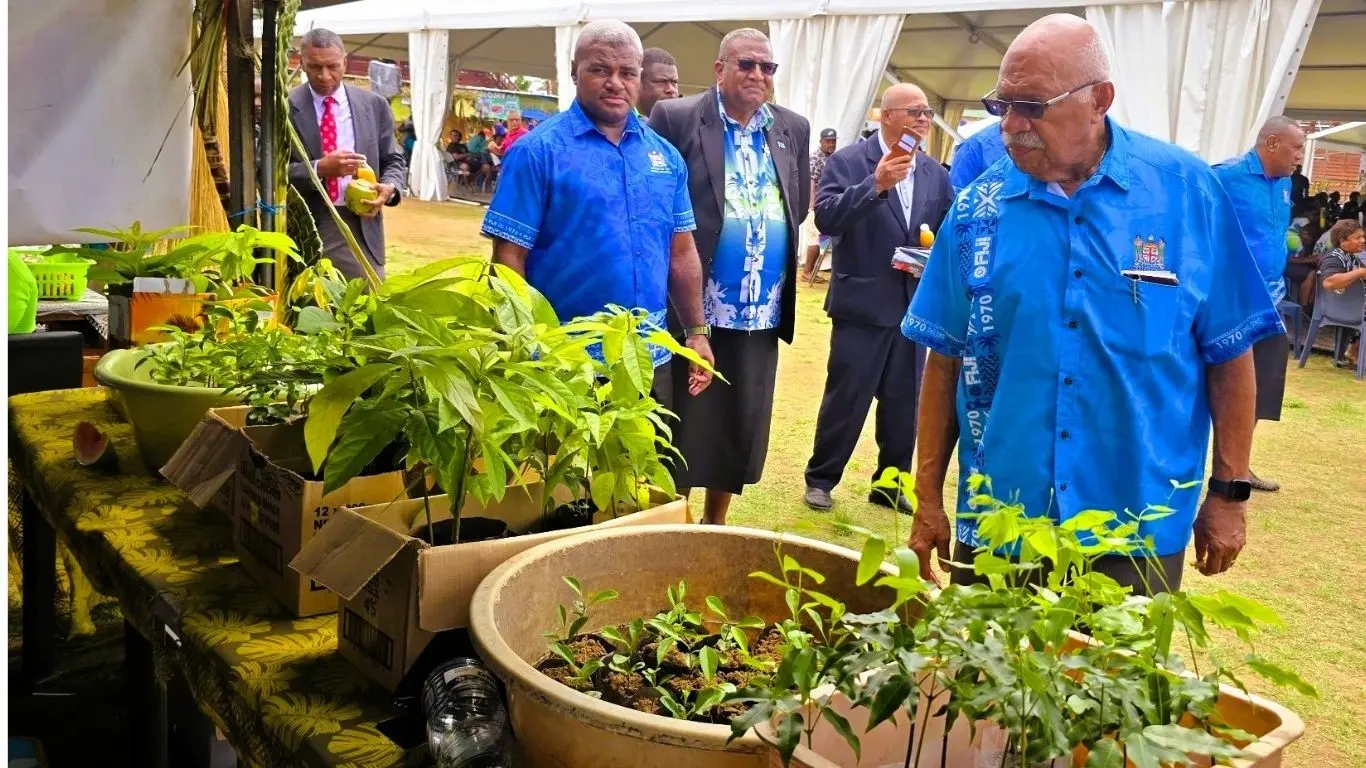
Prime Minister Sitiveni Rabuka visits exhibition booths during the opening day of the 2026 National Agriculture Show in Labasa on September 15, 2026.
Photo: Sampras Anand
Prime Minister Sitiveni Rabuka has challenged Fiji's agricultural sector to move beyond simply producing more food, saying the future of farming must be driven by higher productivity, innovation and better returns for farmers.
Launching the 2026 National Agriculture Show at Subrail Park in Labasa today, Mr Rabuka said agriculture had a critical role to play in Fiji's economic transformation and ambitions of becoming a high-income economy by 2050.
"The future of agriculture cannot be based only on increasing the volume of what we produce," he said.
Related stories
"Instead, it should be based on higher productivity, stronger businesses, better technology, greater value addition and improved returns for farmers."
The national agriculture show has returned to the Northern Division after a six-year absence.
Mr Rabuka said agriculture was not operating on the margins of the economy but remained central to food security, employment, exports, import substitution and national resilience.
He pointed to figures showing the sector's contribution to Fiji's real gross domestic product increased from 6.5 per cent in 2014 to 12.8 per cent in 2024.
"This demonstrates the growing importance of the sector to Fiji's economy," he said.
The Prime Minister urged farmers to focus on increasing productivity, saying improved yields would raise farm incomes, strengthen rural businesses and make the sector more competitive.
He linked those efforts to Government's broader goal of lifting Fiji's economic growth to support a high-income economy by 2050.
The launch also coincided with World Coconut Day celebrations, where Mr Rabuka highlighted the economic potential of reviving Fiji's ageing coconut industry.
He said more than 30,000 hectares of coconut plantations, representing about half of Fiji's total coconut acreage, required rehabilitation or replanting.
"This is a challenge, but it's also an economic opportunity," he said.
Mr Rabuka said restoring plantations would boost productivity, improve household incomes and ensure a steady supply of raw materials for local processing and export markets.
To support the effort, Government is establishing coconut nurseries in all four agricultural divisions and strengthening the capacity of technical officers, with seedling distribution expected to begin in early 2027.
Mr Rabuka called on farmers, businesses, researchers and students to work together to grow the sector and contribute towards Fiji's economic goals.
"Every farmer who improves productivity contributes, every business that invests in processing contributes, every student researcher who develops a better farming method contributes," he said.
He encouraged participants at the agriculture show to use the event as a platform to connect ideas with investment, research with production and farmers with markets.