Girmit records digitisation to help families trace roots
Their immigration passes, passenger registers, plantation assignments and other historical documents contain personal details that could help descendants learn more about their ancestors and family histories.
Saturday 21 November 2026 | 06:00
Updated 21 November 2026 | 07:04 FJT

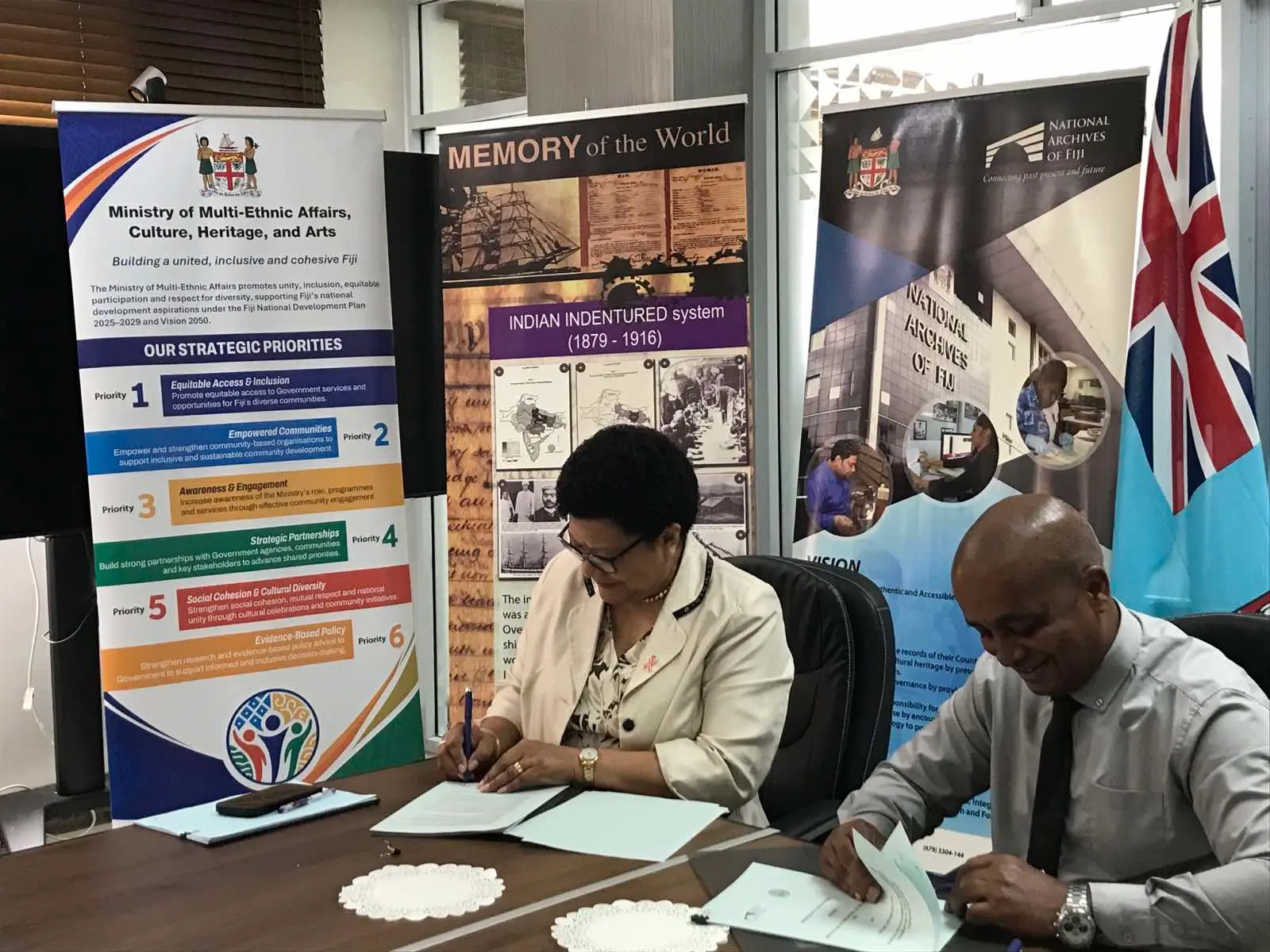
Permanent Secretary for Multi-Ethnic Affairs, Culture and Heritage Arts (Dr Vinesh Kumar)and Permanent Secretary for Information Eseta Nadakuitavuki Signing of Memorandum of understanding Between Ministry of Multi-Ethnic Affairs, Culture and Heritage Arts and National Archives of Fiji at Bali Tower in Suva on November 20, 2026.
Photo: Lavenia Waqanivanua
Descendants of Fiji's Girmit labourers could find it easier to trace their ancestral roots as the Government moves into the second phase of a project to digitise and preserve historical immigration records.
The Ministry of Multi-Ethnic Affairs, Culture and Heritage Arts and the National Archives of Fiji signed a memorandum of understanding (MOU) at Bali Tower in Suva yesterday, formalising their partnership to protect and improve access to the records.
The agreement paves the way for Phase Two of the Girmit Digitisation Project, which will involve scanning, indexing and managing historical documents while safeguarding fragile originals.
Related stories
Permanent Secretary for Multi-Ethnic Affairs, Culture and Heritage Arts Dr Vinesh Kumar said the partnership would combine the Ministry's digital development work with the National Archives' expertise in preserving historical records.
“A history we did not create, but carry the responsibility to preserve,” Mr Kumar said.
He said approximately 60,537 Indians arrived in Fiji between 1879 and 1916 under the indenture system, commonly known as Girmit.
Their immigration passes, passenger registers, plantation assignments and other historical documents contain personal details that could help descendants learn more about their ancestors and family histories.
Phase One of the project has been completed, establishing the database structure, backing up existing digital records and developing an initial digital system capable of accommodating more than 60,000 Girmit-era reports.
Under Phase Two, the Ministry will provide digitisation equipment, computers and a server.
Staff will undertake scanning, indexing and data entry under the guidance of the National Archives.
Permanent Secretary for Information Eseta Nadakuitavuki said the agreement was an important step towards protecting the fragile historical collection.
High-resolution digital copies would reduce the need to handle delicate bound registers and immigration passes, helping prevent further deterioration.
Ms Nadakuitavuki said the documents would be digitised to archival standards using uncompressed TIFF format to support long-term preservation and future search technologies.
The National Archives will remain the sole statutory custodian of the original records, while master digital files will be formally transferred to the department for permanent preservation.
A large-format scanner supplied through the project will also be permanently transferred to the National Archives upon completion, strengthening its ability to digitise other national collections.
The project, which began in February 2025, aims to protect Fiji's documentary heritage from deterioration, disaster and loss while improving access for citizens, researchers and the global Fijian diaspora.