Opinion: A distinctly Fiji democracy: The reset our nation needs
The principle of equal citizenship is indispensable. Fiji belongs to all its citizens. No one should feel like a guest in their own country. Every citizen deserves equal dignity, equal protection of the law and a government accountable to all.
Sunday 25 October 2026 | 14:30
Updated 26 October 2026 | 16:12 FJT
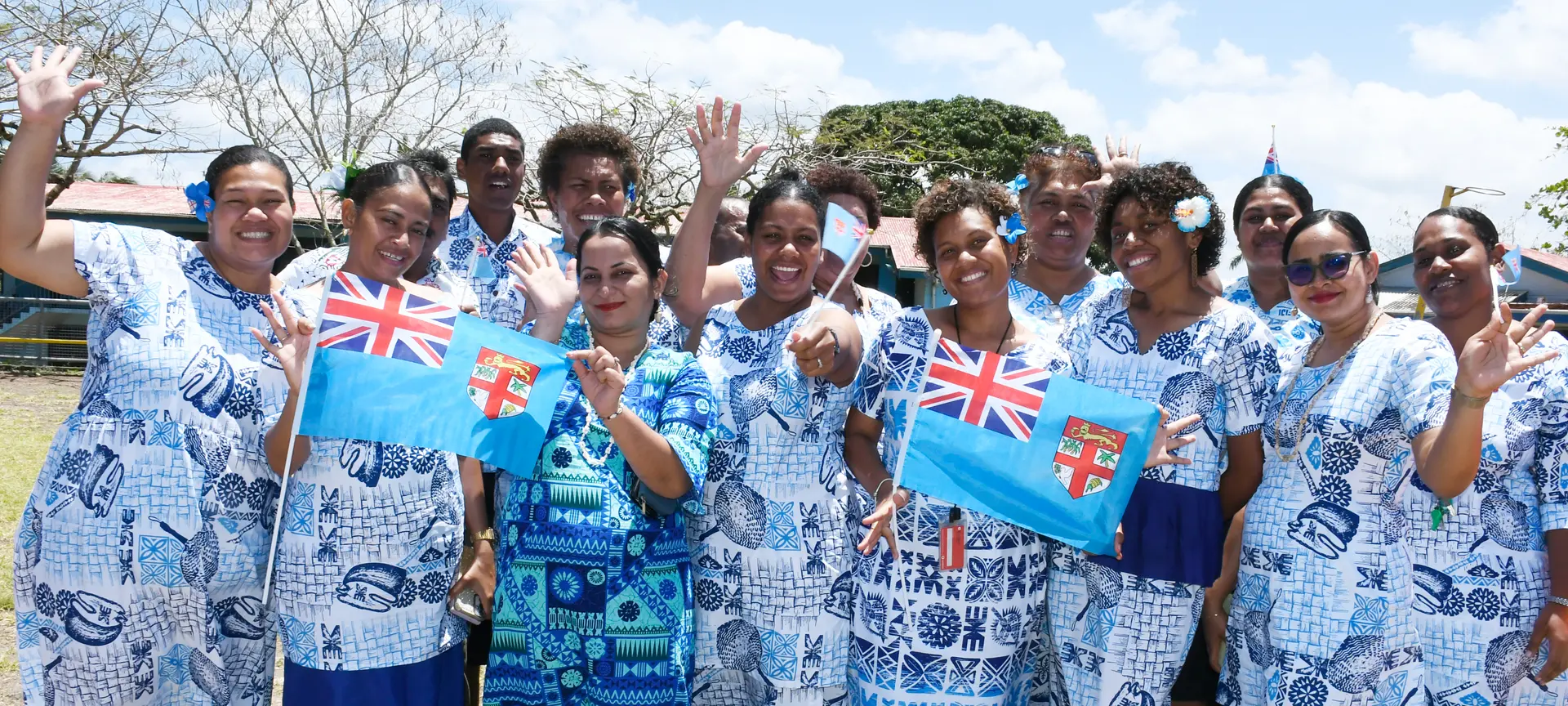
Teachers and students of Holy Trinity Primary School celebrate Fiji Day on October 9, 2026, at the school.
Photo: Ronald Kumar
Fifty six years after independence, Fiji is still wrestling with questions that should have been confronted in 1970.
Who are we as a nation? How do we reconcile our iTaukei foundations with equal citizenship? What place should our traditional institutions occupy in a modern democracy? And how do we ensure that constitutional power serves the people rather than those temporarily entrusted with government?
These questions have followed us through independence, coups, constitutional upheavals and repeated promises of reconciliation. They will not disappear simply because we rewrite a preamble or rearrange the composition of a select committee.
Related stories
A distinctly Fiji democracy may be the reset our nation requires.
But that reset must speak honestly to anxieties on all sides: to those who fear that indigenous recognition may become a justification for permanent privilege, and to those who fear that equal citizenship may become a pretext for cultural displacement.
The principle of equal citizenship is indispensable. Fiji belongs to all its citizens. No one should feel like a guest in their own country. Every citizen deserves equal dignity, equal protection of the law and a government accountable to all.
Nothing in a distinctly Fiji democracy should compromise those principles. But equal citizenship does not require us to pretend that history began yesterday. Nor does it require us to regard the Vanua as merely another interest group, or the Deed of Cession as a historical relic with no bearing on the legitimacy of the modern State.
The 'Vanua' existed before colonial government. Its relationships, obligations, leadership and customary authority were not inventions of British administration. Colonialism reorganised and regulated many of them, but it did not create the iTaukei relationship with their land and sea.
That relationship is more than a commercial transaction. It encompasses ancestry, identity, kinship, spiritual continuity and obligations to generations yet unborn.
Recognising itaukei foundations do not diminish anyone else's citizenship. It acknowledges that our constitutional order rests upon a history that predates the State itself. Yet recognition must mean more than ceremonial respect or constitutional reassurance.
Consider customary land and resources. We rightly proclaim that iTaukei land ownership is protected. But ownership and control are not necessarily the same. Indigenous landowners hold customary title but remain constrained in determining how their land is administered, developed and used for economic advancement.
A people should remain perpetual spectators to development upon their ancestral land.
Disagreements over customary boundaries and resource entitlements are real. They require fair adjudication, clear procedures and accountable institutions. But disunity does not extinguish ownership, any more than disagreement between political parties extinguishes democracy.
Complexity is a reason to strengthen governance, not an excuse to perpetuate the inherited assumption, that the State always know better.
The same principle applies to the Bose Levu Vakaturaga. It's constitutional recognition should reflect its enduring responsibility to safeguard the well-being, identity and collective interests of the 'Vanua'.
Its independence must not depend upon the goodwill of successive governments. But constitutional protection carries corresponding responsibilities. The BLV must exercise its authority in service of the people, respecting the proprietary rights of 'mataqali' and other customary landowning communities.
Protecting the institutions of the Vanua must never become a substitute for empowering the people of the 'Vanua'. Critics rightly warn that traditional institutions can become instruments of elite privilege, where leaders speak in the people's name while those they represent remain impoverished or unheard. That danger must be acknowledged, not dismissed.
But accountability does not mean subordinating customary institutions to a State that disregards indigenous history. It means ensuring that authority remains answerable to those it exists to serve.
This is equally relevant to chiefly succession. Tradition is not static. Leadership grounded in courage, wisdom, humility and service is not a rejection of tradition but an affirmation of its highest ideals.
Hereditary lineage may establish chiefly entitlement, but it does not automatically confer mana or command respect. A chief's standing must ultimately be sustained through relationships, service and the confidence of the people. When succession becomes disconnected from those obligations, the institution itself is weakened.
A mature Fiji democracy should be capable of examining such questions without treating every discussion of traditional leadership as an attack upon the 'Vanua'.
Yet indigenous recognition alone cannot resolve our constitutional difficulties. A distinctly Fiji democracy must be uncompromising about constitutional supremacy, the rule of law and accountability. We must confront the legacy of coups, sweeping immunity provisions, political interference in public institutions and the temptation to treat constitutional reform as an exercise in political convenience.
A Constitution should restrain power, not merely distribute it. It should protect institutional independence, guarantee meaningful public participation and provide effective remedies when rights are violated.
It must also look beyond electoral cycles. National development, education, environmental stewardship and the well-being of future generations require continuity of purpose that no single government can provide. Our troubled history demands equal honesty.
The coups of 1987 and 2000 inflicted suffering, particularly upon lndo-Fijians who were targeted, displaced or made to feel insecure in their own country. Those experiences cannot be dismissed through appeals to indigenous tradition.
But the iTaukei experience also deserves examination. Those coups were justified in the name of indigenous protection. Yet what did ordinary iTaukei ultimately gain?
We inherited weakened institutions, fractured communities, damaged investor confidence and diminished trust. Genuine anxieties over land, identity and political security were exploited, while the promised benefits often failed to reach those in whose name power was seized.
Fiji cannot move beyond competing grievances without acknowledging both experiences.
The Deed of Cession remains part of our historical foundation. Independence did not erase that history, but neither can its obligations be resolved simply by invoking documents written more than 150 years ago.
They demand honest examination within the realities of a modern, multiracial democracy. We cannot turn back the clock, nor should we. But neither should we mistake the passage of time for the resolution of history.
The answer is not to reject democracy, constitutional supremacy or equal citizenship. It is to ask whether we have sufficient, cultural diversity and shared aspirations. As former Chief Justice Daniel Fatiaki reminded the Constitution Review Commission:
*Vax Populi Est Suprema Lex* - the voice of the people is the supreme law. That principle should guide our constitutional renewal.
Not the convenience of a coalition. Not the inherited assumptions of colonial administration. Certainly not the ambitions of individual leaders. And the voice of the people must mean all the people - not one community, political party or institution speaking on behalf of everyone else. Fifty-six years after independence, perhaps our greatest unfinished task is to develop the confidence to build a constitutional democracy authentically our own.
One that recognises our iTaukei foundations without diminishing anyone's citizenship.
One that respects tradition without placing it beyond accountability. One that protects rights without fearing their exercise.
And one that understands national unity not as the absence of differences, but as the capacity to govern those differences with justice, wisdom and mutual respect.
Independence gave us the right to govern ourselves. A distinctly Fiji democracy may finally give us the constitutional confidence to do so on our own terms.
By: Ro Naulu Mataitini
- Ro Naulu Mataitini is a member of the Bose Levu Vakaturaga and a regular columnist on current affairs. The views expressed in the article are of the author alone and not of Fiji Sun and/or its employees.