From village craft to $1,200 payday
Among her creations was the bisikete mat, which features a distinctive geometric pattern created through the careful weaving of black and natural-coloured pandanus strips.
Friday 20 November 2026 | 08:00
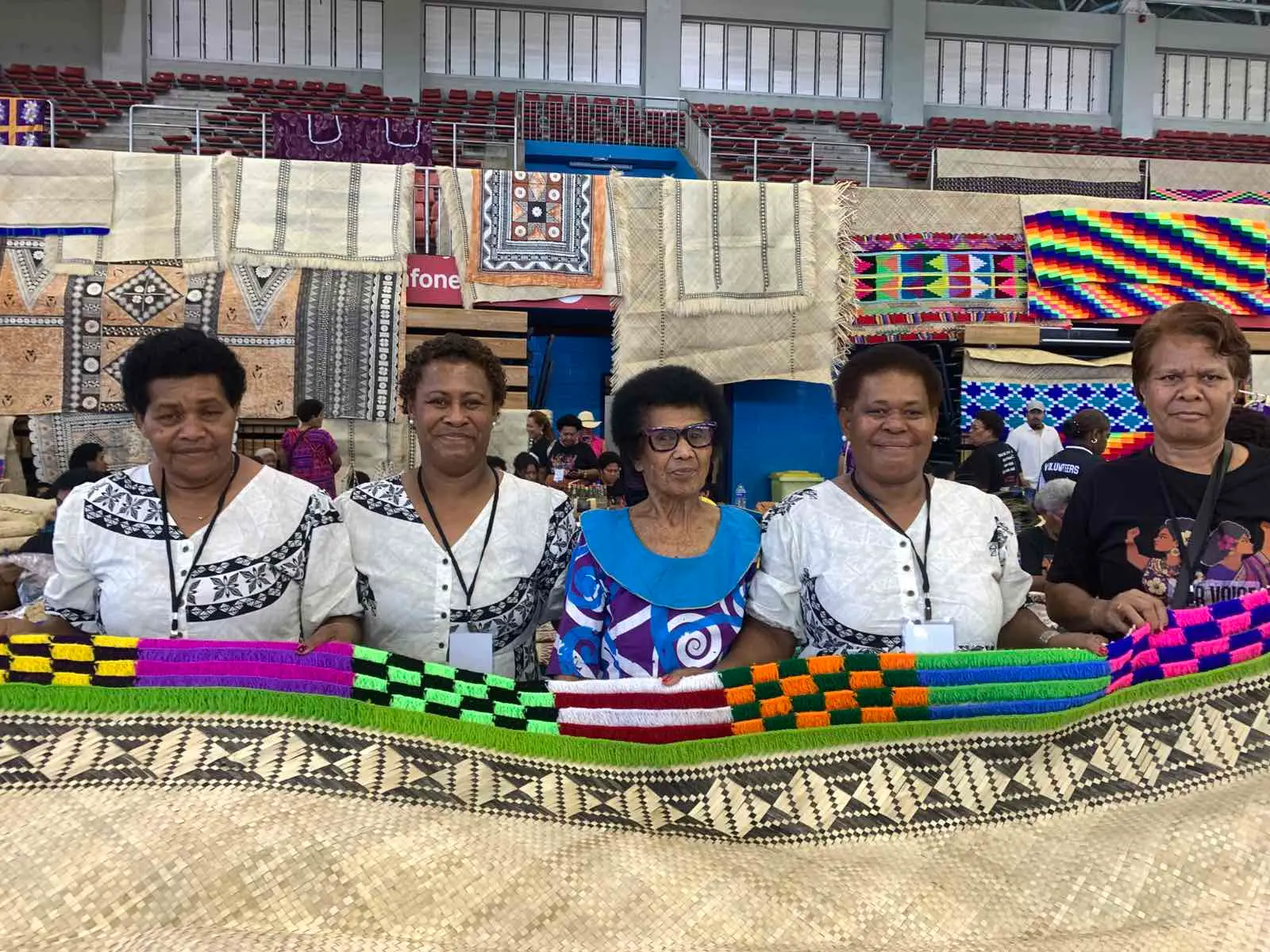
The Naceva Women's Club from Dravuwalu, Kadavu during the Fiji National Women's Expo at the Vodafone Arena in Suva on November 19, 2026.
Photo: Milika Rabulu
A skill Akanisi Moli learnt at 19 has become a source of income 34 years later, earning her $1,200 from just four traditional Fijian mats.
For the 53-year-old from Dravuwalu, Naceva, Kadavu, weaving is more than a way to make money. It is a tradition she hopes to keep alive by passing her knowledge on to young women in her village.
At this year's Fiji National Women's Expo at the Vodafone Arena, Ms Moli turned years of patience and craftsmanship into earnings, selling four of her handmade mats.
Related stories
But behind each sale are hours of careful preparation and weaving, using techniques she first learnt as a teenager.
"I started learning how to weave mats when I was 19 years old, and I also teach young girls in my village how to weave," Ms Moli said.
Her work includes traditional mats such as the delana, katurua (two-fathom mat) and katu dua kasavu va waqa ni iloilo.
Among her creations is the bisikete mat, recognised for its geometric patterns formed by weaving black and natural-coloured pandanus strips.
The process begins long before the first strip is woven.
Ms Moli harvests voivoi (pandanus) leaves, which are then stripped, boiled, dried, softened and split into strips.
Only after that preparation can the weaving begin, with each strip carefully worked into the mat's design.
The black patterns, known as somo, and colourful kula finishing along the edges give the finished mats their distinctive appearance.
It is work that demands time, patience and dedication.
For Ms Moli, however, the effort brings both financial rewards and the satisfaction of preserving a craft that remains important during traditional and family occasions.
"This is my source of income at home," she said.
Having relied on the skill herself, she wants younger women to recognise its value.
She is already teaching girls in her village how to weave, hoping they will carry the tradition forward while also gaining a practical way to support themselves.
Her message is particularly directed at young women living in villages or those without formal employment.
"My message to all young girls out there, especially those in the villages or those who are not working, is that if you want to earn money, just weave mats," she said.
More than three decades after learning to weave, Ms Moli continues to turn voivoi leaves into mats that provide for her household.
And by teaching the next generation, she hopes the skill that has supported her will continue to benefit others.